
Prelude to a Crisis: Rome in the Late Republic
By 50 BCE, the Roman Republic was teetering on the edge of chaos. Decades of political instability, class conflict, and civil unrest had eroded the foundation of the once-mighty republic. In the heart of it all was Gaius Julius Caesar—a brilliant general, shrewd politician, and populist hero whose rise threatened the traditional power held by the Senate and Roman aristocracy.
Caesar’s military campaigns in Gaul had made him a living legend. His conquests expanded Roman territory, brought untold riches to the Republic, and earned him the fierce loyalty of his battle-hardened legions. But success in the provinces came at a political cost. Back in Rome, Caesar’s enemies, most notably the conservative Senatorial faction known as the Optimates, led by Pompey the Great and Cato the Younger, feared that Caesar would march on Rome to seize absolute power.
In 50 BCE, under immense pressure from Caesar’s growing influence, the Senate, now closely aligned with Pompey, demanded that Caesar disband his army and return to Rome as a private citizen. Refusal would be deemed treason. It was a calculated trap—without the protection of his legions, Caesar would be vulnerable to prosecution or assassination.
Faced with the ultimate choice—power or peace—Caesar chose neither.
He chose history.
The Crossing: January 49 BCE
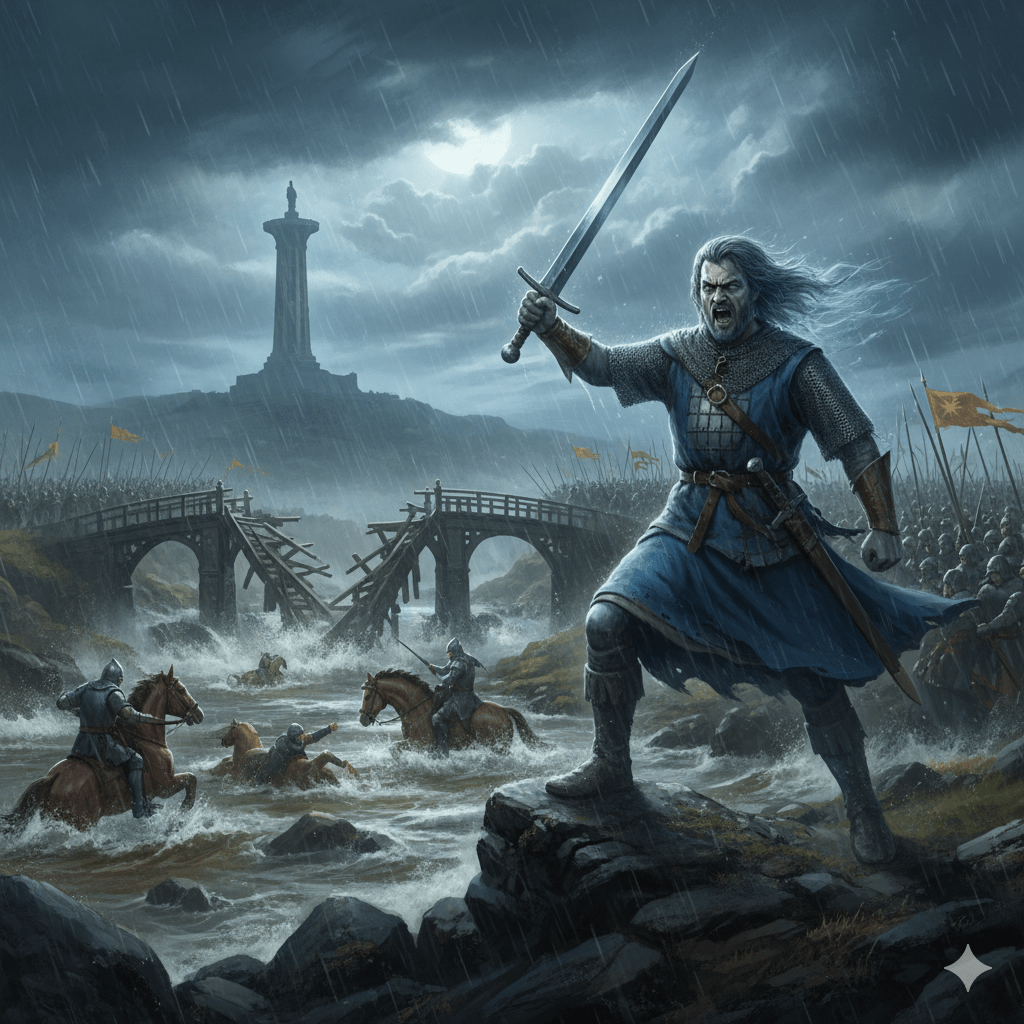
On a cold winter’s day in January 49 BCE, Caesar and his loyal legion—the Legio XIII Gemina—arrived at the Rubicon River, a shallow stream in northern Italy that marked the boundary between Cisalpine Gaul and the Roman heartland. Roman law forbade a general from leading troops across this river under arms. To do so was considered an act of war against the Senate and the Republic itself.
Standing at the banks, Caesar faced a moment that would forever define him and alter the trajectory of Western civilization.
According to the ancient historian Suetonius, Caesar paused, uncertain. Then, reportedly in a dramatic flourish, he uttered the fateful Latin phrase:
“Alea iacta est” — “The die is cast.”
And with that, he ordered his troops to cross the Rubicon.
The decision sparked a civil war that would engulf the Roman world.
Why the Rubicon Mattered
To modern eyes, the Rubicon might seem like just another stream, but in the Roman world, it held tremendous symbolic and legal weight. Roman governors had imperium—military authority—in their assigned provinces, but that power ended at the Rubicon. To cross it with troops was the equivalent of declaring war on the Roman state.
Caesar knew this. He knew that once he crossed, there would be no turning back. His move was not only a military maneuver but a symbolic act of defiance against the corrupt Senate and what he portrayed as the betrayal of Roman ideals.
For Caesar, this wasn’t merely about survival. It was about justice, ambition, and ultimately, control. In his eyes, he had been wronged—by political enemies who feared his popularity and sought to destroy him. In a letter (recorded by Appian), he would later argue that he was defending the rights of the tribunes and the dignity of the Roman people.
The Rubicon wasn’t just a river.
It was a point of no return.
Rome in Panic
News of Caesar’s crossing spread quickly—and it caused panic in Rome.
Pompey, who had once been Caesar’s ally in the First Triumvirate, now led the opposition. But Caesar’s advance was so swift, so bold, that Pompey and many senators fled the city rather than face him in battle. Within weeks, Caesar entered Rome unopposed.
But this was only the beginning. The war would rage for four more years, stretching from Spain to Greece to Egypt. Brother would fight brother. Alliances would shift like sand. Caesar’s enemies—Pompey, Cato, Scipio—would all eventually fall, either in battle or by suicide.
The civil war was a catastrophe for the Republic, but a triumph for Caesar.
The Aftermath: From Republic to Empire
By 45 BCE, Caesar stood unchallenged. He had been declared dictator for life, held near-total power, and was hailed as the father of Rome’s future. Yet the very act of consolidating power made him a target. His reforms threatened the old order, and many feared that he intended to make himself king—a title anathema to Roman ideals.
On March 15, 44 BCE—the Ides of March—Caesar was assassinated by a group of senators, including some he considered allies, such as Brutus and Cassius.
Ironically, his death did not restore the Republic.
Instead, it paved the way for his grand-nephew and adopted son, Octavian (later Augustus), to rise and become Rome’s first Emperor.
The Republic died not with a bang, but with the splash of a boot in the Rubicon.
Legacy: Why the Rubicon Still Resonates
Caesar’s crossing of the Rubicon has become more than just a historical event—it is a universal metaphor. To “cross the Rubicon” now means to pass a point of no return, to make an irrevocable decision with fateful consequences.
In politics, business, literature, and warfare, the phrase carries the weight of bold action, risk, and transformation.
The Rubicon moment is that sliver of time before action, when one can still retreat, still reconsider. Afterward, there is only forward—toward victory or ruin.
And for Caesar, it was both.
Sources
- Suetonius, The Twelve Caesars, Book I: Life of Julius Caesar
- Appian, The Civil Wars
- Plutarch, Lives, “Caesar” and “Pompey”
- Cassius Dio, Roman History, Book 41
- Goldsworthy, Adrian. Caesar: Life of a Colossus. Yale University Press, 2006.
- Holland, Tom. Rubicon: The Last Years of the Roman Republic. Anchor Books, 2005.





 History in 5 Minutes or less
Leave a comment