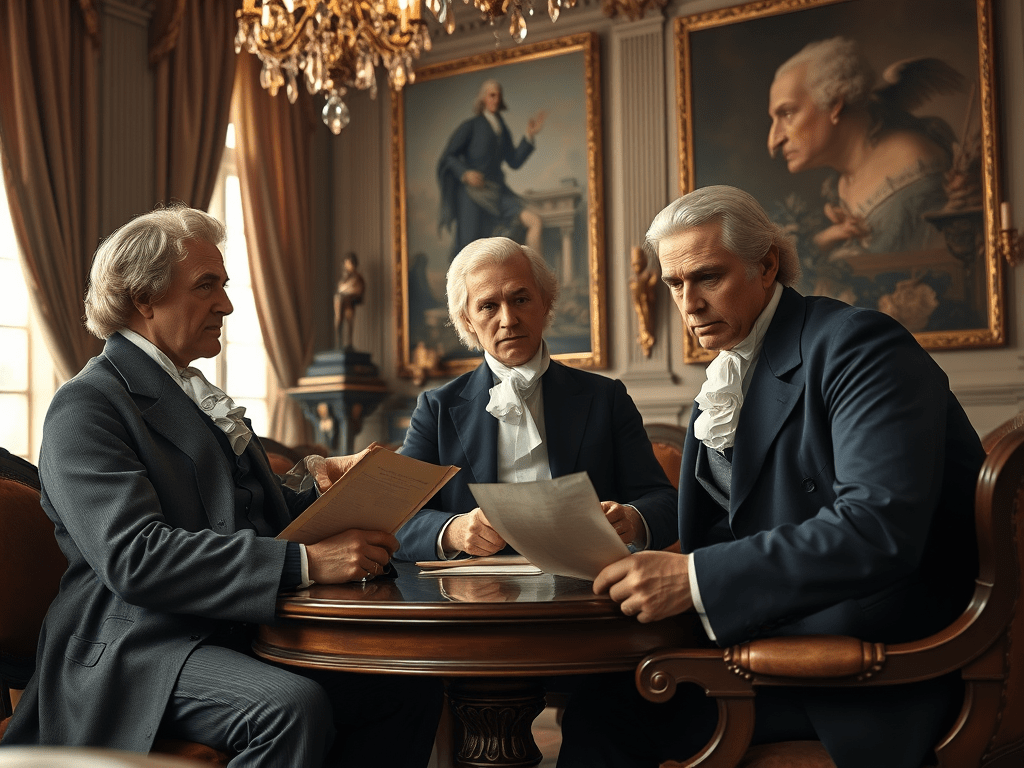
Have you ever seen something that seemed too good to be true? Imagine you were at a garage sale and the owner, overwhelmed by the sheer volume of stuff they had, offered you their entire attic – including some valuable vintage toys and a few boxes of what could be priceless family heirlooms – for the price of a really nice dinner. That’s essentially what happened with the Louisiana Purchase. Except, the attic was a third of the continent, and the “owner” was Napoleon Bonaparte, the fearsome French Emperor, who was suddenly very keen on getting rid of his overseas possessions.
This wasn’t a well-thought-out plan, carefully plotted over years of diplomatic negotiation. It was a perfect storm of ambition, desperation, and a heavy dose of plain good luck. It’s a story of unexpected turns, high-stakes brinkmanship, and the formation of the United States as we know it.
The original “Mission: Impossible”
In the early 1800s, America was still a scrappy young nation, barely decades old. Its western border was the mighty Mississippi River. Beyond that was a vast, mysterious territory claimed by Spain. This wasn’t just empty space; the vibrant, bustling port of New Orleans, strategically located at the mouth of the Mississippi, was absolutely crucial for American trade. Farmers and merchants in the territories of Kentucky and Ohio relied on it to ship their goods to the rest of the world. Spain, a decaying empire, was a manageable neighbor. They were more or less okay with Americans using the port, for a price.
But in 1801, a secret treaty was signed. Spain, feeling the heat from its powerful neighbor, France, retroceded (the fancy word for “gave back”) the Louisiana Territory to them. This was bad news for the young United States. France, under the ambitious Napoleon, was a superpower. It was like swapping your reliable, slightly goofy neighbor for a temperamental, powerful, and unpredictable bully. The American government was horrified. If Napoleon controlled the Mississippi, he could single-handedly choke off American trade.
President Thomas Jefferson was in a bind. He was a man who preferred diplomacy over conflict, but he knew this situation was untenable. He needed to secure access to the Mississippi. And so, he hatched a plan that, at the time, seemed like a long shot, bordering on impossible.
Jefferson sent a high-ranking diplomat, Robert Livingston, to Paris with instructions to negotiate the purchase of New Orleans and the surrounding area. His goal was modest: just enough land to guarantee American control over the river’s mouth. His budget was a mere $10 million. It was like trying to buy a multi-million dollar mansion with the change in your pocket. But Jefferson was desperate. He also sent James Monroe to join the negotiations, hoping his presence would signal to the French the gravity of the situation. They arrived in a Paris that was very different from the elegant, philosophical city they had imagined. It was a city of intrigue, paranoia, and the very real threat of war.
Napoleon’s U-Turn: A Tale of Revolutions and Money
As the Americans were twiddling their thumbs, navigating the labyrinthine French bureaucracy, a major crisis was unfolding in the French colony of Saint-Domingue (modern-day Haiti). It was the jewel of the French colonial empire, known for its enormously profitable sugar plantations, all run on the back of brutal slave labor. A successful slave revolt, led by the brilliant Toussaint Louverture, had overthrown French rule. Napoleon, never one to back down, sent a massive army of 20,000 soldiers to crush the rebellion.
His troops, however, faced a deadly enemy: yellow fever. They died by the thousands. The French army was decimated, and their resources were drained. Napoleon, who was planning a massive invasion of Britain, was low on both troops and cash. The dream of a grand French empire in the Americas was crumbling. He realized that holding on to the vast, sparsely-populated Louisiana Territory was becoming a massive, and perhaps impossible, liability. He could try and keep it, but it would be a constant drain on his already-strained military. Or, he could use it as a powerful bargaining chip.
Napoleon was a master of grand gestures and lightning-fast decisions. His finance minister, François Barbé-Marbois, reportedly woke him one morning to tell him that the Americans were ready to talk about New Orleans. He dismissively said, “Give them the whole territory.” When his shocked minister pointed out that the Americans only wanted a tiny part of it, Napoleon simply replied, “If I cannot defend it, I must sell it.” He was practical to a fault. And he was also in a hurry. The war with Britain was looming, and he knew he needed quick cash.
The Greatest Deal in History…Almost Spoiled
On April 11, 1803, just as James Monroe arrived in Paris, things took an unexpected turn. Instead of negotiating for a small slice of land, the French government made a mind-blowing counter-offer: “Why don’t you buy the whole thing?” This was a game-changer. It was the equivalent of going to a car dealership looking for a reliable sedan and being offered a fleet of luxury cars for the same price. Livingston and Monroe were stunned. They had no instructions to buy a territory that was nearly a million square miles. They didn’t have the authority. They didn’t have the money. It was a classic “carpe diem” moment.
What did they do? They took a leap of faith. They knew this was a once-in-a-lifetime opportunity. To turn it down would be crazy. They also knew that Jefferson would be practical. After days of intense negotiation, they agreed on a price. The final cost for the Louisiana Purchase was $15 million. While that seems like a staggering amount of money back then, a closer look shows it to be perhaps the single greatest land deal in human history. To put it in perspective, the cost per acre was approximately three cents. This single purchase doubled the size of the entire nation, adding an area that eventually would become 15 states. It was a deal that defined America.
But when word got back to Washington, not everyone was thrilled. This was one of the most controversial events in early American history. Jefferson’s own party, the Democratic-Republicans, was divided. Jefferson, a strict constructionist of the Constitution, was personally conflicted. The Constitution didn’t say anything about the President being allowed to buy foreign territory. Was this an abuse of power? Was he acting like a king? Some accused him of being a hypocrite. The whole situation was a real test of Jefferson’s political convictions. In the end, practicality won. He believed that the acquisition of this vast territory would be vital for the future of the nation, providing a massive “empire of liberty” and securing America’s borders for generations to come. He decided that the long-term benefits outweighed his constitutional concerns. He submitted the treaty to the Senate, where it was, after much heated debate, ratified on October 20, 1803.
A Legacy of Land and Consequence
The Louisiana Purchase was a profound moment, a tectonic shift in the geopolitical landscape of the Americas. But it’s important to understand the consequences, which were as large as the territory itself. The purchase wasn’t just about land; it was about the people living on it. This vast area was home to countless Native American nations. For them, the transaction was a catastrophic event. From their perspective, one foreign government (France) had sold land they had never truly owned to another foreign government (the United States). It directly led to the systematic and tragic displacement of many tribes from their ancestral lands. It was a devastating disruption to their entire way of life. The purchase may have fulfilled Jefferson’s dream of a massive American “empire,” but it also created a legacy of broken promises and profound injustice.
At the same time, the purchase unleashed an era of unprecedented exploration and westward expansion. This was the trigger for the legendary Lewis and Clark expedition, which mapped and documented the new territory. Americans began pouring into the region, leading to a wave of new states. The massive expansion also forced the young nation to confront the central moral issue of the day: slavery. New territories were added. Would they be free or slave states? This fueled a political and social tension that would eventually culminate in the Civil War, another pivotal moment in American history. The purchase was a grand and ambitious move, but it also sowed the seeds of a deep and terrible future conflict.
Why This Still Matters: The Big Picture
This isn’t just a fascinating story from history books. It’s a moment that still resonates in the 21st century. It’s a key reason why the United States looks the way it does on a map. Without it, the U.S. might be a much smaller, fractured, and politically divided set of coastal states, and not the continental superpower we know today. It set a precedent for rapid territorial expansion and confirmed America’s status as an emerging global force. The sheer scale and audacity of the purchase helped shape the American identity as a forward-looking, “can-do” nation, which is still a core part of the national mythos today. The purchase is a powerful reminder of how unexpected events, political maneuvering, and a fair amount of plain luck can fundamentally shape a country for centuries to come. It’s a story that continues to inform our understanding of American power, expansion, and its complicated moral legacy.
Sources:
- “The Louisiana Purchase, 1803.” Office of the Historian, U.S. Department of State.
- “Louisiana Purchase.” National Archives and Records Administration.
- Undaunted Courage: Meriwether Lewis, Thomas Jefferson, and the Opening of the American West by Stephen E. Ambrose.
- Jefferson and the Ordeal of Liberty by Dumas Malone.
- “The Great Land Purchase: The Historical Roots of the Louisiana Purchase.” A History Matters Presentation by Dr. Andrew Roberts.



 History in 5 Minutes or less
Leave a comment