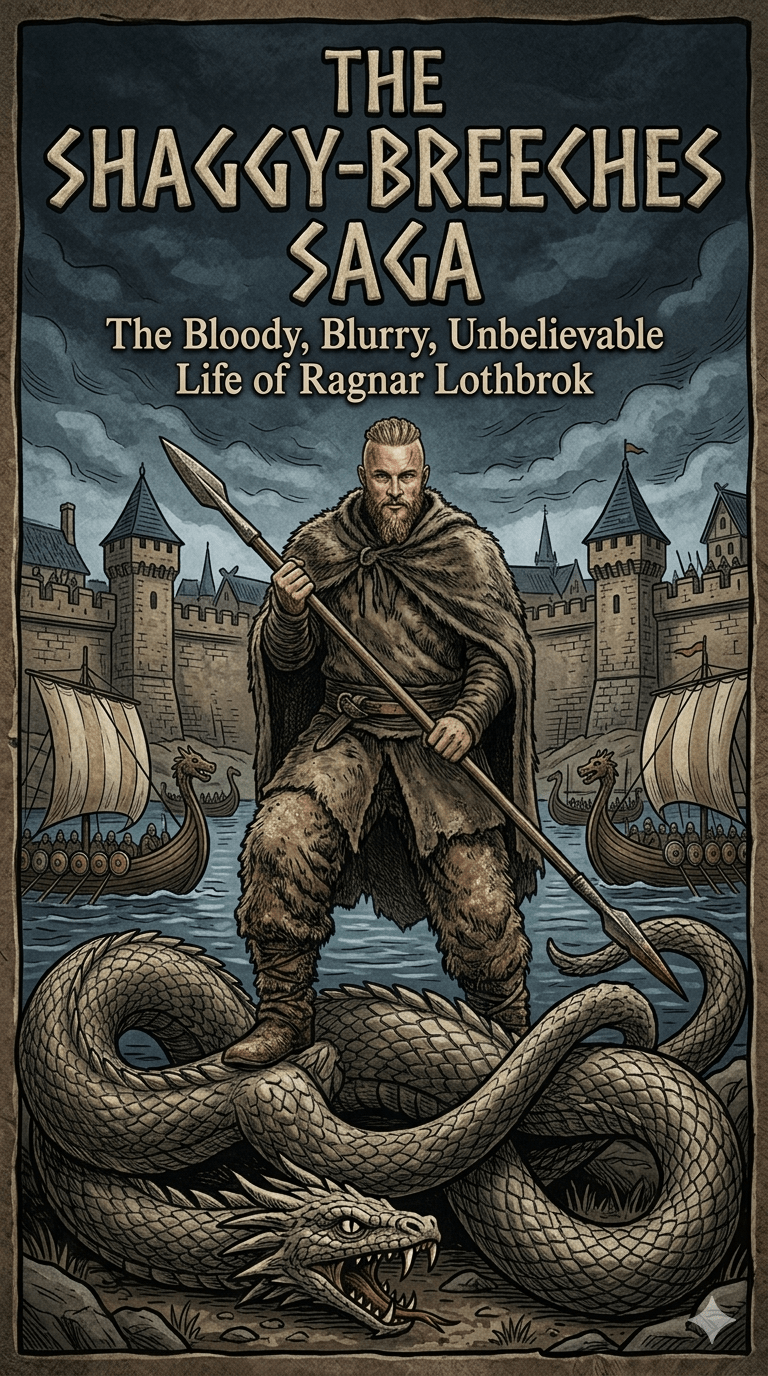
Did he really wrestle a giant snake, father a whole football team’s worth of terrifying raiders, and die screaming about his pigs in a pit full of vipers? In the year 865, the kings of England were about to meet the most dangerous man they’d never heard of… or were they? Strap on your horned helmet—wait, don’t, they didn’t actually wear those—because we’re about to separate the muddy fact from the magnificent fiction of the most famous Viking to ever (maybe) sail a longship. This is the wild, tangled story of Ragnar “Hairy-Breeches” Lothbrok.
Rewind: A Snake, a Dress, and some Seriously Stinky Pants
Before we get to the legendary death that launched a thousand ships, let’s rewind to the beginning. Or, a beginning. According to the Icelandic Ragnars Saga Loðbrókar, Ragnar was the son of a king, but he was a king without a kingdom, which, in the 9th-century Viking world, meant one thing: he needed to go find some people and hit them. His first legendary quest, however, wasn’t for gold, but for a wife. And not just any wife, but Thora Borgarhjort, whose father, King Herrauðr of Götaland, had a slight problem. He’d given his daughter a cute baby serpent which had awkwardly grown into a giant, city-block-sized venomous nightmare that guarded her tower and demanded a daily meal of ox. As you do.
Ragnar, hearing of this, didn’t just grab an axe. He developed a cunning plan involving high-concept fashion. He found a pair of wooly trousers and a shaggy cloak, and—this is the key detail—he dipped them in tar and rolled them in sand, baking them into a rigid, stink-proof suit of armor. In this encrusted outfit, he looked like a cross between a muddy bear and a swamp monster. But it worked. The tar-armor deflected the snake’s venom. He marched right up and speared the giant beast through the heart. He then won the girl, and, more importantly, a nickname that would stick for millennia: Loðbrók, which translates literally, and unglamorously, as “Hairy-Breeches.” The moral? In the Dark Ages, a good, waterproof pants-invention was just as heroic as a magic sword.

The Problem of Paris and the Rise of the Scourge
This is where the legend and history start to get blurry, messy, and extremely violent. Was Ragnar one person? Most historians think probably not. He seems to be a composite character—a convenient “Greatest Hits” album of several different 9th-century Viking leaders. One of these figures, a chieftain named Reginherus, is recorded in Frankish annals as leading a massive raid up the Seine River. In 845, this Viking fleet appeared before Paris. It was Easter weekend. The Frankish King, Charles the Bald, who was, ironically, not very bold, was so terrified that he didn’t fight; he simply paid the Vikings an astronomical bribe of 7,000 pounds of silver to leave. This was a catastrophic mistake. It showed every other Viking raider that if they just brought enough ships, they could hold entire kingdoms to ransom without breaking a sweat.
Back in Scandinavia, this historical “Reginherus” may have blended into the character of Ragnar. The stories say he used his massive fame and wealth (whether from the tar-pants or the Paris payoff) to attract a legendary following. He became a scourge of the seas, radiating terror. The myths make him a king of Denmark and Sweden simultaneously, ruling a vast domain. But his true power wasn’t land; it was reputation. He was the prototype for the ambitious, charismatic Viking king, setting the standard for all who followed.

The Sins of the Sons and the Rise of the Great Heathen Army
Ragnar’s biggest contribution to history, however, wasn’t his own actions, but the children he (allegedly) fathered. He had several wives—including Thora, the snake-slayer’s prize, and Aslaug, a mysterious woman found living in poverty who turned out to be the daughter of the famous dragon-slayer Sigurd. From these unions came a generation of sons whose names are, remarkably, much better attested in historical records than their father’s. There was Bjorn Ironside, who raided the Mediterranean; Ivar the Boneless, a brilliant and cruel strategist (the “Boneless” part is a debate: was it a physical disability, impressive flexibility, or just a nickname for impotence? History is cruel and vague); Sigurd Snake-in-the-Eye; and Hvitserk.
These sons grew up in their father’s enormous, tar-scented shadow. The sagas tell us that as they grew, they became incredibly successful raiders, conquering territory and gathering immense wealth. Ragnar, supposedly, became jealous. He saw his own fame eclipsed by his offspring. This ego-driven anxiety led him to make the single stupidest decision of his life: he decided to conquer all of England with only two ships, just to prove he was still the top Viking. This wasn’t a military strategy; it was a lethal mid-life crisis.
The predictable happened. Ragnar sailed to the Kingdom of Northumbria (modern northeast England), where King Ælla was waiting. His tiny force was overwhelmed. Ragnar was captured alive. Ælla, not known for his hospitality, decided to execute the pagan pirate in the most dramatic way possible: he threw Ragnar into a deep pit filled entirely with venomous vipers. This is the moment that cemented the legend. According to the poets, as the snakes bit him, Ragnar did not scream in pain. He didn’t beg. He sang a defiant death song, the Krákumál, predicting his own legend. He famously boasted: “How the little pigs would grunt if they knew how the old boar suffers!”

Why This Still Matters
The grunt of those “little pigs” would change the face of Europe. When news of Ragnar’s gruesome death reached his sons, they didn’t just weep; they mobilized. In 865, the same year Ragnar supposedly died, a coalition of Viking leaders, including Ivar the Boneless and Halfdan (another apparent son), landed in England. This wasn’t a standard Viking raid designed for quick plunder; it was a full-scale invasion force. The Anglo-Saxons called it the “Great Heathen Army.”
This army didn’t leave. Over the next decade, they systematically systematically conquered three of the four major Anglo-Saxon kingdoms: Northumbria, East Anglia, and Mercia. They settled the land, creating a region of Viking law and culture known as the Danelaw. They nearly wiped out Anglo-Saxon England entirely, and it was only the desperate resistance of King Alfred the Great of Wessex that saved a remnant.
The legend of Ragnar, therefore, is the ultimate “蝴蝶效应” (butterfly effect) story. Whether he was a single man who wore sticky pants or a mythic composite of many leaders, the story about his death—the idea of a legendary father murdered by a foreign king—served as the primary motivation for the single largest, most transformative Viking invasion of the British Isles. It fundamentally altered the genetics, the language (words like ‘sky’, ‘leg’, and ‘take’ are Norse), and the political boundaries of what would eventually become England. Ragnar Lothbrok may be a ghost, but he is a ghost who left a massive, indelible footprint on the modern world.
Sources
- The Saga of Ragnar Lothbrok (Icelandic, 13th Century). Translated by Ben Waggoner.
- Gesta Danorum (Deeds of the Danes) by Saxo Grammaticus (Danish, 12th Century).
- The Anglo-Saxon Chronicle (9th-12th Century).
- Jones, Gwyn. A History of the Vikings. Oxford University Press, 1984.
- Phelps, Ian. “Ragnar Lothbrok: The Hairy-Breeches Legend.” Scandinavian Studies (2011).


 History in 5 Minutes or less
Leave a comment