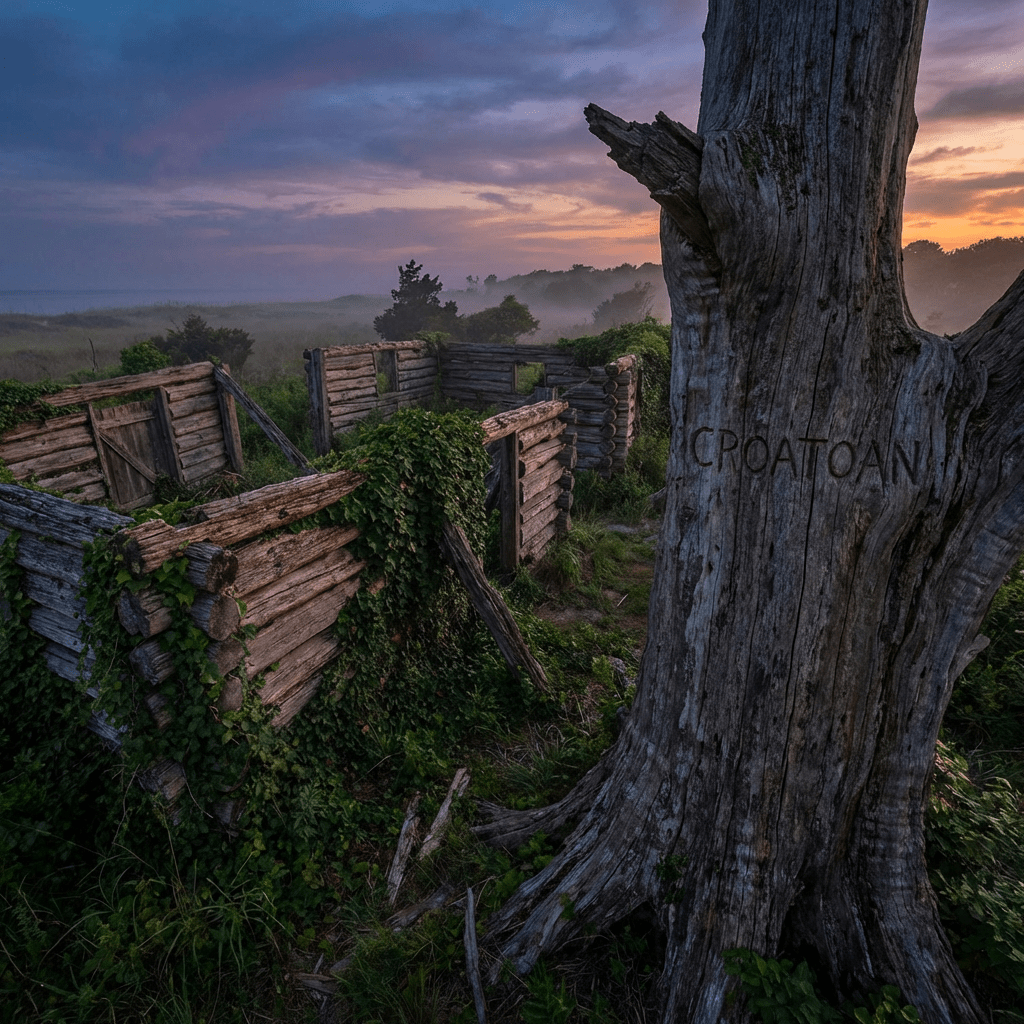
In 1590, John White stepped off a ship onto the shores of Roanoke Island, expecting to be greeted by the joyous shouts of his daughter and granddaughter—instead, he found a ghost town where the only thing left alive was the wind whistling through a picket fence. He didn’t find bodies, he didn’t find charred ruins, and he didn’t find a struggle; he simply found an empty clearing and a single word carved into a wooden post: CROATOAN.
The Dream of a New World
The story of Roanoke isn’t just a mystery; it’s a sixteenth-century corporate thriller that went horribly sideways. To understand how 115 people vanished into thin air, we have to look at the man with the plan: Sir Walter Raleigh.
Raleigh was the ultimate Elizabethan “influencer.” He had the Queen’s ear, a flair for poetry, and a desperate need to find a way to make England as rich as Spain. Spain was currently hauling literal boatloads of gold out of South and Central America, and England was feeling a bit like the sibling who got left out of the will. Raleigh’s pitch? Establish a base in North America to harass Spanish treasure ships and maybe find some gold of their own.
In 1584 and 1585, preliminary expeditions were sent. They were, to put it mildly, a disaster. The soldiers sent there were better at picking fights than planting corn. They managed to alienate the local indigenous tribes—specifically the Secotan—by accusing them of stealing a silver cup and then burning an entire village in retaliation. Not exactly a “Welcome to the Neighborhood” fruit basket.
By the time the “Lost Colony” was ready to set sail in 1587, the vibe was already rancid. But this time, Raleigh tried something different. Instead of just soldiers, he sent families.
The 1587 Voyage: A Bad Omen
The 1587 expedition was led by John White, an artist whose watercolors provide us with the best visual record of 16th-century Native American life. White wasn’t a hardened military man; he was a grandfather. Among the 115 settlers were his pregnant daughter, Eleanor Dare, and her husband, Ananias.
The plan was actually to settle in the Chesapeake Bay area, which had better harbors. But the fleet’s pilot, a grumpy Portuguese man named Simon Fernandes, had other ideas. He was a privateer at heart and wanted to get back to the Caribbean to hunt Spanish ships before the season ended. When they reached Roanoke Island to check on a small garrison left behind from the previous year, Fernandes basically told the settlers, “This is your stop,” and refused to take them any further.
The settlers stepped off the boats and immediately found the remains of the previous garrison: a single skeleton, bleached by the sun. It was the 16th-century equivalent of checking into a hotel and finding a “Do Not Disturb” sign on a crime scene.
Despite the dread, they got to work. On August 18, 1587, Eleanor Dare gave birth to Virginia Dare, the first English child born in the Americas. For a moment, there was hope. But the clock was ticking. Their supplies were low, the local tribes were (understandably) hostile, and winter was coming.
The settlers begged John White to head back to England to hustle for more supplies. He didn’t want to go—he didn’t want to leave his newborn granddaughter—but they insisted. He promised to return within months.
The Three-Year “Lunch Break”
John White sailed into a nightmare. He arrived in England just as the Spanish Armada was preparing to invade. Queen Elizabeth I declared a “shipping freeze,” meaning every single English vessel was pressed into military service to defend the homeland.
White was stuck. He tried to get back to Roanoke in 1588 with two small, poorly equipped ships, but the captains were more interested in piracy than rescue missions. They got into a fight with French ships, got looted, and limped back to England with their tails between their legs.
For three agonizing years, White sat in England, staring across the Atlantic, wondering if his family was starving or dead. It wasn’t until 1590, after the Spanish threat had subsided, that he finally secured passage on a privateering vessel.
The Return to Silence
When White finally made it back to Roanoke in August 1590, it was his granddaughter’s third birthday. He expected to see smoke from chimneys and children playing on the beach.
Instead, he found the Mary Celeste of the woods.
The settlement was surrounded by a “high palisade of great trees, with courtes and flankers, very Fort-like.” But inside? Nothing. The houses had been taken down, not burned or destroyed, but dismantled. This was a crucial detail—it suggested a planned move, not a panicked flight.
Then he saw it. On a prominent tree at the entrance to the palisade, the letters “CRO” were carved. On one of the main posts of the fort, the word “CROATOAN” was etched in capital letters.
White had an agreement with the settlers: if they had to leave, they would carve the name of their destination. If they were in distress, they were supposed to carve a Maltese Cross above the name.
There was no cross.
White was actually relieved. Croatoan (now known as Hatteras Island) was the home of the Croatan tribe, who had been friendly to the English. Their leader, Manteo, had even traveled to England twice. White assumed his family was safe and sound, living among friends fifty miles to the south.
He prepared to sail to Croatoan the next day. But then, the classic Roanoke luck struck again. A massive storm blew in. The ship lost its anchors, the food was rotting, and the crew was on the verge of mutiny. The captain refused to go further south and insisted on heading back to England via the Caribbean.
John White never saw his family again. He died in Ireland years later, haunted by the “Croatoan” sign.
The Theories: Where Did They Go?
For 400 years, historians, archaeologists, and “ancient alien” enthusiasts have debated the fate of the 115. Let’s break down the most likely—and the most bizarre—scenarios.
1. The “Integration” Theory (The Most Likely)
This is the Occam’s Razor of the Roanoke mystery. The settlers were starving, outnumbered, and abandoned. The Croatan people were friendly and had plenty of food. It makes perfect sense that the English dismantled their houses, moved to Hatteras Island, intermarried, and eventually assimilated into the tribe.
Later explorers in the 1700s reported seeing “Grey-eyed Indians” in the region who claimed to have ancestors who could “talk in a book” (read). DNA testing in recent years has been inconclusive but suggestive.
2. The “Split and Scatter” Theory
New archaeological evidence, specifically from the “First Colony Foundation,” suggests the group might have split up. Some may have gone to Croatoan, while another group headed inland to a location dubbed “Site X” in Bertie County.
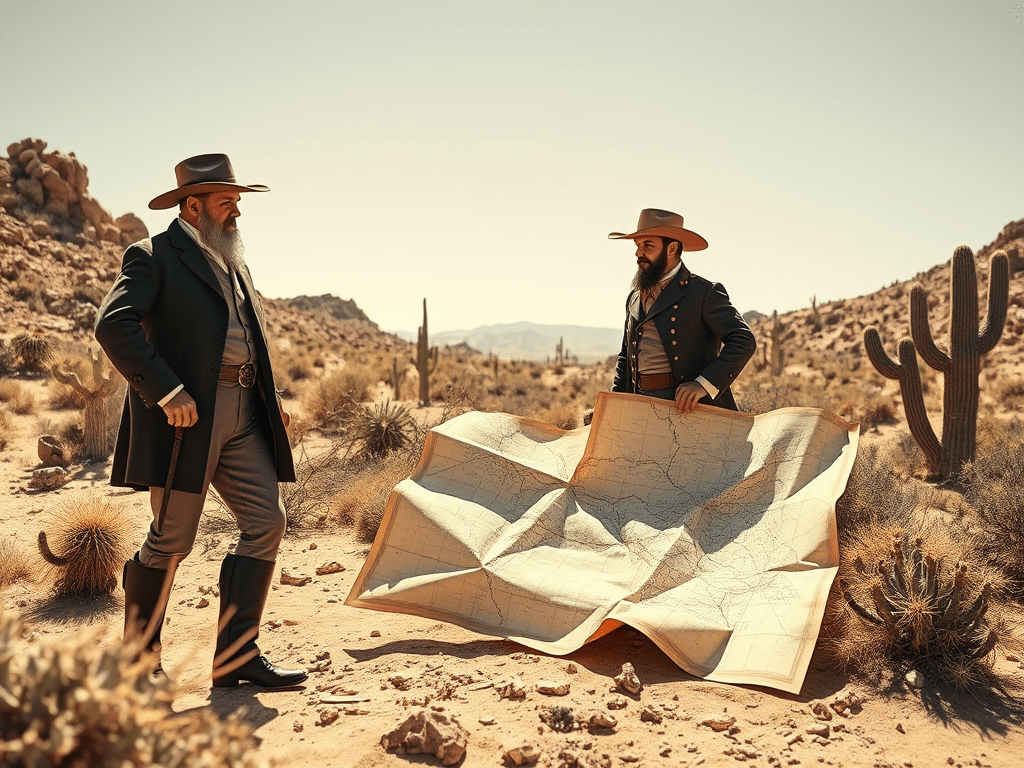
Why “Site X”? In 2012, researchers looked at John White’s 1585 map (the Virginea Pars) and noticed a small patch of paper used to correct a mistake. When they looked under the patch with modern imaging, they found a hidden symbol of a fort. Excavations at that inland spot have turned up English pottery styles (Border Ware) that match what the Roanoke settlers would have carried.
3. The “Chesapeake Massacre” Theory
When the Jamestown colony was established in 1607, Captain John Smith went looking for the Roanoke survivors. He claimed he heard from Chief Powhatan (Pocahontas’s father) that he had killed the Roanoke settlers because they were living with a rival tribe near the Chesapeake Bay.
However, many historians think Smith might have been exaggerating or that Powhatan was just trying to intimidate the new English arrivals. No physical evidence of a massacre has ever been found.
4. The “Spanish Hit Squad”
Spain knew the English were on Roanoke. They considered the entire coast of North America their territory (which they called La Florida). Spanish records show they sent scouts to find the colony to wipe it out. They found the location, but it was already empty. While they didn’t kill the settlers, the fear of a Spanish attack might have been what drove the settlers to move inland or to Croatoan.
Why This Still Matters
You might be wondering: “It’s been 400 years, why are we still talking about a few missing Elizabethans?”
First, Roanoke is the ultimate American origin story, It’s a story of failure, mystery, and the brutal reality of the “New World.” It reminds us that history isn’t a straight line of progress; sometimes, it’s a dead end.
Second, the mystery of Roanoke has forced us to look closer at the relationship between European settlers and Indigenous peoples. For centuries, the story was told as a “tragedy” of lost Europeans. Now, we look at it through the lens of survival and adaptation. If the settlers survived, it was because they abandoned their “Englishness” and became part of the sophisticated social structures of the Carolina Algonquians.
Finally, Roanoke is a testament to human curiosity. We hate an unfinished story. The word “Croatoan” has become a cultural shorthand for the unexplained, appearing in everything from Stephen King novels to American Horror Story. We keep digging because we want to know that even when we are “lost,” someone will eventually come looking for us.
The 115 people of Roanoke didn’t just vanish into a vacuum. They stepped into the woods and became a part of the landscape, leaving us with a puzzle that may never be fully solved—and perhaps, it’s better that way.
Sources
- Horn, James. A Kingdom Strange: The Brief and Tragic History of the Lost Colony of Roanoke. Basic Books, 2010.
- Milton, Giles. Big Chief Elizabeth: The Adventures and Fate of the First English Colonists in America. Farrar, Straus and Giroux, 2000.
- National Parks Service. “Roanoke: The Abandoned Colony.” Fort Raleigh National Historic Site.
- First Colony Foundation. “The Search for Site X: Archaeological Evidence of the Lost Colony.”
- The British Museum. “John White’s Watercolors: The First Images of North America.”
 History in 5 Minutes or less
Leave a comment