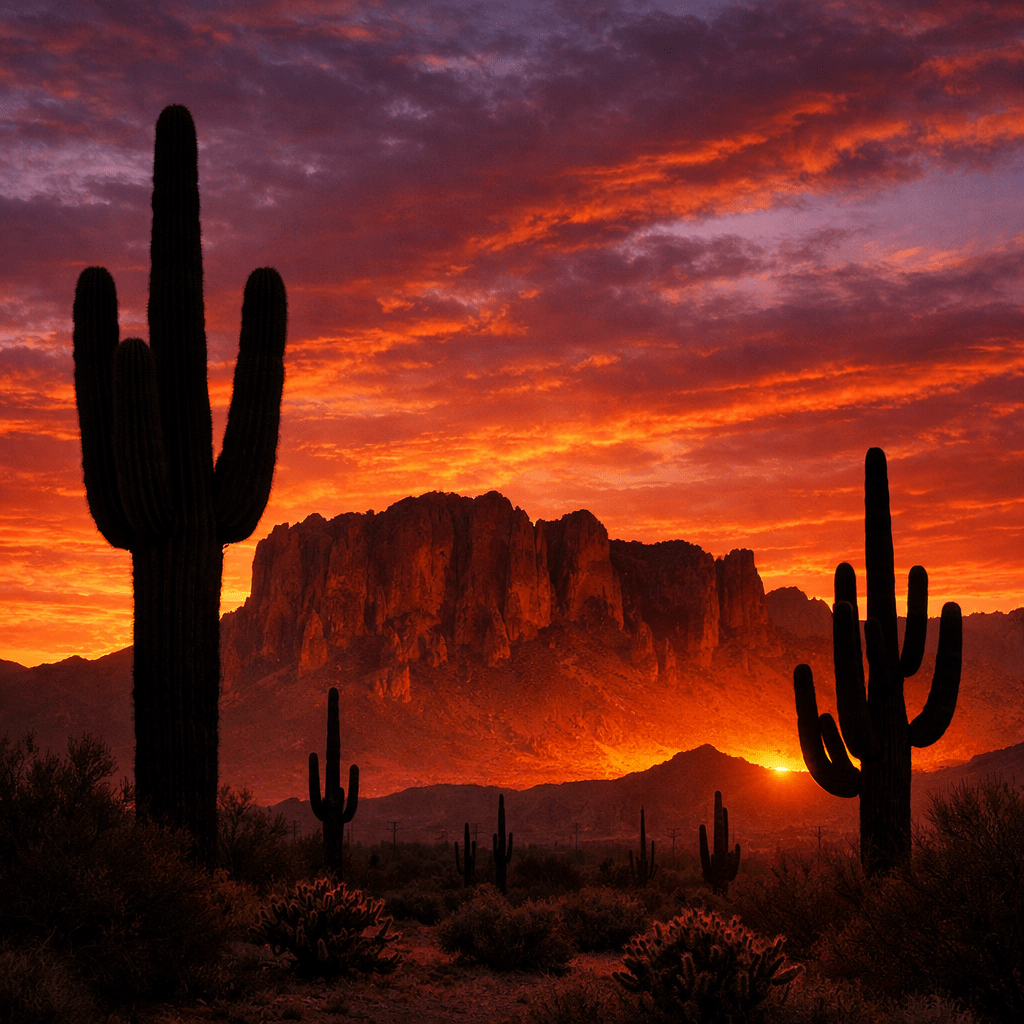
The Skeleton in the Saguaro
What if I told you there is a mountain in Arizona that has swallowed more men than it has ever enriched, and that somewhere in its jagged, heat-shimmering canyons lies a pile of gold worth roughly $200 million? For over a century, people have been found decapitated, dehydrated, or simply “missing” while hunting for the Lost Dutchman’s Mine—a treasure that remains the most famous, and most lethal, unsolved mystery of the American West.
But before we dig into the piles of gold, we have to talk about a man who died in a small adobe house in Phoenix in 1891, clutching a secret that would drive thousands of people to the brink of insanity.
The Curse of the Superstition Mountains
To understand the mine, you have to understand the place. East of Phoenix lie the Superstition Mountains. They don’t look like the rolling, friendly hills of the East Coast. They are volcanic, jagged, and terrifyingly vertical. The Apaches called them the “Home of the Thunder God,” and for centuries, they avoided the inner reaches of the range, believing it to be a gateway to the underworld.
The legend really begins with the Peralta family, wealthy Mexican landowners who allegedly struck it rich in the 1840s. According to lore, they organized a massive expedition to haul gold back to Mexico, only to be ambushed by Apaches who were tired of the “pale eyes” digging holes in their sacred ground. The “Massacre Grounds” on the north side of the mountain are still pointed out to tourists today. The gold, it is said, was scattered or buried by the Apaches, who had no use for the yellow metal that brought nothing but trouble.
Enter “The Dutchman”
The “Dutchman” wasn’t actually Dutch. He was German. Jakob Waltz arrived in the Arizona Territory in the 1860s. He was a quiet, suspicious man with a thick accent and a beard that looked like it housed several species of desert rodents.
Around the 1870s, Waltz began appearing in Phoenix with pockets full of “bonanza” oregold so pure it looked like it had been melted and poured into the rock. When his gold ran low, he would disappear into the Superstitions for a few days and return with a fresh supply. People tried to follow him, of course. Legend says he would lead them in circles, sit on a high ridge with a Winchester rifle, and wait for them to give up—or, in darker versions of the story, he’d just shoot them.
Waltz never filed a legal claim. In his mind, the mountains were his bank, and he was the only one with the PIN.
The Deathbed Map
In 1891, a massive flood hit Phoenix. Waltz, then in his 80s, was rescued from his flooded home but contracted pneumonia. As he lay dying, he was cared for by a woman named Julia Thomas. In his final hours, realizing he couldn’t take the gold to the grave, he allegedly told Julia the location of his “private bank.”
He gave her clues that have haunted treasure hunters for 130 years:
- “The rays of the setting sun shine into my mine.”
- “No miner will ever find my mine.” (Supposedly because it was a hidden cache or a vertical shaft masked by brush).
- “From my mine, you can see the Weaver’s Needle, but you cannot see the mine from the Needle.”
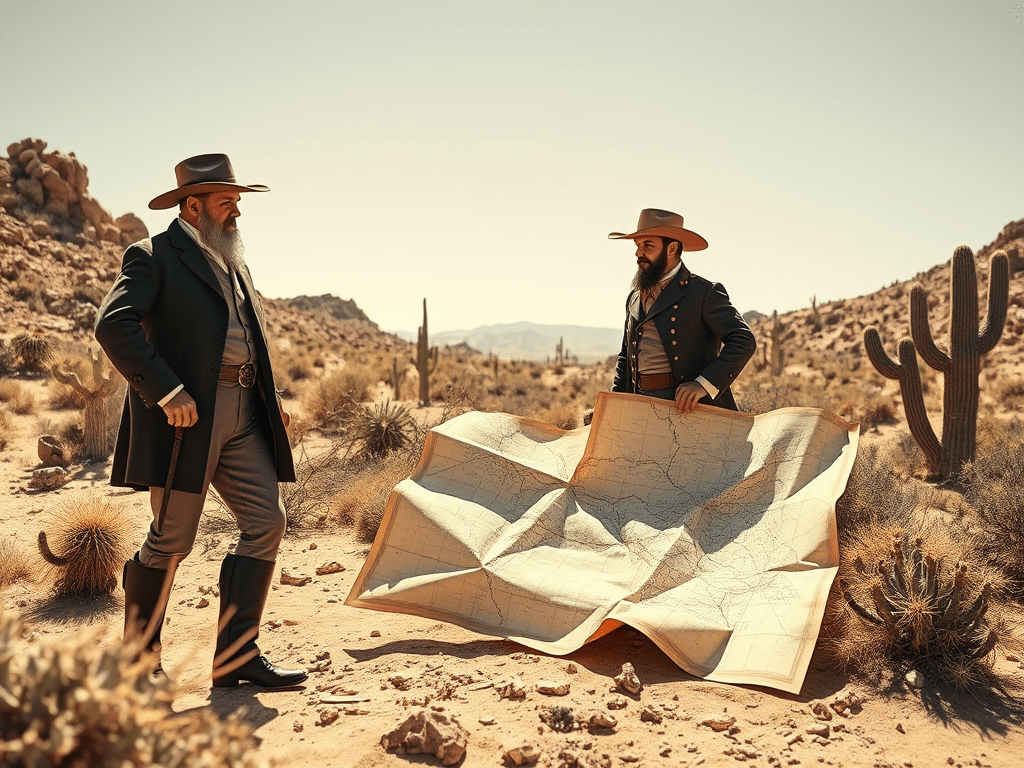
Waltz died, and Julia Thomas sold her bakery to fund an expedition. She found nothing but heatstroke. Desperate and broke, she eventually started selling hand-drawn “maps” to the mine to tourists. These maps—most of them fakes or based on fever-dream recollections—are the ancestors of the thousands of “Dutchman Maps” circulating today.
The Body Count Rises
If this were just a story about a lost mine, it would be a curiosity. What makes it a legend is the body count.
In 1931, a retired government worker named Adolph Ruth headed into the mountains with what he claimed were “authentic” Peralta maps. When he didn’t return, a search party went out. They found his skull six months later with two bullet holes in it. His body was found nearly a mile away. Curiously, his maps were missing, but his checkbook contained a cryptic note: “Veni, Vidi, Vici” (I came, I saw, I conquered).
Since then, the Superstitions have claimed dozens of lives. Some die of “Desert Madness”—the psychological breakdown that happens when you’re 110 degrees deep in a labyrinth of cacti and rock. Others die of “Lead Poisoning”—as in, getting shot by other treasure hunters who are just as paranoid as Jakob Waltz was.
Geologic Fact vs. Golden Fiction
Is there actually gold there? Geologists are the ultimate buzzkills of the Dutchman legend. The Superstition Mountains are primarily volcanic rock (rhyolite and dacite). Gold is typically found in metamorphic or igneous rock like quartz. Scientifically speaking, the Superstitions are the “wrong” kind of mountains for a massive gold strike.
However, there are “islands” of older rock trapped within the volcanic layers. Furthermore, Waltz’s ore was real. After he died, a cigar box of his gold was found under his bed. It was tested and found to be high-grade gold that matched nothing else in the immediate area. Some believe Waltz didn’t have a “mine” at all, but rather found a Peralta “cache”—a hidden stockpile of gold stolen and buried during the Mexican-American War era.
The Modern Hunt
Today, the Superstition Mountains are a federally protected wilderness area. It is illegal to use motorized vehicles, and—crucially—it is illegal to “mine” or remove minerals. But that doesn’t stop the “Dutchman Hunters.”
Equipped with GPS, drones, and infrared cameras, modern seekers still comb the Needle Canyon and Black Top Mesa. They argue over the “Spanish Symbols” carved into rocks—circles, crosses, and hearts that some claim are trail markers and others claim are just natural erosion. They are a community of “believers” who view the hunt not just as a way to get rich, but as a puzzle that needs to be solved.
Why This Still Matters
The Lost Dutchman’s Mine isn’t really about the gold anymore. It’s a testament to the enduring American myth of the “Big Strike”—the idea that one lucky day, one right turn in a canyon, or one decoded map can change your life forever.
In a world where every square inch of the planet is mapped by Google Earth and tracked by satellites, the Superstition Mountains represent one of the few remaining “blank spots.” It matters because it reminds us that nature is still bigger than us, still more dangerous than us, and still capable of holding onto a secret for over a century. The mine is the ultimate “What If?”
Whether Jakob Waltz was a lucky miner, a clever thief, or a murderous liar, he succeeded in becoming immortal. As long as Weaver’s Needle casts its long shadow over the desert, someone will be out there, canteen nearly empty, squinting at the rocks, hoping to find the glint of the Dutchman’s gold.
Sources
- The Killer Mountains by Curt Gentry
- Superstition Gold by Oren Arnold
- The Arizona Historical Society Archives: Records on Jakob Waltz
- U.S. Geological Survey (USGS): Mineral Report on the Superstition Wilderness Area
- Journal of Arizona History: “The Peralta Mines: Fact or Fable?”


 History in 5 Minutes or less
Leave a comment