
The Curse of Tippecanoe: A Presidential Mystery
It was a cold and bleak winter day in March 1841 when William Henry Harrison, the newly elected President of the United States, delivered his inaugural address. Known as “Old Tippecanoe” for his heroic role in the Battle of Tippecanoe in 1811, Harrison, at 68 years old, refused to heed the advice of his doctors and advisors. Despite the bitter cold, he insisted on giving a 105-minute speech outdoors, without a coat or gloves.
Less than a month later, on April 4, 1841, Harrison died, most likely from pneumonia, just 30 days after taking office. His untimely death has remained a subject of speculation and intrigue ever since. Was it a tragic consequence of poor planning and an ill-advised decision to expose himself to the harsh winter weather? Or could it have been something more, perhaps a curse, set in motion years before?
The Roots of the Curse: Tippecanoe and Tecumseh
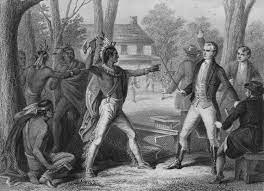
To understand the origins of Harrison’s death, we must look back to 1811, when Harrison was the governor of the Indiana Territory. During this time, he was tasked with dealing with the powerful Shawnee Chief Tecumseh and his brother, known as the Prophet, who had been rallying Native American tribes to resist white encroachment. While Tecumseh traveled to recruit more allies, his brother, the Prophet, led an attack on Harrison’s forces at a settlement called Tippecanoe. Despite the Prophet’s warriors’ best efforts, Harrison’s troops successfully repelled the attack, and the battle became known as the Battle of Tippecanoe.
This victory marked the beginning of the end for Tecumseh’s Confederacy. However, the conflict didn’t end there. A year later, during the War of 1812, Tecumseh and his forces allied with the British against Harrison’s troops. At the Battle of the Thames in Ontario, Canada, Tecumseh was killed in combat, effectively ending the Shawnee chief’s resistance.
The Prophecy: Harrison and Tecumseh’s Fateful Meeting
What’s often overlooked is the meeting between Harrison and Tecumseh that occurred years earlier, in 1808, when Harrison, then the territorial governor, had a chance encounter with the Shawnee leader along the Great Lakes. During their conversation, Harrison reportedly told Tecumseh, “Should the whites continue their expansion into the region, I assure you it will be productive of bad consequences.” Was this a prophetic warning? Some historians believe it may have been, as Harrison’s involvement in Tecumseh’s defeat—and Tecumseh’s subsequent death—set in motion a strange series of events that would haunt future U.S. presidents for generations.
The Curse Begins
After Harrison’s sudden death in 1841, a peculiar pattern began to emerge among U.S. presidents, particularly those elected in years ending in zero. From Harrison’s untimely death to the assassinations of Presidents Lincoln, Garfield, McKinley, and Kennedy, many began to wonder if there was something more than mere coincidence at play.
Here is the list of presidents elected in zero years who met tragic fates in office:
- William Henry Harrison (1840): Died of pneumonia after just 31 days in office.
- Abraham Lincoln (1860): Assassinated in 1865.
- James A. Garfield (1880): Assassinated in 1881.
- William McKinley (1900): Assassinated in 1901.
- Warren G. Harding (1920): Died in office in 1923.
- Franklin D. Roosevelt (1932): Died in office during his fourth term in 1945.
- John F. Kennedy (1960): Assassinated in 1963.
This eerie pattern of presidential deaths became widely known as the “Curse of Tippecanoe.” For over a century, it seemed as though any president elected in a year ending in zero would meet an untimely death, whether through assassination or natural causes.
The Exception: Ronald Reagan and the Curse
However, the curse was not an unbroken streak. In 1980, Ronald Reagan was elected as president, and many feared he too would fall victim to the curse. Just 69 days into his presidency, Reagan was shot by John Hinckley Jr. in an assassination attempt outside a Washington D.C. hotel. Miraculously, Reagan survived, with the bullet narrowly missing his heart. His survival was seen by some as breaking the curse once and for all, though others still point to the near-miss as proof that the curse had not been entirely vanquished.
Curse or Coincidence?
Was there truly a curse on presidents elected in zero years? Some believe that the pattern is nothing more than coincidence, a product of random chance. Others, however, remain convinced that the “Curse of Tippecanoe” was real—a result of the prophecy made by Tecumseh all those years ago. Whether or not the curse is grounded in reality, it is a story that continues to capture the imagination of history buffs and casual readers alike.
What is undeniable is that the pattern of tragic presidential deaths has left a mark on American history. From Harrison’s death in 1841 to Kennedy’s assassination in 1963, these events have shaped the nation in ways both expected and unforeseen.
The Truth in the Eye of the Beholder
Whether you believe in the curse or dismiss it as coincidence, the tale of Tippecanoe and the series of fateful presidencies is a story that captivates. It’s one of those pieces of American history that blends the mysterious with the factual, allowing for endless debate and discussion.
And, as any good storyteller will tell you, the truth of the “Curse of Tippecanoe” ultimately depends on the eye of the beholder.
Sources
Kelly, M. (2020, December 10). Has Tecumseh’s curse killed Seven us presidents? ThoughtCo. https://www.thoughtco.com/tecumsehs-curse-and-the-us-presidents-105440
U.S. Department of the Interior. (n.d.). Summer 1811: Tecumseh attempts to negotiate with White American settlers (U.S. National Park Service). National Parks Service. https://www.nps.gov/articles/tecumseh.htm#:~:text=At%20their%20meeting%2C%20Tecumseh%20spoke,%2C%20Tecumseh%20warned%2C%20%E2%80%9CI%20assure

 History in 5 Minutes or less
Leave a comment