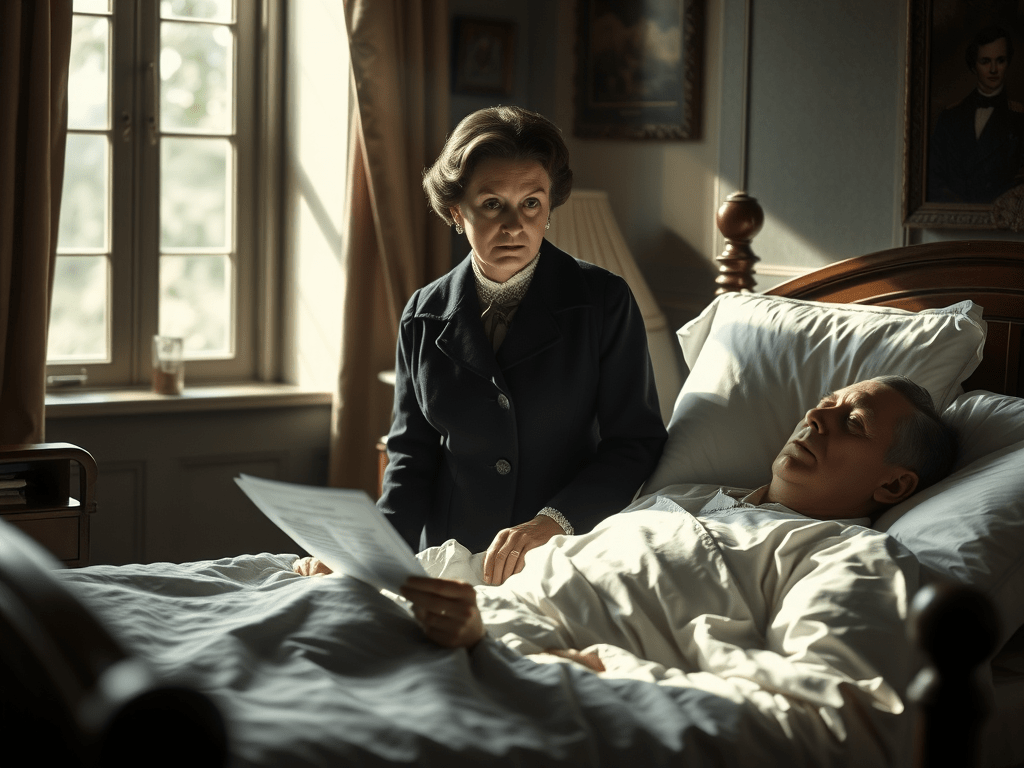
The day is October 2, 1919, and President Woodrow Wilson lays in bed, mouth drooping and unconscious. The President has suffered a stroke. The outlook doesn’t look good, Wilson is having trouble speaking and the left side of his body is paralyzed. Given the medical standards of the time, doctors believed that complete rest and isolation from stress or distractions were essential to his recovery. The Presidents condition is kept from congress, most of his cabinet and other senior officials in the government. It is only a select few in the Presidents inner circle including Wilsons wife Edith* and his personal physician Dr. Cary T. Grayson who know the presidents’ true condition. During this time, Edith takes on an extraordinary role in managing not only her husband’s personal affairs but also his presidential duties.
Edith Wilson’s Role in the Presidency
Edith Wilson’s actions during this period are often framed in terms of her devotion to her husband, but there are significant questions surrounding the extent of her involvement in the administration’s day-to-day operations. After the stroke, Edith effectively became the gatekeeper to the president. She controlled access to him, deciding who could visit and what information reached his bedside. She would meet with important officials, including members of Congress, and relay their concerns to Wilson. At times, she would offer her own opinion on matters of state and politics, though whether she was truly acting in a consultative or directive role remains unclear.
One of the most striking aspects of Edith’s role during this period was the way she shielded the public from the extent of her husband’s incapacitation. While Wilson had been a vigorous and vocal advocate for the League of Nations, his failure to fully recover from the stroke meant that he was unable to push the agenda forward in Congress. Historians have speculated that Edith, along with Dr. Grayson, may have made decisions that were, in essence, acts of governance. For instance, some believe she may have signed documents or issued statements in Wilson’s name without his direct input.
There is no concrete evidence to suggest that Edith actively crafted or signed significant legislation or diplomatic agreements on her husband’s behalf. However, given the isolation imposed on Wilson, it is plausible that she, in her capacity as the closest advisor, made decisions that affected the course of policy. She certainly had influence, though whether it extended into areas like drafting legislation is unclear.
The League of Nations and Congressional Opposition
Perhaps the most significant issue during Wilson’s incapacitation was the fate of the League of Nations, the international body Wilson had championed as part of his Fourteen Points to ensure peace and prevent future global conflicts after World War I. Wilson’s intense advocacy for the League and his personal belief in its importance had made it a key focus of his presidency.
However, after Wilson’s stroke, his ability to rally support for the League of Nations was severely hindered. Congress, had grown increasingly hostile to Wilson’s foreign policy. The Senate, under the leadership of opponents like Henry Cabot Lodge, refused to ratify the Treaty of Versailles, which included the League Covenant. The refusal to join the League of Nations, as well as the rejection of Wilson’s vision for post-war diplomacy, marked one of the most significant foreign policy defeats in American history.
In the absence of a fully functioning president, Edith’s role in managing these challenges becomes especially important. It is possible that she did not have the political expertise or authority to sway Congressional opinion, but by controlling access to the President, she may have inadvertently influenced the trajectory of U.S. foreign policy. Her decision to keep Wilson isolated from direct political pressure may have allowed the opposition to grow unchecked.
Public Perception and the Mystery of Edith Wilson’s Intentions
The public never learned the full extent of the President’s incapacitation, and Edith’s actions were seen in different lights by different observers. Some historians saw her as a devoted wife who acted out of love and a duty to protect her husband, believing she was merely trying to shield him from the stress of politics. Others, however, questioned whether she was using her position to influence or even dictate policy in ways that were undemocratic.
Some critics have suggested that Edith’s control of the White House was a form of de facto transfer of presidential authority. They argue that by effectively acting as a conduit for policy, Edith Wilson may have exercised a form of governance without being elected or accountable to the people. On the other hand, others contend that Edith Wilson simply stepped into the breach at a time when the president could not function, doing what was necessary to keep the wheels of government turning.
The truth is likely somewhere in between. Edith Wilson, by all accounts, was deeply loyal to her husband, and her actions may have been driven as much by a desire to protect him as by a sense of duty to the country. However, there’s no denying she played a central role in the functioning of the White House at a critical moment in American history.
A Lasting Legacy
Ultimately, the period of Wilson’s illness raises important questions about the fragility of the presidential office. Edith Wilson’s legacy is unclear: Was she a caretaker, preserving the dignity of her husband’s presidency? Or was she, at least in the eyes of some, a hidden force behind the throne, manipulating the workings of the government from behind closed doors?
This mystery, combined with the failure of the League of Nations and the ongoing debates over U.S. foreign policy in the early 20th century, continues to capture the imagination of historians. The role of an unelected First Lady in the workings of government, particularly in such a high-stakes moment in history, remains a cautionary tale for those who consider the balance of power in a democratic society.
* Edith Wilson is not the Presidents first wife. Wilson was first married to the former Ellen Axson who died in 1914 only a few years into her husband’s presidency
Sources:
Bhatia, S. (2023, April 4). Was Edith Wilson the first woman president?. Washington Monthly. https://washingtonmonthly.com/2023/04/04/was-edith-wilson-the-first-woman-president/
The United States Government. (2021, January 15). Edith Bolling Galt Wilson. The White House. https://www.whitehouse.gov/about-the-white-house/first-families/edith-bolling-galt-wilson/





 History in 5 Minutes or less
Leave a comment