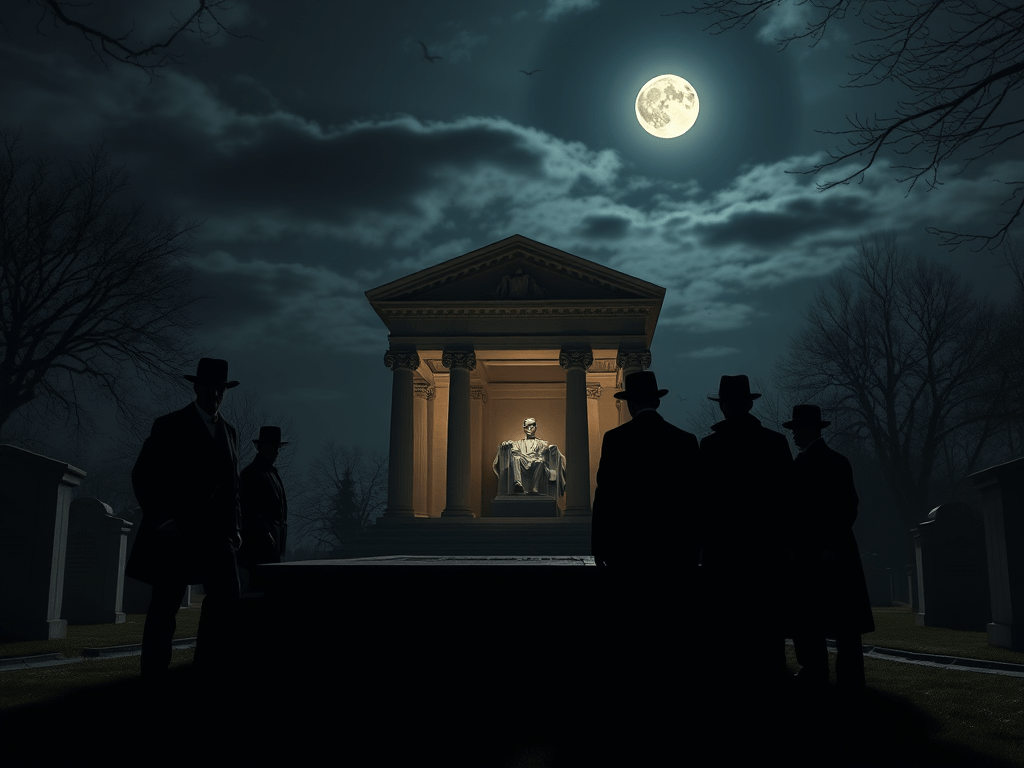
This is a fascinating tale of intrigue, political tension, and high-stakes crime intertwined with the very fabric of American history! The election of 1876, while a source of national controversy in its own right, serves as the backdrop for an audacious and bizarre plot to steal the body of Abraham Lincoln. It’s a story that blends the turbulent politics of the time with a criminal conspiracy, showing how Lincoln’s legacy was so potent that even in death, his remains were seen as a symbol worth exploiting.
The Election of 1876 and the Context of the Plot
Rutherford B. Hayes and Samuel J. Tilden’s contentious election was marked by bitter disputes over voter fraud and contested results in several Southern states. The outcome of the election itself wasn’t settled until a special Electoral Commission was formed to resolve the dispute, leading to Hayes’s eventual victory after the Compromise of 1877. However, the election—and the chaos surrounding it—provided a perfect cover for a much more unusual criminal endeavor: the plot to steal Lincoln’s body.
The timing was crucial. As the nation was focused on a pivotal election, the perpetrators thought that security around Lincoln’s tomb in Oak Ridge Cemetery in Springfield, Illinois, would be lax. Little did they know, their plan would be thwarted by a covert operation involving the newly-formed Secret Service and the Pinkerton Detective Agency, which was far outside the usual scope of their work. In fact, the Secret Service at this time was more concerned with protecting U.S. currency from counterfeiters than guarding political figures. However, as the investigation into Boyd’s counterfeiting operation progressed, the agents became involved in this peculiar crime.
The Conspirators and the Scheme
The scheme itself, led by Irish crime boss Jim Kinealy and his accomplices, was brazen. They intended to steal Lincoln’s body from its tomb in a daring midnight heist, and then ransom it in exchange for the release of Benjamin Boyd, a notorious counterfeiter, and a hefty sum of $200,000. Boyd’s capture and subsequent sentence to the Joliet Penitentiary had hit the counterfeiting ring hard, and this elaborate plot was their attempt at a dramatic solution. They saw Lincoln’s remains as a high-profile, symbolic ransom that could buy their freedom.
But Kinealy’s team didn’t realize they had an informant in their midst: Lewis Swegles, who had been subtly working for the Secret Service. His role was pivotal. By warning the authorities, he ensured that the authorities had a plan in place to catch the criminals in the act.
The Heist: A Disaster in the Making
The night of November 7, 1876, saw the conspirators make their move. Under the cover of the election, when many were distracted by the political spectacle, they broke into the tomb at Oak Ridge Cemetery with relative ease. The tomb’s security was minimal, with only a simple chain lock to keep anyone out. However, the conspirators’ success was short-lived.
After prying open the sarcophagus containing Lincoln’s casket, the body proved difficult to extract. This turned out to be a fateful obstacle. Had they been able to remove Lincoln’s body from the tomb, they might have succeeded, but in the chaos that followed, their plan unraveled.
Swegles, who had been watching the proceedings from outside the tomb, gave the signal to the waiting Pinkertons by whispering the word “wash.” This could have been a signal for a number of reasons—perhaps indicating that something was amiss, or perhaps it was an instinctual warning to abort the mission. Whatever the case, Kinealy and his crew, sensing that something was wrong, decided to pull out.
The Confusion and Escape
What followed was a chaotic scene. In the confusion, a Pinkerton agent accidentally discharged his weapon, causing a series of shots to be fired. In the mayhem, the Pinkertons began firing at one another, adding to the chaos, while the conspirators, realizing the operation had gone awry, managed to flee the scene. When the dust settled, Lincoln’s body remained in the tomb, though it was half-extracted from the sarcophagus.
It was a botched operation in every sense, but despite their escape, Kinealy, Mullen, Hughes, and Swegles were eventually arrested at the same pub where they had originally planned the heist. This criminal misadventure ultimately raised serious questions about the security surrounding Lincoln’s tomb, and led to a larger investigation into how to protect such a valuable and culturally significant relic.
Aftermath: The New Tomb and Lingering Questions
The failed attempt at robbing Lincoln’s grave led to the construction of a new, more secure tomb in 1901. By then, the tomb had been in a state of disrepair for some time, and it was clear that something more substantial was needed to protect Lincoln’s remains. The new tomb, built to be much more secure and stable, was completed in time for the reburial of Lincoln and his family.
However, there remained a lingering mystery surrounding Lincoln’s final resting place. As the years went by, rumors circulated about whether or not the real Lincoln was still buried there. Some suggested that Lincoln’s remains had been moved, hidden, or even stolen again. While these rumors were never substantiated, the fact that millions of people visit the tomb every year suggests that the public’s interest in Lincoln’s legacy—and perhaps a little of that historical mystery—remains alive and well.
The story of the failed heist, the involvement of the Secret Service and Pinkertons, and the creation of a more secure tomb stands as a testament to the lasting power of Lincoln’s memory and the intrigue surrounding his legacy—even in death. And while his body may very well be resting peacefully in the tomb today, the legend of that attempted grave robbery will forever remain a strange, but unforgettable chapter in American history.

Sources:
A plot to steal the remains of President Lincoln (U.S. National Park Service). (n.d.). https://www.nps.gov/articles/000/a-plot-to-steal-the-remains-of-president-lincoln.htm




 History in 5 Minutes or less
Leave a comment