The Newburgh Conspiracy: Washington’s Moment of Leadership
It was mid-March 1783, and the officers of the Continental Army had gathered in Newburgh, New York, for an emergency meeting. The mood was tense, as the men faced a growing frustration: the lack of support from the Continental Congress. Pay was in arrears, provisions were scarce, and morale was dangerously low. To many of the officers, this felt like a betrayal—especially after the sacrifices made to secure victory in the Revolutionary War, which was now all but certain.
Unknown to most, George Washington was aware of an anonymous letter that had circulated among the officers, calling for action. The letter, more of a veiled threat than a formal petition, accused Congress of “trampling on the soldiers’ rights” and suggested that if peace was declared, the army might refuse to lay down their arms and march on Philadelphia. The letter also hinted that if the war continued, the army could simply refuse to fight and go home, leaving the colonies to face the British alone.
Washington’s Dilemma
Washington knew the officers’ frustrations were genuine. He, too, had experienced the hardships of the war—losses, long separations from his family, and the relentless pressure of leading an army with insufficient resources. But he also understood that the survival of the new nation depended on the unity and discipline of the army, and he feared the consequences if the officers turned against their government.
Washington had already issued a general order forbidding unsanctioned meetings, hoping to cool the officers’ tempers. But a formal meeting was called by Washington a few days later, and while he made it clear he would not attend, he wanted to discuss the matter openly. Washington was deeply concerned, knowing that the army’s loyalty and cohesion could determine the future of the revolution.
The Meeting in Newburgh
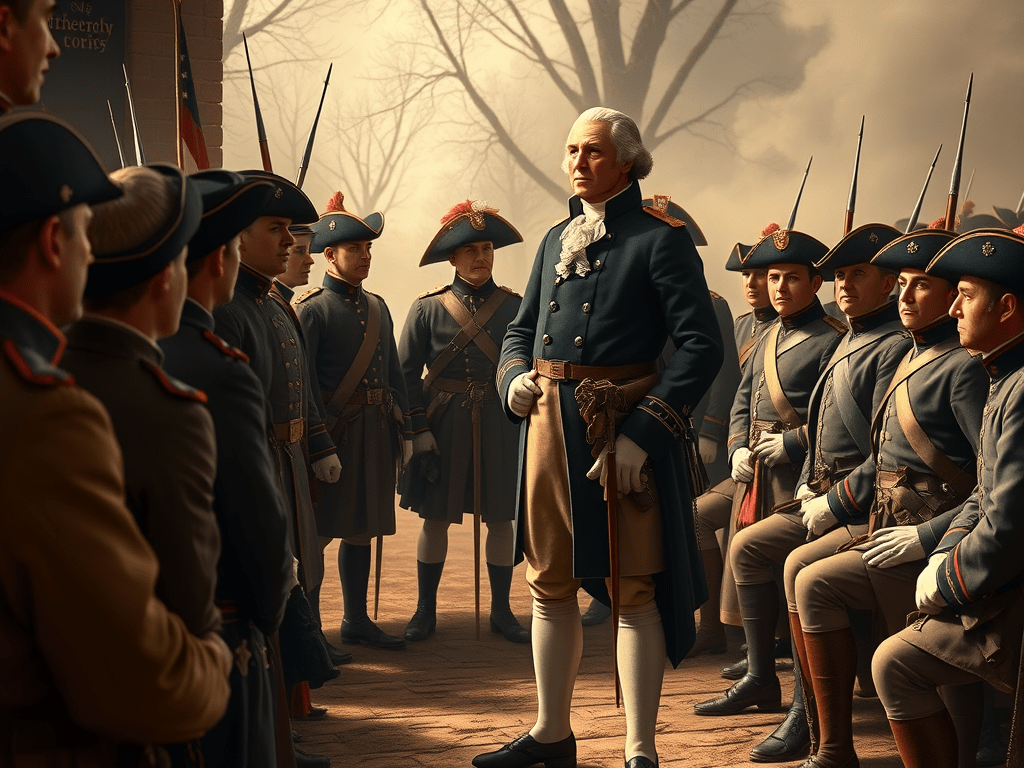
On the day of the meeting, the officers gathered, anxious and uncertain. Midway through the proceedings, to their surprise, Washington appeared—dressed in his full military uniform. His entrance was met with stunned silence, and the officers stood in reverence of the man who had led them through years of war.
Washington’s presence alone was enough to command respect, but it was what happened next that would forever mark this moment in history. With the officers seated before him, Washington began by denouncing the contents of the letter, urging the soldiers to trust in the intentions of Congress and to remain loyal to the cause of independence. His voice was firm, but there was a deep empathy in his words—he understood their frustrations, their sacrifices, and their suffering.
But it was toward the end of his speech that Washington revealed the full measure of his leadership. He reached into his coat pocket and pulled out a letter—a letter from a Congressman named Joseph Jones of Virginia, expressing support for Washington and the army. As he began to read, the general’s voice faltered. Washington, aged and weary from years of war, struggled to decipher the small print.
With a deep sigh, he slowly removed a pair of spectacles from his pocket and said, “Gentlemen, you must pardon me, for I have not only grown gray but almost blind in service to my country.”
A Moment of Vulnerability
The room fell silent as the officers watched their commander, a man they had followed through countless battles, struggle with his own vulnerability. Washington’s act of humility—admitting his physical frailty—had a profound effect on those present. Many of the officers, hardened by years of war, were moved to tears. Here was their leader, a man who had given everything for the cause of liberty, admitting his own sacrifice.
Washington’s words and his display of vulnerability struck a chord with the officers. It was a moment of pure, unspoken connection between a leader and his men. They saw not only a commander, but a man who shared their struggles and hardships. Washington’s empathy—his willingness to show his weakness—was what they needed to see at that moment, and it rekindled their resolve.
The Aftermath
When the meeting concluded, the officers resolved to set aside their grievances. They would continue to fight under Washington’s leadership, trusting that the sacrifices of the past would eventually lead to the freedom and independence they had all longed for.
In the years that followed, this moment would be remembered as one of Washington’s greatest acts of leadership. It was not a grand military victory or a strategic maneuver that saved the revolution, but a simple act of vulnerability and empathy. By opening his heart to his soldiers, Washington reminded them of the shared cause that bound them together—a cause worth fighting for, no matter the personal cost.
Legacy of Leadership
The Newburgh Conspiracy, as it came to be known, is often cited as one of the greatest tests of Washington’s leadership. His ability to lead not just with authority, but with compassion, ensured the survival of the Continental Army and the success of the American Revolution. At that critical moment, when the officers were ready to turn against their government, Washington’s humility and unwavering commitment to the cause inspired them to stay the course.
This display of empathy and vulnerability was perhaps Washington’s most profound contribution to the young nation—one that ultimately preserved the ideals of liberty and independence. In that room in Newburgh, George Washington proved that true leadership comes not from power, but from understanding and guiding others through their darkest hours.

A Spotlight on a Primary Source by George Washington. (n.d.). George Washington and the Newburgh Conspiracy, 1783. George Washington and the Newburgh Conspiracy, 1783 | Gilder Lehrman Institute of American History. https://www.gilderlehrman.org/history-resources/spotlight-primary-source/george-washington-and-newburgh-conspiracy-1783
A&E Television Networks. (n.d.). George Washington puts an end to the newburgh conspiracy. History.com. https://www.history.com/this-day-in-history/washington-puts-an-end-to-the-newburgh-conspiracy


 History in 5 Minutes or less
Leave a comment