
It is late 1943, the big three of Roosevelt, Churchill, and Stalin are set to meet for the first time in Tehran, Iran. The objective is to discuss the next stages of the war against Germany and Japan. In Early 1943, the Russians had secured a major victory halting the German advance deep inside Russia. As early as 1942, Roosevelt had assured Stalin the British and Americans would open a second front in Europe from the West. What comes out of this meeting are the preliminary plans for Operation Overlord* or D-Day as it will later be known. Even though there are disagreements among the allies, they all agree, without this second front the best they could hope for was a stalemate in Europe.
Where to launch the Invasion for Operation Overlord?
The landing site chosen for the operation was the beaches of Normandy located in northwest France. The size and scope of such an invasion would be the largest the world had ever seen. It was estimated 160,000 soldiers were needed for the success of the operation. Hitler knows an invasion is coming, but German intelligence is spotty and not exactly clear of the location. The Germans believe the invasion will either come from the beaches of Normandy or Pas de Calais which is roughly 200 miles to the north. Calais is the logical choice as it is the closest to England of any possible landing site. With two potential landing sites, the allies see an opportunity to deceive the Germans by presenting the possibility that an invasion would come from Calais.
The Allied Deception Plan, Operation Fortitude:
To deceive the Germans and divert attention from Normandy, the Allies launched an elaborate deception plan called Operation Fortitude. This operation was designed to convince the German high command that the invasion would indeed take place at Pas de Calais.
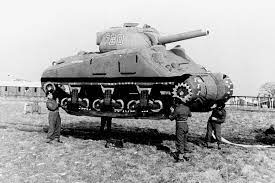
The core of the deception was the creation of a fictitious army, known as the First United States Army Group (FUSAG). This “army” was a ghost force, with no real soldiers but instead made up of inflatable tanks, dummy aircraft, fake landing craft, and even simulated radio transmissions to suggest the presence of a massive military force. To make the operation more convincing, the Allies put General George S. Patton in charge of FUSAG. Patton, widely known for his aggressive leadership and previous success in North Africa, was a popular and influential figure. His appointment lent credibility to the ruse, especially since the Germans believed he had been sidelined by the Allies due to his controversial actions specifically the slapping incident in 1943, where he had struck a soldier suffering from combat fatigue, an act that had caused a public scandal.
Patton’s involvement played a critical role in convincing the Germans that the Allies would invade Calais. Hitler, knowing Patton’s reputation, believed the Allies would not have sidelined one of their best generals for simply slapping a soldier. This miscalculation worked to the Allies’ advantage.
The Deception in Action:
In addition to the fake army, the Allies utilized several tactics to reinforce the illusion that Calais was the invasion target. They intercepted and created fake radio transmissions, movements of military supplies to make the Germans believe a large-scale build-up was occurring at Calais. The Germans, relying on reconnaissance planes, were tricked by the impressive appearance of FUSAG’s fake tanks, planes, and infrastructure. Their intelligence confirmed the Allies’ deception, and in response, the Germans withheld critical reinforcements from Normandy, focusing instead on Calais.
Impact on the Normandy Invasion:
As a result of the deception, German forces were thinned out at Normandy, which made it easier for the Allies to establish a foothold. While historians continue to debate the precise extent to which Fortitude directly contributed to the success of the invasion, it is clear the deception played a critical role in diverting German attention and resources away from Normandy at a crucial moment.
The Collaboration:
One of the most significant outcomes of Operation Overlord and Fortitude was the unprecedented level of collaboration between the Allies. The successful execution of the operation was a testament to the coordination between the United States, the United Kingdom, and France, as well as the Soviets on the broader strategic goals of the war. The ability to work together despite political and military differences was one of the keys to the eventual defeat of Nazi Germany and its Axis partners.
Conclusion:
The Tehran Conference set the stage for D-Day and the Allied invasion of Normandy, which ultimately led to the liberation of Western Europe. The use of Operation Fortitude demonstrated not only the Allies’ military ingenuity but also the trust and cooperation between the nations involved. The deception of the Germans and the involvement of Patton, despite his earlier controversies, were key elements of the successful Allied strategy to outmaneuver Hitler’s forces in the critical months leading up to the invasion.
*Allied Invasion of Europe
Operation fortitude south. Liberation Route Europe. (n.d.). https://www.liberationroute.com/stories/187/operation-fortitude-south
Operation fortitude: The D-day deception campaign that fooled the Nazis. Sky HISTORY TV channel. (n.d.). https://www.history.co.uk/article/operation-fortitude-the-d-day-deception-campaign-that-fooled-the-nazis



 History in 5 Minutes or less
Leave a comment