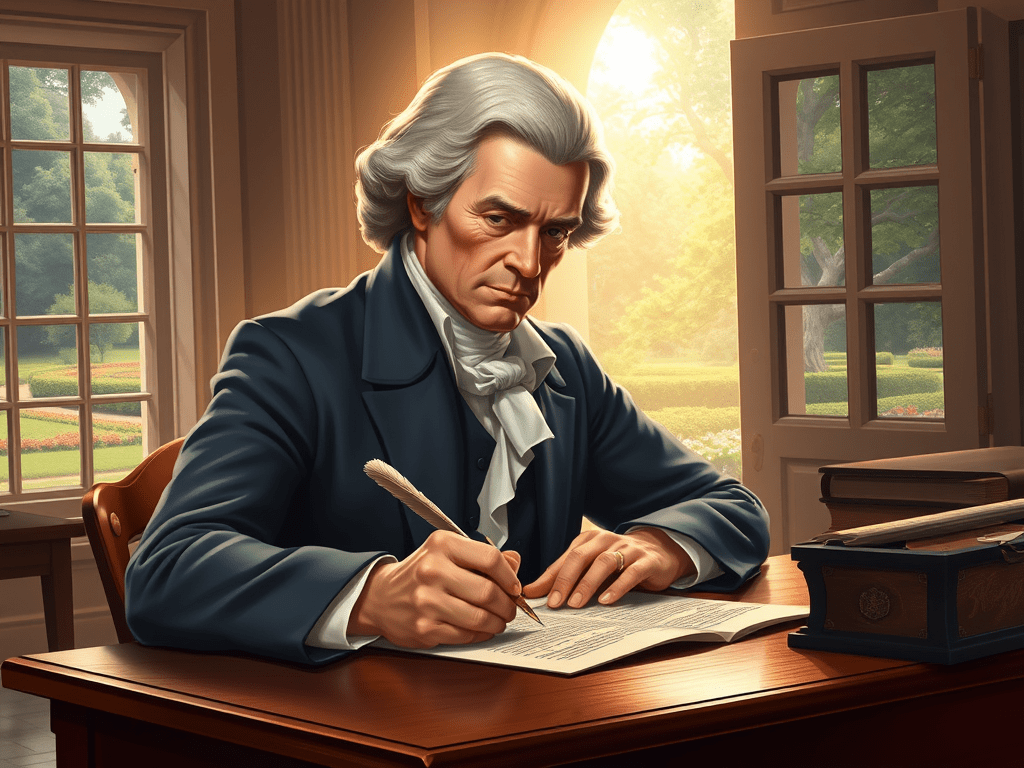
It is July 4, 1826, as the country celebrates its 50th anniversary, A founding father, John Adams, lies in bed at his home in Quincy, Massachusetts. The former President’s health is failing; his doctors give him hours, if not minutes, to live. Surrounded by his family, he utters his final words: “Thomas Jefferson survives.”
The Revolutionary Duo Turned Rivals
Thomas Jefferson and John Adams began their journey together in the 1770’s as architects of the American Revolution. Jefferson, the eloquent Virginian with a pen that could sway nations, and Adams, the fiery Massachusetts lawyer who spoke with conviction, worked hand in hand to secure American independence. But their friendship took a sharp turn when politics entered the fray.
During Jefferson’s presidency, their political ideologies clashed dramatically. Adams, a staunch Federalist, believed in a strong central government. Jefferson, the Democratic-Republican, championed states’ rights and agrarian values. The bitter election of 1800, in which Jefferson ousted Adams, left their relationship in tatters. Letters stopped. Friendship gave way to cold silence.
The Silence of Years
For over a decade, the two titans of the Revolution avoided each other. Jefferson retreated to Monticello, his sprawling Virginia estate, where he indulged in farming, architecture, and philosophy. Adams returned to his modest farm in Quincy, Massachusetts, spending his days writing and lamenting the state of the young republic.
Mutual friends despaired at their estrangement. Abigail Adams, always a voice of reason, tried to bridge the gap. “Surely two such men can rise above politics,” she wrote. But neither Jefferson nor Adams seemed ready to extend an olive branch. Until that is, an unlikely mediator emerged.
Dr. Rush’s Grand Plan
Dr. Benjamin Rush, a mutual friend and fellow Revolutionary, was determined to mend the rift. In 1812, Rush penned a letter to Adams, suggesting that he reach out to Jefferson. “The nation needs your voices united once more,” he implored.
Adams, ever the impulsive one, took the bait. On New Year’s Day 1812, he wrote a short, warm letter to Jefferson. “Let us, my dear friend, bury the hatchet,” he said, extending a metaphorical handshake across the miles.
A Correspondence for the Ages
Jefferson’s reply was swift and gracious. Thus began one of the most remarkable exchanges in American history. For the next 14 years, the two former presidents wrote to each other about everything under the sun—philosophy, religion, agriculture, family, and the legacy of the Revolution.
Their letters were equal parts profound and humorous. Adams, ever the contrarian, challenged Jefferson’s ideas with sharp wit. Jefferson, the eternal optimist, countered with lofty ideals. Despite their differences, the letters were filled with mutual respect and nostalgia for their shared revolutionary past.
Reflections on Mortality
As they aged, their letters took on a more reflective tone. They mused about their mortality and the future of the United States. Jefferson’s health began to decline, and Adams’s body grew frail, but their minds remained sharp.
In a letter penned in 1825, Jefferson wrote, “We have lived long enough to see the fruits of our labors.” Adams replied, “And what fruits they are! May they endure the storms of time.”
A Final Coincidence
The friendship that had survived revolutions, political feuds, and decades of silence ended in a manner so poetic it seemed almost divine. On July 4, 1826, the 50th anniversary of American independence, both men passed away.
Adams’s last words reportedly were, “Thomas Jefferson survives.” Unbeknownst to him, Jefferson had died just hours earlier at Monticello. The nation mourned the loss of two founding fathers on the very day they had helped create.
Legacy of Their Bond
The Jefferson-Adams correspondence remains a testament to the power of reconciliation and the enduring strength of friendship. Despite their political differences, they found common ground in their shared commitment to the American experiment.
In their twilight years, Jefferson and Adams demonstrated that even the fiercest of rivals could find peace. Their story continues to inspire—a reminder that the bonds of humanity can triumph over division.
Sources:
John Adams & Thomas Jefferson. (n.d.). https://nationalhumanitiescenter.org/pds/livingrev/religion/text3/adamsjeffersoncor.pdf




 History in 5 Minutes or less
Leave a comment