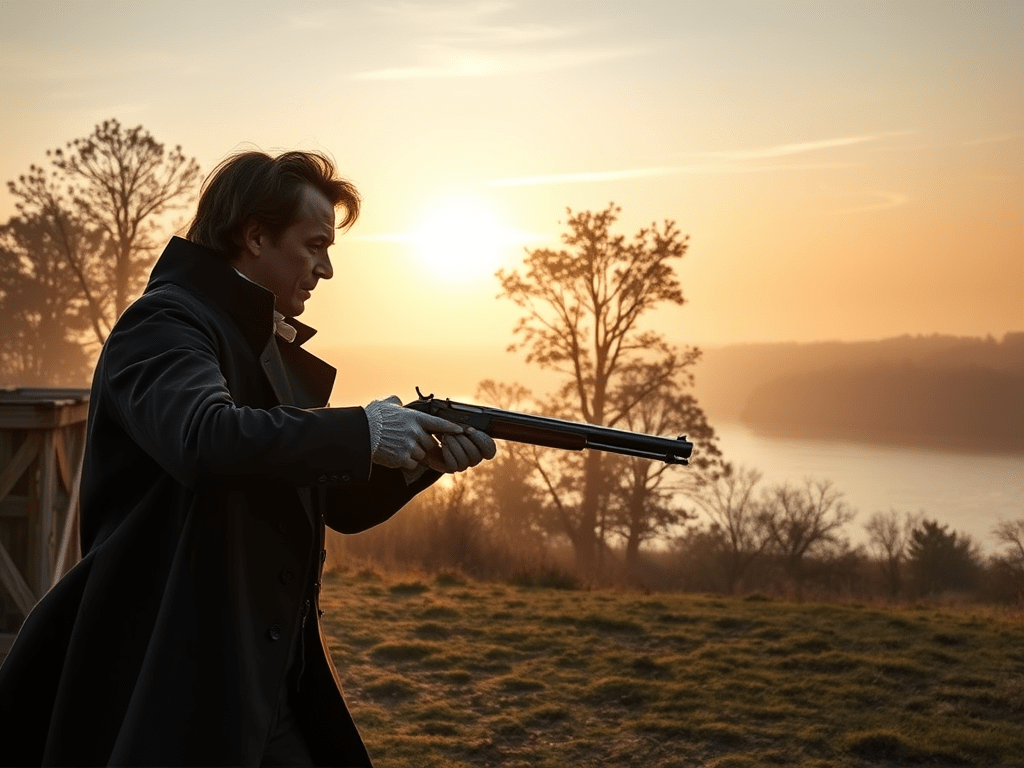
A Feud Years in the Making
By the summer of 1804, Aaron Burr and Alexander Hamilton had been political rivals for over a decade. Burr, the sitting Vice President of the United States, felt personally slighted by Hamilton’s relentless efforts to block his political ambitions. Hamilton, a former Secretary of the Treasury and one of the Founding Fathers, had made a career out of publicly and privately denouncing Burr, calling him everything from a “dangerous man” to “one who ought not to be trusted with the reins of government.”
But it was a particular insult—one allegedly spoken at a dinner party—that pushed Burr over the edge. A newspaper reported that Hamilton had called Burr “despicable.” Enraged, Burr demanded an apology. Hamilton, skilled in the art of insults but hesitant to retract them, refused. The only way to settle such an affair among gentlemen of the time? A duel.
The Secretive Journey to Weehawken
Dueling was technically illegal in both New York and New Jersey, but New Jersey was less strict about enforcing the law. So, in the early morning of July 11, 1804, Burr and Hamilton, accompanied by their seconds (their assistants in the duel), rowed across the Hudson River to the Weehawken dueling grounds. This was the same place where Hamilton’s son, Philip, had died in a duel three years earlier.
The pistols were chosen—large, heavy, flintlock weapons with hair-trigger modifications. The seconds set the terms: Each man would stand ten paces apart. At the signal, they would raise their weapons and fire at will.
The Shot That Echoed Through History
The accounts of what happened next remain murky, clouded by bias and personal loyalties. Some say Hamilton deliberately fired into the air, unwilling to take Burr’s life. Others claim he missed by accident. What is certain is that his shot struck nothing but leaves and morning mist.
Burr, however, took careful aim and fired. His bullet tore through Hamilton’s abdomen, lodging near his spine. The great statesman collapsed, mortally wounded. His second rushed to his side as Burr stood, seemingly unmoved, watching the scene unfold.
A Nation Mourns, A Man Disgraced
Hamilton was taken back to New York, where he lingered in agony for over 24 hours before succumbing to his wounds. His death sent shockwaves through the country. He was buried with great ceremony, honored as a patriot, a war hero, and the architect of America’s financial system.
Burr, on the other hand, became a political outcast. He was charged with murder in both New York and New Jersey (though neither case went to trial). His career never recovered, and he spent the rest of his days drifting through political schemes, including a bizarre plot to create his own empire in the West—an act that led to charges of treason.
Legacy of a Fatal Feud
The Burr-Hamilton duel remains one of the most infamous conflicts in American history. It was more than just a personal dispute, it was a clash of ideologies, egos, and ambitions that shaped the young nation. Hamilton’s legacy endured, his face later gracing the ten-dollar bill. Burr faded into obscurity, remembered more for the man he killed than for his own accomplishments.
And so, on that misty morning in Weehawken, a bullet didn’t just end a life—it altered the course of American history.


 History in 5 Minutes or less
Leave a comment