The Rise of Carnegie Steel
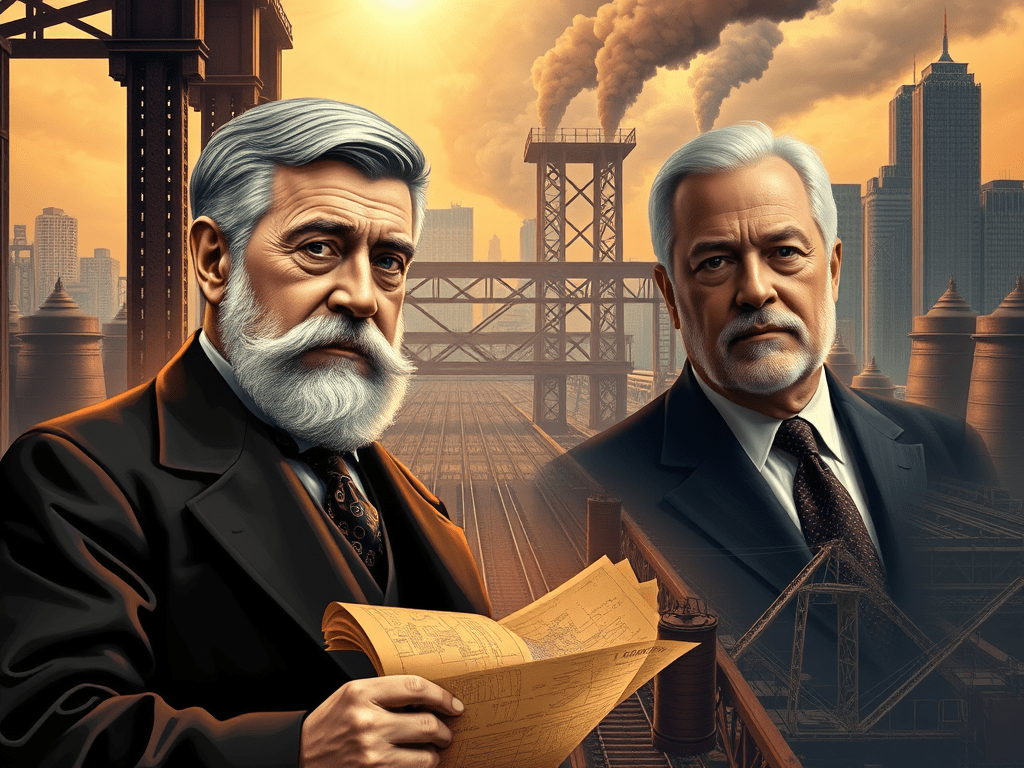
By the late 19th century, Andrew Carnegie was the undisputed king of steel. His Carnegie Steel Company, built on ruthless efficiency and technological innovation, had become the largest and most profitable steel producer in the world. As America’s industrial might grew, so did Carnegie’s empire, supplying the steel that built bridges, skyscrapers, and railroads.
Carnegie’s rise to dominance in the steel industry was no accident. Born in Scotland in 1835, he immigrated to the United States as a child, growing up in poverty before climbing the ranks in the railroad industry. It was there that he first recognized the importance of steel, understanding that it would become the backbone of modern infrastructure. He invested early in the Bessemer process, a revolutionary method of producing steel quickly and cheaply, which allowed him to outproduce and underprice his competitors.
Carnegie’s business philosophy centered around vertical integration—owning every aspect of production, from raw materials to transportation to manufacturing. He acquired iron ore mines, coal fields, and railroads, ensuring his company was not reliant on outside suppliers. This level of control gave Carnegie Steel a massive competitive advantage, allowing it to produce steel at lower costs while maintaining high quality.
As America entered a period of rapid industrialization, the demand for steel skyrocketed. Railroads expanded across the country, skyscrapers reshaped city skylines, and bridges connected regions like never before. Carnegie Steel was at the heart of it all, fueling the growth of an industrial superpower. By the late 1890s, Carnegie’s company was producing more steel than all of Great Britain, solidifying its dominance in the industry.
Despite his success, Carnegie had begun contemplating retirement, eager to step away from business and dedicate his life to philanthropy. However, the competitive nature of the steel industry and increasing friction with his business partners, particularly Henry Clay Frick, made the prospect of selling his empire even more appealing. This set the stage for what would become one of the most legendary business deals in history.
Enter J.P. Morgan
J. Pierpont Morgan, the most powerful financier of his time, had a different vision. He dreamed of consolidating the fragmented steel industry into one massive corporation that could dominate the market and stabilize prices. Morgan, who had already revolutionized the railroad industry through similar mergers, saw Carnegie’s company as the keystone of his plan.
Morgan was not just a banker; he was a master strategist and negotiator. He had already reshaped industries by using his financial prowess to create stability in the chaotic world of American business. His success in consolidating railroads had proven his ability to take struggling, competitive industries and turn them into efficient, profit-generating machines. But the steel industry was an even bigger challenge—it was dominated by cutthroat competition, fluctuating prices, and powerful independent operators like Carnegie.
For years, Morgan had been watching Carnegie’s empire, waiting for the right moment to strike. Carnegie, however, had shown little interest in selling—until a fateful evening in 1900, when he casually mentioned to his longtime partner, Charles Schwab, that he might consider an offer if the price was right.
Morgan knew that acquiring Carnegie Steel would not be easy. Carnegie was a formidable businessman, and his company was worth an unprecedented sum. But Morgan also knew that if he could persuade Carnegie to sell, he could reshape the steel industry forever. He needed to act decisively, and for that, he turned to the man who understood Carnegie better than anyone—Charles Schwab.
Morgan’s reputation as a financial titan gave him an edge. He was a man who could command vast amounts of capital with a single word, and his influence stretched across the business world. He had the resources, the connections, and the vision to make the deal happen. All he needed was for Carnegie to name his price.
The Legendary Dinner at the University Club

Schwab, a sharp and ambitious businessman, saw an opportunity. In December 1900, he attended an exclusive dinner at the University Club in New York, hosted by Morgan and attended by the country’s top industrialists. The atmosphere was thick with cigar smoke and animated conversation, as the most powerful men in American industry gathered to discuss the future of steel.
As the night progressed, Schwab took center stage. With a mix of charisma and hard data, he laid out a bold vision for a new steel trust that would bring together Carnegie Steel and other major producers under one entity—creating an industry behemoth that could control prices, improve efficiency, and eliminate wasteful competition. He spoke of the massive potential profits, the reduction of destructive price wars, and the ability to outpace any foreign competitor.
Morgan, seated at the head of the long dining table, listened intently, occasionally puffing on his cigar. He was a man who valued action over talk, and Schwab’s words resonated with him. The idea of a steel monopoly fit perfectly with his strategy of consolidation. Here was a chance to create something unprecedented—an American steel giant that could dominate the world market.
By the time Schwab finished speaking, the room was silent. The industrialists in attendance grasped the magnitude of what had just been proposed. Morgan, without hesitation, turned to Schwab and simply said, “We should talk.” The deal was now in motion.
The Billion-Dollar Offer
The next morning, Charles Schwab wasted no time. He traveled to Andrew Carnegie’s office, eager to deliver J.P. Morgan’s message. The two men sat across from each other, the weight of a potential deal looming between them. Schwab, always the smooth negotiator, relayed Morgan’s interest in acquiring Carnegie Steel, the crown jewel of the American steel industry.
Carnegie, ever the shrewd businessman, listened intently. He had built his empire from the ground up, turning Carnegie Steel into the dominant force in the industry. Now, after decades of relentless work, he knew the time had come to make a decision. If he were to sell, it would be on his terms.
With a quiet determination, Carnegie reached for a blank sheet of paper. Without discussion, without hesitation, he wrote down a single number: $480 million. It was a staggering sum—an amount so enormous that it would make this the largest business transaction in history at the time. Schwab, barely concealing his excitement, took the note and left for Morgan’s office.
When Schwab presented the figure to Morgan, the financier barely blinked. He studied the number for a moment, then, in his characteristically calm and confident manner, uttered just two words: “I accept.” There was no haggling, no counteroffer, no hesitation. With that simple affirmation, J.P. Morgan had just purchased Carnegie Steel, setting in motion the creation of United States Steel, the world’s first billion-dollar corporation.
The deal marked the dawn of a new era in American business. Carnegie, now one of the wealthiest men in the world, had successfully exited the steel industry, while Morgan had just cemented his dominance in finance and industry. The transaction didn’t just reshape the corporate landscape—it signaled the arrival of modern capitalism on an unprecedented scale.
The Birth of U.S. Steel

With the acquisition of Carnegie Steel secured, J.P. Morgan wasted no time in executing his grand vision. He was not merely buying a company—he was consolidating an entire industry. He understood that the future of American business lay in large-scale corporate integration, and steel was the backbone of the nation’s industrial might.
In early 1901, Morgan moved swiftly to merge Carnegie’s empire with several other major steel companies, including Federal Steel and National Steel. The result was a behemoth unlike anything the business world had ever seen: United States Steel Corporation. With a staggering market capitalization of $1.4 billion, U.S. Steel became the largest corporation in history at the time, an industrial titan that controlled nearly 70% of America’s steel production. The company’s sheer size and dominance reshaped the very foundation of American industry, setting new standards for corporate structure, labor relations, and industrial efficiency.
For Andrew Carnegie, the deal marked the culmination of his life’s work. After decades of relentless ambition and competition, he had built the most powerful steel empire in the world—only to sell it in a single transaction. He walked away with $225 million in gold bonds, an unfathomable fortune that effectively made him the richest man on Earth. But Carnegie had long insisted that amassing wealth was only a means to an end. Unlike Morgan, whose ambitions were tied to financial control, Carnegie saw his fortune as a tool for shaping the world.
True to his word, he retired from business entirely and turned his focus to philanthropy. Believing that wealth should be used to benefit society, he devoted the rest of his life to giving away his fortune. His money funded the construction of over 2,500 public libraries, supported major universities like Carnegie Mellon, and fueled advancements in scientific research, world peace, and the arts. He became one of history’s most influential philanthropists, leaving a legacy that extended far beyond steel.
Meanwhile, U.S. Steel stood as a monument to the new era of industrial capitalism. Under Morgan’s leadership, it became a symbol of corporate America’s power, demonstrating the ability of financial titans to reshape entire industries. Though Carnegie and Morgan had taken vastly different paths—one choosing philanthropy, the other expanding his financial empire—their actions in 1901 had irrevocably changed the course of business, industry, and society.
The Aftermath and Legacy
The deal between Andrew Carnegie and J.P. Morgan did more than just create the world’s first billion-dollar corporation—it reshaped American industry forever. U.S. Steel quickly established itself as the dominant force in the steel market, controlling nearly 70% of production and setting new benchmarks for industrial efficiency. The sheer scale of the corporation was unprecedented, demonstrating the power of consolidation and setting the stage for a future where massive corporate mergers would become the norm.
However, the rise of U.S. Steel was not without controversy. Many critics viewed Morgan’s tactics as a dangerous step toward monopoly, accusing him of stifling competition and consolidating wealth into the hands of a select few. The deal intensified ongoing debates about trusts and monopolies, fueling concerns about the unchecked power of industrialists. In the coming years, these concerns would lead to increased government scrutiny, including the antitrust movement that sought to curb corporate dominance. Yet, to Morgan’s supporters, he was not a monopolist but a visionary, a man who had brought structure and stability to chaotic industries, ensuring efficiency and economic growth.
For Andrew Carnegie, the deal represented the perfect exit—a triumph of both business acumen and personal philosophy. He had spent his career outmaneuvering competitors, revolutionizing steel production, and amassing an unparalleled fortune. Now, with $225 million in gold bonds, he had achieved something few industrialists ever did: he walked away on his own terms. More importantly, he remained true to his long-held belief that the wealthy had a duty to give back. In the years that followed, he dedicated his fortune to philanthropy, funding thousands of libraries, universities, and scientific institutions, forever shaping education and public knowledge.
For J.P. Morgan, the acquisition of Carnegie Steel was yet another masterstroke in a legendary career. It further cemented his reputation as the undisputed king of American finance, a man whose influence stretched across banking, railroads, and now, the steel industry. He had not just purchased a company—he had engineered the future of American industry. U.S. Steel became a symbol of the new corporate age, an era in which finance and big business wielded power previously reserved for governments and monarchs.
And for America, the deal marked the beginning of a new economic reality—one where corporations, not individuals, would dominate the landscape. It was a moment that signaled the rise of modern capitalism, a system in which vast fortunes could be created, industries could be shaped overnight, and power could be consolidated through nothing more than a handshake and a figure written on a sheet of paper.
The legacy of the deal still echoes through history. It set the precedent for corporate mergers, influenced antitrust laws, and demonstrated the raw power of finance in shaping the industrial world. It was a moment that defined the Gilded Age, a time of extreme wealth, unprecedented economic expansion, and the ever-present tension between capitalism’s promise and its perils.





 History in 5 Minutes or less
Leave a comment