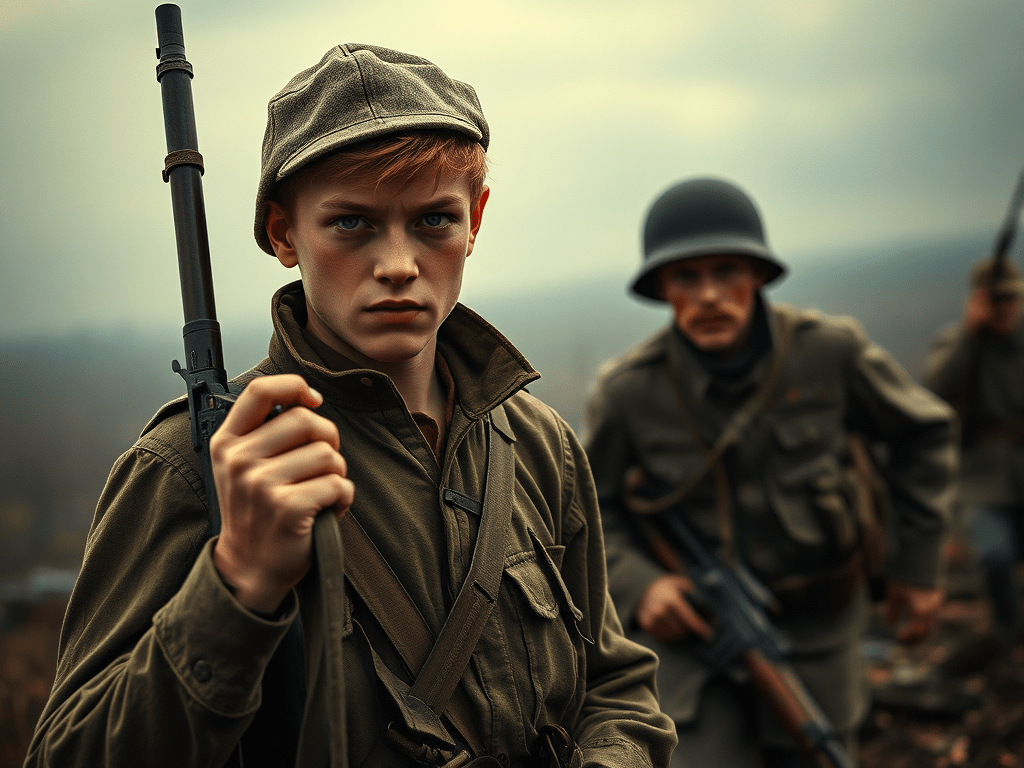
A Battlefield Encounter in 1918
In the autumn of 1918, World War I was nearing its end. The German army was retreating across the Western Front, battered by the relentless advance of the British and French forces. Among the chaos of war, a young British soldier named Henry Tandey found himself in the thick of battle near the French village of Marcoing.
Tandey was no ordinary soldier. A member of the Duke of Wellington’s Regiment, he had fought bravely throughout the war and would later become one of Britain’s most decorated soldiers. But on that fateful day, he unknowingly made a decision that would echo through history.
The Moment of Mercy
During the battle, the British forces successfully pushed the Germans back. As the gunfire subsided, a wounded German soldier, limping and unarmed, stumbled into Tandey’s line of sight. The man was young, with a thin mustache and piercing eyes. He looked defeated, exhausted, and barely able to stand.
Tandey raised his rifle, finger resting on the trigger. He had every reason to shoot—the man was the enemy, after all. But something made him hesitate. Perhaps it was the sheer exhaustion of war, or maybe it was the sight of the wounded man’s hopelessness. In a moment of compassion, Tandey lowered his rifle. The German soldier nodded in gratitude and limped away, disappearing into the battlefield haze.
That soldier was Adolf Hitler.
Who Was Henry Tandey?
Henry Tandey was born on August 30, 1891, in Leamington Spa, Warwickshire, England. Growing up in a working-class family, he had a humble upbringing and spent his early years as a laborer. But as tensions in Europe escalated, he joined the British Army in 1910, enlisting in the Green Howards Regiment before transferring to the Duke of Wellington’s Regiment.
When World War I broke out in 1914, Tandey was among the thousands of British soldiers sent to the frontlines. Over the course of the war, he fought in some of its most grueling battles, including Ypres, the Somme, and Passchendaele—conflicts that would define a generation and leave millions dead.
Hitler’s Own Recollection: The Meeting with Chamberlain
In September 1938, Adolf Hitler met British Prime Minister Neville Chamberlain in Munich to negotiate what would become the Munich Agreement. The agreement was meant to appease Hitler by allowing Nazi Germany to annex the Sudetenland from Czechoslovakia in the hope of preventing a larger European conflict.
During their meeting, Hitler pointed out a painting hanging in his office—a detailed battlefield scene from World War I by the Italian artist Fortunino Matania. The painting, titled The Menin Crossroads, depicted a group of British soldiers from the Duke of Wellington’s Regiment assisting their wounded comrades.
Hitler then told Chamberlain a surprising story. He claimed that he recognized one of the soldiers in the painting as Henry Tandey, the same man who had spared his life on the battlefield in 1918. According to Hitler, he had been wounded and retreating near Marcoing when he encountered Tandey, who had him in his sights but chose not to shoot.
“He nearly killed me,” Hitler allegedly said, “but took pity on me. I will never forget that soldier.”
The Photograph and the Myth
The story of this battlefield encounter wasn’t widely known until after Chamberlain returned to Britain and recounted Hitler’s words. According to some accounts, Chamberlain mentioned the incident to a journalist, and the tale soon spread.
Adding to the intrigue, Hitler had allegedly acquired a photograph of Henry Tandey in uniform. Some versions of the story claim that the Nazi leader kept this photo in his possession and would show it to guests, recounting how this British soldier had unknowingly spared the future Führer of Germany.
While this claim has never been fully verified, it fueled speculation that Hitler truly believed he had encountered Tandey during the war.
Fact or Fiction?
Despite Hitler’s own words, historians remain skeptical about the story for several reasons:
Inconsistent Records – While Tandey’s regiment was indeed engaged near Marcoing in September 1918, there are no definitive records placing Hitler at the same location at that exact time.
Hitler’s Habit of Embellishment – Hitler was known for mythologizing his past, often crafting dramatic narratives to reinforce his image. Some historians believe that he may have fabricated or exaggerated the encounter to add a sense of fate to his rise to power.
The Painting’s Accuracy – The painting The Menin Crossroads was not based on the Marcoing battle but rather on an earlier engagement. It’s possible Hitler recognized the uniform and connected the painting with the story rather than having an actual memory of Tandey.
Could One Bullet Have Changed History?
It’s easy to wonder how history might have unfolded had Tandey pulled the trigger. Without Hitler, there would have been no Nazi regime, no World War II, no Holocaust. Millions of lives could have been spared.
However, history is rarely so simple. The circumstances that led to Hitler’s rise were deeply rooted in Germany’s post-war economic collapse, resentment over the Treaty of Versailles, and the appeal of extreme nationalism. If Hitler had died in 1918, would another figure have emerged in his place?
Henry Tandey’s Recollection: A Memory of Mercy
Henry Tandey never sought fame for his actions in World War I. He was a soldier, not a storyteller, and he spoke little about his experiences. However, after the story of his alleged encounter with Adolf Hitler surfaced in 1938, people naturally wanted to hear Tandey’s side.
Tandey acknowledged that he had spared the lives of wounded or surrendering German soldiers during the war—something not uncommon among soldiers who had seen enough bloodshed. He recalled an incident in September 1918 during the Battle of Marcoing, where his regiment had successfully pushed back German forces. Amid the retreat, he saw a wounded German soldier stumbling away from the battlefield. The man was unarmed and looked helpless.
“I took aim but couldn’t shoot a wounded man,” Tandey reportedly said later in life. “So I let him go.”
At the time, this moment was just one of many during the war. Like countless other soldiers, Tandey had faced moral dilemmas on the battlefield. Killing an enemy in combat was one thing, but shooting a wounded man who posed no immediate threat was another.
The Moment He Learned of Hitler’s Claim
The alleged connection between Tandey and Hitler didn’t come to light until 1938 when British Prime Minister Neville Chamberlain returned from his meeting with Hitler in Munich. According to some accounts, Chamberlain, or someone close to him, informed Tandey that Hitler himself had claimed to be the man he had spared on the battlefield 20 years earlier.
Tandey was reportedly stunned. He had no way of confirming whether the wounded soldier he spared that day was truly Hitler, but the idea horrified him.
“If only I had known what he would become,” he supposedly remarked, “I would have shot him.”
While Tandey never definitively confirmed the encounter, he didn’t outright deny it either. He simply admitted that he had shown mercy to wounded German soldiers on multiple occasions and that it was possible Hitler had been among them.
Tandey’s Later Reflections
In the years that followed, Tandey lived a quiet life, working in a factory and trying to leave his wartime experiences behind. But the story haunted him. As Hitler launched World War II, Tandey became deeply troubled by the idea that his mercy might have cost millions of lives. Some accounts suggest that he suffered guilt, though others say he dismissed the story as mere speculation.
As historians later debated the accuracy of the claim, Tandey himself refrained from making any strong declarations. In interviews, he maintained his stance: he had spared men in battle, but whether one of them was Hitler, he could never know for sure.
When Henry Tandey passed away in 1977 at the age of 86, he remained Britain’s most decorated private soldier of World War I. Despite his many acts of valor, history remembers him most for the shot he didn’t take—a shot that might have altered the course of the 20th century.
 History in 5 Minutes or less
Leave a comment