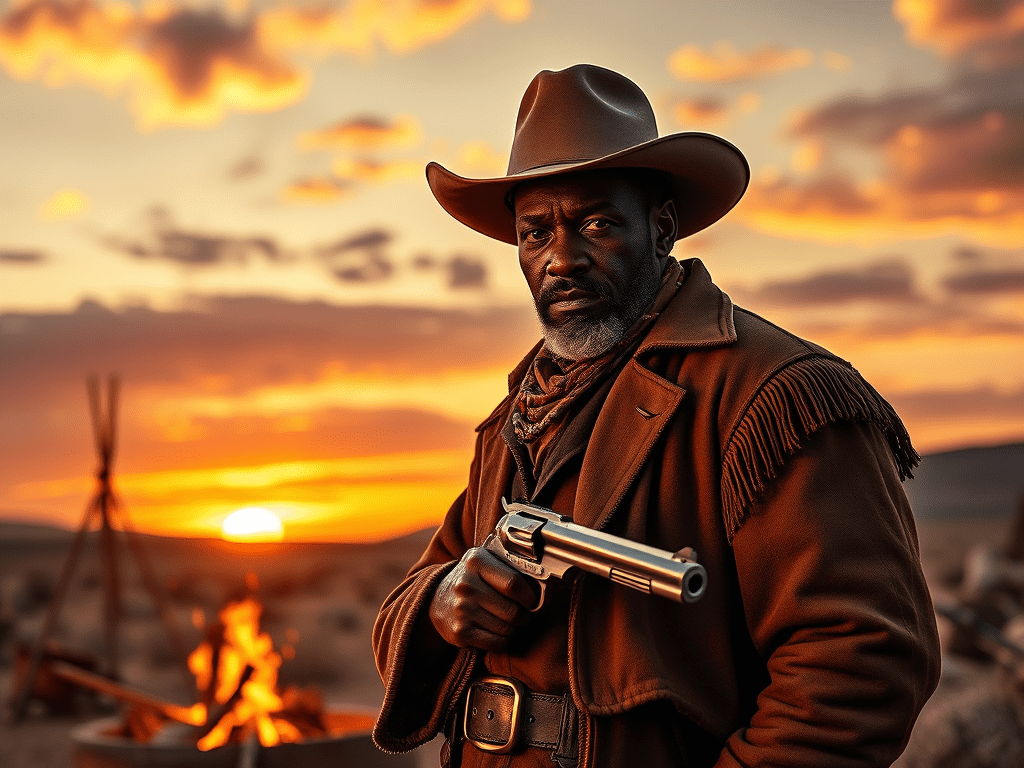
From Enslaved to Free Man
Born into slavery in 1838 in Crawford County, Arkansas, Bass Reeves’ early life was dictated by the harsh realities of bondage. He was owned by Colonel George Reeves, a politician and landowner, who took Bass with him to Texas. However, fate had other plans. During the Civil War, when Colonel Reeves joined the Confederate Army, Bass managed to escape into Indian Territory (present-day Oklahoma).
Among the Seminole, Creek, and Cherokee tribes, he found refuge and a new way of life. He lived among the Native Americans for years, learning their customs, languages, and survival techniques. His time with the tribes not only saved his life but also transformed him into an expert tracker, hunter, and scout. The Creeks, in particular, took him in, teaching him how to navigate the vast and often dangerous wilderness, how to track people and animals with precision, and how to fight using both firearms and hand-to-hand combat.
Through these experiences, Reeves became fluent in multiple Native American languages, which would later become one of his greatest assets as a lawman. He also learned the value of honor and justice from the tribal leaders, who upheld their own systems of law and governance. These lessons stayed with him long after he left Indian Territory, shaping the way he approached his career as a U.S. Marshal.
Becoming a U.S. Marshal
After the Civil War ended and slavery was abolished, Reeves settled in Arkansas as a farmer and family man. He built a respectable life, but his reputation as an expert marksman and tracker spread far and wide. He was known not only for his sharpshooting skills but also for his ability to handle horses and navigate the rugged terrain of Indian Territory.
His big break came in 1875 when Judge Isaac Parker, known as the “Hanging Judge” of Fort Smith, Arkansas, launched an aggressive campaign to bring law and order to the lawless frontier. With over 75,000 square miles of untamed land and rampant criminal activity, Parker needed skilled lawmen who could enforce justice where others had failed. He appointed James Fagan as a U.S. Marshal and tasked him with recruiting deputies.
Fagan, aware of Reeves’ unmatched tracking abilities and deep knowledge of Indian Territory, saw in him the perfect candidate for the job. Despite being illiterate, Reeves had an extraordinary memory and could recite warrants verbatim after hearing them once. He accepted the role and became one of the first Black deputy U.S. marshals west of the Mississippi.
A Fearless Enforcer of Justice
Reeves’ career as a lawman was marked by extraordinary courage and strategic cunning. He was known for his ability to outthink and outmaneuver criminals, often using disguises and deception to bring fugitives to justice. He would sometimes pose as an outlaw himself, earning the trust of criminals before revealing his true identity and making arrests. This method allowed him to capture many fugitives who would have otherwise remained elusive.
His skills with firearms were unmatched—he was ambidextrous, capable of shooting with deadly accuracy using both hands. In one encounter, he was ambushed by two outlaws who had the drop on him. With lightning-fast reflexes, he drew both his pistols and took them down before they could pull the trigger. His fearlessness in such situations made him a legend among both fellow lawmen and outlaws alike.
One of Reeves’ most legendary arrests involved bringing in Bob Dozier, a ruthless outlaw known for robbery, murder, and cattle rustling. Unlike most criminals who feared Reeves, Dozier underestimated him. That was a mistake. Dozier had managed to elude capture for years, but Reeves meticulously tracked him down. In a tense standoff, Dozier attempted to fight his way out, but Reeves outdrew and killed him, cementing his reputation as a relentless enforcer of the law.
Reeves also arrested some of the most dangerous criminals of the time, often traveling hundreds of miles on horseback through treacherous territory. He brought in horse thieves, murderers, and violent gangs, single-handedly capturing entire outlaw bands. Over his 32-year career, he arrested more than 3,000 criminals—an astonishing record for any lawman of the Wild West.
Upholding the Law, Even Against His Own Son
Reeves’ commitment to justice was unwavering, even when it tested the limits of his own heart. One of the most heart-wrenching moments of his career came when he was given the unthinkable task of arresting his own son, Bennie Reeves, for murder.
Bennie had been accused of killing his wife in a fit of rage. As a deputy marshal, Bass Reeves had sworn an oath to uphold the law above all else, and despite the personal pain it caused him, he did not hesitate. Instead of allowing another lawman to carry out the warrant, he took it upon himself to bring Bennie to justice.
With the same determination he applied to all his cases, Reeves tracked down his son and made the arrest. Bennie was tried, convicted, and sentenced to life in prison. Though it was a devastating personal loss, Reeves’ decision demonstrated his unshakable integrity and belief that no one—not even family—was above the law.
The Legacy of Bass Reeves
By the time he retired in 1907, Bass Reeves had arrested more outlaws than almost any other lawman of his era, surviving countless gunfights without ever being wounded. His career and legendary exploits served as an inspiration for future generations of Black law enforcement officers.
Many historians believe that Reeves’ life was the inspiration behind the Lone Ranger character. Like Reeves, the Lone Ranger was known for his expert tracking skills, his use of disguises, and his relentless pursuit of justice. The legend of the Lone Ranger often tells of a lawman who worked alongside Native Americans, much like Reeves did throughout his career. Although the connection is debated, Reeves’ impact on the mythology of the Wild West is undeniable.
Despite his incredible contributions to law enforcement, Bass Reeves was largely forgotten by mainstream history for many years. However, his legacy has recently been revived, with books, documentaries, and television series recognizing his vital role in taming the lawless frontier.
Bass Reeves passed away in 1910, but his story continues to inspire. His life is a testament to the idea that justice knows no racial bounds and that true heroes are defined by their actions, not the color of their skin.





 History in 5 Minutes or less
Leave a comment