The Road to Surrender
By the spring of 1865, the Confederate States of America were collapsing. Richmond, the capital of the Confederacy, had fallen. General Robert E. Lee’s once-mighty Army of Northern Virginia was starving, threadbare, and harried at every turn by Union forces under General Ulysses S. Grant.
For weeks, Lee had been retreating west through Virginia, hoping to link up with General Joseph E. Johnston’s army in North Carolina. But Grant was relentless. The Union army, twice as large and far better supplied, cut off supply lines and boxed Lee in near the small village of Appomattox Court House.
On the morning of April 9, 1865, Lee looked at the tattered ranks of his army—many of whom had not eaten in days—and made the fateful decision: it was time to surrender.
A Meeting Between Titans
When General Robert E. Lee sent word to General Ulysses S. Grant on the morning of April 9, 1865, requesting a meeting to discuss surrender, the stage was set for one of the most iconic encounters in American history.
The two men represented opposing poles of the national conflict. Lee, the embodiment of Southern tradition and honor, had resisted calls to lead the Union army years earlier out of loyalty to his home state of Virginia. Grant, born in Ohio and representing the Union’s quiet resolve, had risen from obscurity to command all Union armies through sheer tenacity and strategic brilliance.
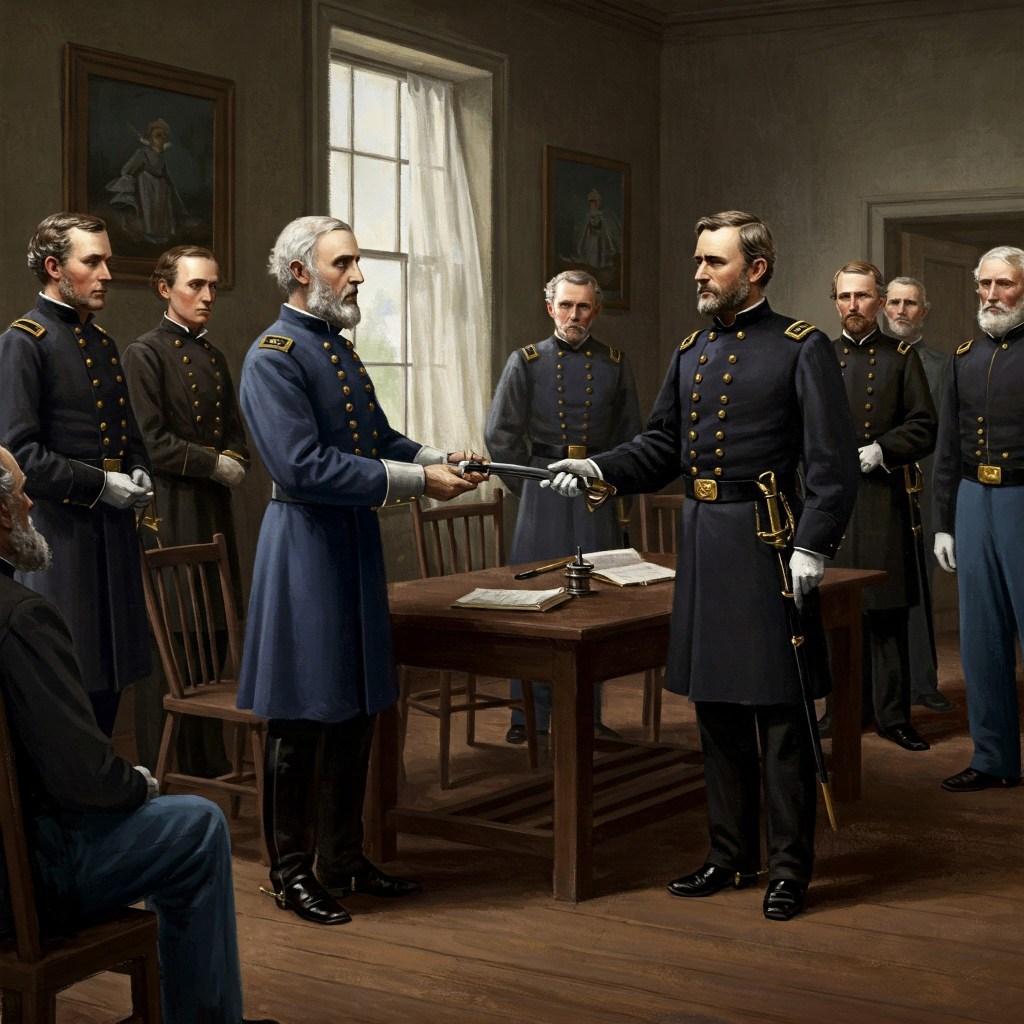
The meeting took place in the parlor of the McLean House, chosen because it was centrally located and unassuming. Lee arrived early, dressed with care in a new gray uniform, polished boots, and his ceremonial sword—a conscious display of dignity and formality. His stately posture and composed demeanor reflected a man who, though defeated, had not been broken.
Grant arrived nearly half an hour later, having rushed from his headquarters. Unlike Lee, he was wearing a simple sack coat without insignia, his boots muddy from the field. He looked more like a working soldier than the victorious general of a triumphant army. But Grant’s plainness masked a deep sense of resolve and, importantly, compassion.
Though from different worlds, the two men had fought together in the Mexican-American War. Their conversation opened not with the war just ended, but with memories of those shared battles decades earlier. This small talk wasn’t idle—it was a deliberate softening of what could have been a humiliating experience for Lee. Grant didn’t come to punish. He came to end the war.
Formalities and Friendship
Once the initial pleasantries faded, Lee brought the conversation back to the matter at hand. The war, he said with measured sadness, was over. Grant replied that he was ready to receive Lee’s surrender.
Grant then outlined the terms. They were surprisingly generous—perhaps even shocking. Confederate officers would be allowed to keep their sidearms, horses, and baggage. The enlisted men could take home any horses they claimed, which would be critical for the coming planting season.
Lee, clearly moved by the leniency, asked for food for his starving men. Without hesitation, Grant ordered three days’ rations—25,000 meals—to be sent to the Confederate lines.
There was no gloating, no triumphalism. Grant understood that crushing the South’s dignity would make healing the nation impossible. He wrote later that he felt sadness, not joy, upon Lee’s surrender: “I felt like anything rather than rejoicing at the downfall of a foe who had fought so long and valiantly.”
Lee, for his part, maintained the stoic grace that had earned him admiration from friend and foe alike. He accepted the terms, not only because his army was outmatched, but because he wanted to spare his men any more suffering.
The Signing of Peace
With terms agreed upon, both men turned to their staff officers to begin drafting the official surrender documents. Colonel Ely Parker, a Seneca Native American and Grant’s military secretary, took dictation. When Parker handed the finished copy to Lee, the Confederate general looked up and remarked, “It is good to have one real American here.”
Parker later recalled replying, “We are all Americans.”
It was a brief moment, but one filled with symbolic weight: the war had been a brutal fight between brothers, but now it was time to begin seeing one another as countrymen again.
Lee signed the documents with a steady hand, then rose and bid farewell. He mounted his horse, Traveller, and rode slowly back to his camp. Union officers watched in silence as he passed. One said later that no man had ever looked more alone.

A Salute for the Ages
On April 12, the formal surrender ceremony was held. It was not a parade of victors and vanquished, but a solemn military ritual. Lee himself did not attend; instead, Confederate General John B. Gordon led the surrender of arms.
Union General Joshua Chamberlain, chosen by Grant to preside over the ceremony, had fought bravely at Gettysburg and elsewhere. As the Confederate soldiers marched past to stack their weapons, Chamberlain did something remarkable: he ordered his men to come to attention and present arms—a soldier’s salute.
Gordon, stunned, returned the salute. It was a mutual gesture of respect between warriors, not enemies. In that moment, the men ceased to be blue or gray—they were simply soldiers, exhausted and proud.
There were tears on both sides. No cheers. No drums. Just the quiet sound of rifles being laid down and flags gently furled.
The War Ends, the Nation Heals
Though scattered Confederate armies would continue to surrender in the following weeks, Appomattox marked the spiritual end of the Civil War. After four years, over 10,000 battles, and more than 620,000 deaths, the guns were finally falling silent.
Lee returned to civilian life, choosing reconciliation over resistance. He became president of Washington College in Lexington, Virginia, and encouraged his fellow Southerners to accept the outcome of the war and rebuild.
Grant, hailed as the man who saved the Union, would go on to serve two terms as President. He advocated for Reconstruction and civil rights for freed slaves, though his efforts were often undercut by political resistance and violence in the South.
Appomattox showed that victory need not come with vengeance. The compassion Grant extended and the dignity Lee preserved laid the groundwork for a fragile but vital peace.
And so, in a quiet room in a modest house, two men—so different, yet bound by honor—brought a nation back from the brink.




 History in 5 Minutes or less
Leave a comment