
Tennessee Titans Collide
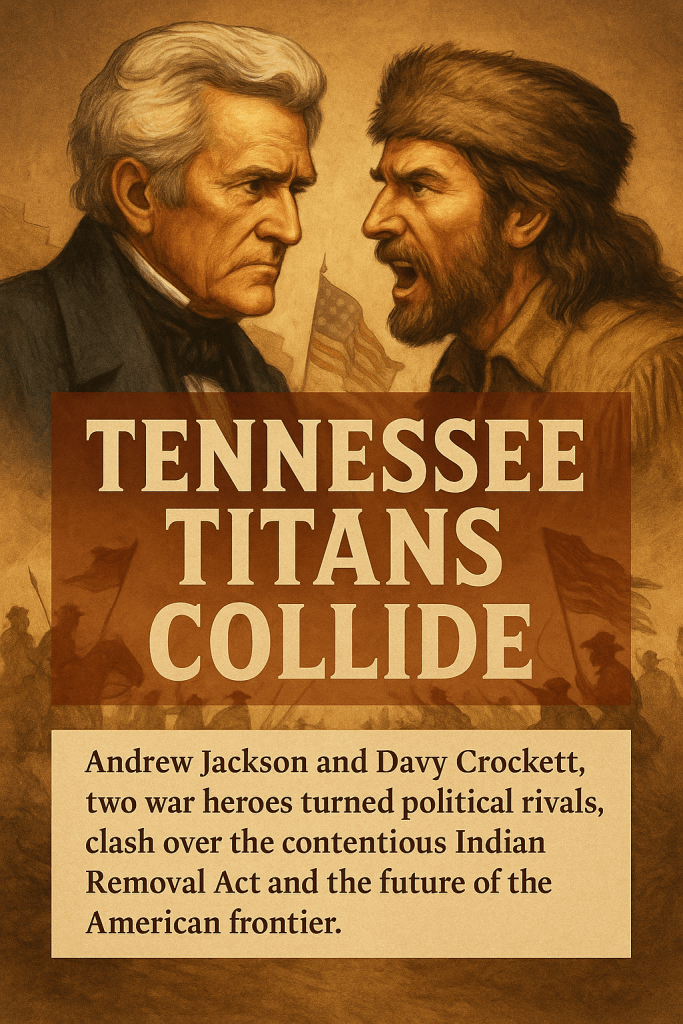
In the early decades of the 19th century, Tennessee was a crucible of American ambition, a place where legends were forged in gunpowder, grit, and populist appeal. Among its most famous sons were Andrew Jackson and Davy Crockett—both war heroes, both frontiersmen, and both embodiments of the untamed spirit of the new republic.
Yet, while their roots ran through the same soil, Jackson and Crockett were cut from very different cloth. Jackson was an aristocrat-in-the-making, molded by law, politics, and war. Crockett was the people’s man—unvarnished, self-educated, and celebrated more for his stories and survival than for speeches or strategy. Their eventual clash would reflect not just personal differences but two starkly opposing visions for the young United States.
Jackson the General: Iron-Willed and Unyielding
Andrew Jackson’s rise was steeped in violence and tenacity. Orphaned in the Revolutionary War and scarred by British soldiers, he forged a tough, uncompromising character early in life. As a general, he became a household name after his stunning victory at the Battle of New Orleans in 1815, which capped the War of 1812 and catapulted him into national stardom.
Jackson’s brand of leadership was firm, sometimes brutal. He viewed challenges as battles to be won and wielded political power as he had military authority—with decisive, sometimes dictatorial control. His presidency (1829–1837) was marked by strong executive action, the dismantling of the Bank of the United States, and a controversial expansion of federal authority.
But perhaps his most enduring—and infamous—legacy was the Indian Removal Act of 1830, a law he personally championed and signed into effect.
Crockett the Maverick: From Wilderness to Washington
Davy Crockett’s legend begins in the wilds of Tennessee, where he earned a reputation as a hunter, woodsman, and spinner of tales. His rough charm and unpretentious manner carried him to Washington as a Congressman, where he quickly became a voice for the common man. He wore buckskin instead of suits, and he spoke plainly, peppering his speeches with wit and wisdom drawn from frontier life.
Though initially a supporter of Jackson, particularly for his military service, Crockett’s political conscience soon drew him away. He stood apart from the machine politics that Jackson cultivated, refusing to rubber-stamp legislation he found morally dubious—even at the cost of his career.
A Rift Over the Indian Removal Act
The Indian Removal Act was a watershed moment in U.S. policy—and in the relationship between Jackson and Crockett. Jackson framed the law as a pragmatic necessity. White settlers wanted land, Native tribes stood in the way, and relocation, he argued, would “protect” the tribes from extinction.
But Crockett, uniquely among his peers in Tennessee, saw the truth more plainly. He viewed the policy as a land grab and an act of moral cowardice. In his own words:
“I believed it was a wicked, unjust measure… I had rather be honestly damned than hypocritically immortalized.”
Crockett was one of the few Southern Congressmen to vote against the Act. It was a lonely stand—one that alienated him from Jackson, from his party, and ultimately from his constituents.
His political career began to unravel as Jacksonian loyalists rallied to unseat him. Still, Crockett refused to back down, cementing his place in history as a rare voice of dissent against an otherwise popular but devastating policy.
The Political Fallout: Isolation and Exile
Crockett’s vote against the Indian Removal Act made him a pariah in Jackson’s Democratic Party. The political machine in Tennessee, loyal to Jackson, turned its considerable resources toward defeating Crockett in the next election. After briefly reclaiming his seat in 1832, he was again defeated in 1834.
Rather than retreat quietly, Crockett responded with defiance:
“You may all go to hell, and I will go to Texas.”
It was more than a memorable line—it was an act of final rebellion. Disillusioned by American politics and Jackson’s vision of expansionism, Crockett set out for Texas, where a revolution was stirring.
Crockett in Texas: A Final Stand for Freedom
When Crockett arrived in Texas in early 1836, he found a volatile landscape. The Texians—Anglo-American settlers in Mexican Texas—had risen in rebellion against the Mexican government under General Santa Anna. Crockett joined the cause with the same restless independence that had defined his life.
He arrived at the Alamo, a former mission turned makeshift fortress, alongside a small band of volunteers. What followed was one of the most iconic last stands in American history.
The 13-day siege of the Alamo ended in tragedy, as Mexican forces overwhelmed the defenders on March 6, 1836. Crockett was among the fallen. Though the exact circumstances of his death remain debated—some say he died fighting, others claim he was executed afterward—his sacrifice became legendary.
Jackson’s Silence and a Nation Divided
Back in Washington, President Jackson reportedly had little to say about Crockett’s death. The two had grown too far apart, and Crockett’s defiance had turned personal. To acknowledge the death of his old subordinate* would have required confronting a conflict that reflected poorly on his administration.
But history would not forget Crockett. While Jackson’s presidency left a significant institutional legacy, Crockett’s death at the Alamo gave him something arguably more enduring: a place in American folklore.
A Clash of Symbols: Power vs. Principle
The feud between Jackson and Crockett was about more than personal pride or party loyalty. It was a symbolic battle for the soul of America.
- Jackson embodied the strength of the central government, the rise of populist authoritarianism, and the relentless push for expansion—often at any cost.
- Crockett represented a rugged, principled individualism, a refusal to conform, and a belief that progress should not come at the price of justice.
Their fight mirrored broader tensions that would continue to shape America: between federal power and local control, between progress and ethics, between might and right.
Legacy: Who Truly Won?
From a purely political standpoint, Jackson won the battle. He served two terms as president, redefined executive authority, and guided the nation’s aggressive growth. Crockett, meanwhile, died far from home, outnumbered, outgunned, and out of office.
But legacy is not always measured in office held or policies passed. Crockett’s image—as the straight-shooting, anti-establishment hero—endured. In the 20th century, he was immortalized in books, ballads, and a 1950s Disney television series that introduced a new generation to the man in the coonskin cap.
Jackson, too, remains an iconic—if increasingly controversial—figure. Once a fixture on the $20 bill, his role in Native American removal and his use of executive power have sparked new critiques in modern scholarship.
Conclusion: Two Titans, One Story of America
The Jackson-Crockett feud wasn’t just about two men—it was about competing ideals in a country still defining itself. Jackson believed in power, unity, and destiny. Crockett believed in conscience, resistance, and moral clarity.
In the end, both men got what they wanted—Jackson, his power; Crockett, his legend. And together, they left behind a story that still resonates with Americans wrestling with the balance between strength and justice, loyalty and truth.
*Crocket served under Jackson in the Creek War (1813) as well as the war of 1812
Sources:
- Crockett, Davy. A Narrative of the Life of David Crockett of the State of Tennessee, 1834.
- Remini, Robert V. Andrew Jackson: The Course of American Freedom, 1822–1832.
- Brands, H.W. Andrew Jackson: His Life and Times.
- Greenberg, Amy S. A Wicked War: Polk, Clay, Lincoln, and the 1846 U.S. Invasion of Mexico.
- Wallis, Michael. David Crockett: The Lion of the West.
- U.S. House of Representatives History Archives – Indian Removal Act Debates.


 History in 5 Minutes or less
Leave a comment