A World on the Brink
In October 1962, Earth held its breath. For nearly two weeks, the United States and the Soviet Union stood locked in a deadly stare-down, armed to the teeth with nuclear weapons capable of wiping out human civilization in hours. The Cuban Missile Crisis was the Cold War’s most terrifying moment. It brought the superpowers, and by extension the entire world, to the very brink of nuclear catastrophe.
But how did it come to this? How did a tropical island just 90 miles from Florida become the flashpoint for what might have been the end of the world?
Prologue: Seeds of a Showdown
The seeds of confrontation were sown years before. In January 1959, a bearded guerrilla named Fidel Castro overthrew Cuban dictator Fulgencio Batista. Batista had ruled with U.S. backing and the support of American business interests, but corruption and repression made him deeply unpopular.
Castro promised justice and reform—but soon aligned himself with the Soviet Union. U.S. officials grew alarmed as he expropriated American-owned property and invited Soviet advisors onto Cuban soil. By late 1960, relations had collapsed. The U.S. imposed an economic embargo. Castro responded by cementing his alliance with Moscow.
Then came the Bay of Pigs in April 1961. A CIA-organized force of Cuban exiles landed on Cuba’s southern coast, hoping to ignite an uprising against Castro. The plan was catastrophically flawed. Castro’s forces crushed the invaders in three days. President John F. Kennedy, only months into his presidency, was humiliated on the world stage.
Soviet Premier Nikita Khrushchev interpreted Kennedy’s failure as weakness. Meanwhile, he watched as American Jupiter nuclear missiles were deployed in Turkey, well within striking distance of Soviet cities. Khrushchev decided it was time to turn the tables.
Discovery: The Spy Plane’s Snapshot
On the morning of October 14, 1962, a U-2 reconnaissance plane flew a high-altitude mission over western Cuba. The flight, routine at the time, yielded shocking results. Intelligence analysts studying the photographs identified long-range missile launch sites under construction—Soviet-made, nuclear-capable, and designed to strike much of the U.S. within minutes.
The next day, the photos reached President Kennedy. He now knew the world had entered a new, dangerous phase. Soviet nuclear missiles were being stationed just a short flight from Washington, D.C.
The immediate question: what to do?
Day 1: The ExComm is Born
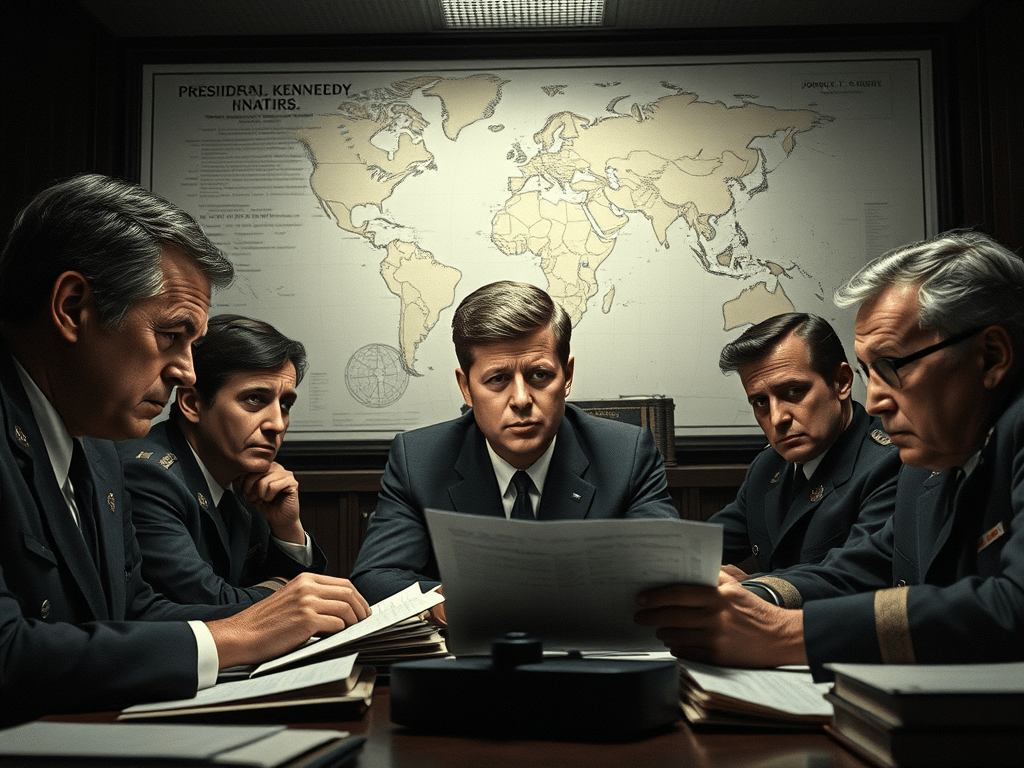
On October 16, Kennedy formed the Executive Committee of the National Security Council—ExComm—to secretly assess options. Around the table sat the country’s top officials, including Robert McNamara (Secretary of Defense), Dean Rusk (Secretary of State), George Ball (Undersecretary of State), CIA Director John McCone, and his own brother, Attorney General Robert F. Kennedy.
Tensions flared in the room. Military leaders, especially the Joint Chiefs of Staff led by General Curtis LeMay, pushed for an immediate air strike to destroy the missile sites, followed by an invasion to eliminate Castro. Civilian advisors, however, warned such actions could provoke all-out war with the Soviets.
Kennedy listened carefully. He was skeptical of military overconfidence. The ghosts of World War I loomed large—he had recently read Barbara Tuchman’s The Guns of August, which described how great powers had blundered into a cataclysm. He didn’t want history to repeat itself—with nuclear weapons in play.
Days 2–4: A Game of Shadows
As the U.S. pondered its next move, the world remained blissfully unaware of the crisis. Kennedy and ExComm kept the discovery secret for several tense days, even as they plotted next steps.
Meanwhile, Khrushchev publicly denied any offensive weapons were being sent to Cuba. On October 18, Soviet Foreign Minister Andrei Gromyko met Kennedy in the Oval Office and doubled down on the lie. He claimed Soviet aid to Cuba was purely defensive.
Kennedy, already in possession of the U-2 photographs, said nothing. He let Gromyko talk, then ushered him out without confrontation. It was a masterclass in strategic patience—Kennedy was biding his time.
Behind closed doors, the president and his advisors weighed their options: a surprise military strike (likely leading to Soviet retaliation in Berlin), or a more measured response—a naval “quarantine” to block further missile shipments.
Day 5: Going Public
On the evening of October 22, Kennedy addressed the nation on live television.
With somber authority, he laid out the facts: Soviet nuclear missiles were in Cuba, capable of devastating American cities. This, he declared, was a threat to peace in the Western Hemisphere.
He announced a naval quarantine around Cuba, to intercept any offensive military equipment. He demanded the immediate dismantling and withdrawal of the missiles.
“The greatest danger of all would be to do nothing,” Kennedy warned.
The world was stunned. In Moscow, Khrushchev was furious. In Cuba, Castro placed his forces on high alert. Across America, families stocked fallout shelters and schoolchildren practiced duck-and-cover drills. DEFCON levels climbed.
The countdown had begun.
Day 6–8: The Brinkmanship Builds
American warships formed a blockade ring around Cuba. The U.S. Navy began boarding and inspecting ships for weapons. Tensions reached fever pitch on October 24, when Soviet cargo ships approached the quarantine line. For hours, war planners braced for a possible shootout.
Then, in a moment of pure relief, the Soviet ships stopped short and turned back.
It seemed a win for the U.S.—but the missiles on the island were still being rapidly assembled. Time was running out. By October 25, aerial photos showed that at least some of the missile sites would be fully operational within days.
The pressure on Kennedy intensified. The Pentagon renewed calls for air strikes and invasion. The president still resisted, hoping diplomacy might yet offer a path out.
Day 9: The Letter Game Begins
On October 26, Khrushchev broke the silence. He sent a long, rambling letter to Kennedy, describing the dangers of war and offering a way out. If the U.S. pledged not to invade Cuba, he would remove the missiles.
Kennedy saw hope in the offer. The proposal was direct and, importantly, left the U.S. with its dignity intact. He considered accepting it.
But the next day, everything changed.
Day 10: Black Saturday
October 27 became known as Black Saturday. The day began with shocking news: a U-2 spy plane had been shot down over Cuba by a Soviet-supplied surface-to-air missile. Major Rudolf Anderson Jr., the pilot, was killed—the only American casualty of the crisis.
That same day, another U-2 strayed into Soviet airspace near Alaska, nearly triggering Soviet air defenses.
Even worse, a U.S. destroyer dropped depth charges on a submerged Soviet submarine, B-59, which carried a nuclear-tipped torpedo. The sub, cut off from communications, feared war had already begun. Its captain and political officer voted to launch.
Only the presence of Vasili Arkhipov, second-in-command, stopped them. Arkhipov refused to authorize the launch. One man had just saved the planet.
Later that day, a second, harsher letter arrived from Khrushchev. It demanded not only a no-invasion pledge but also the removal of U.S. missiles from Turkey.
Kennedy now faced a terrifying dilemma. Respond to the second letter and seem weak? Or accept the first and risk Khrushchev rejecting it?
The Secret Deal
That evening, Kennedy made a bold decision. Publicly, he would respond to the first letter—the more reasonable one—and ignore the second. Privately, he would strike a deal.
Through backchannel diplomacy, Robert Kennedy met with Soviet Ambassador Anatoly Dobrynin. He told him that the U.S. would remove its Jupiter missiles from Turkey—but quietly, within a few months, and with no public connection to the Cuban crisis.
It was a diplomatic sleight of hand. Khrushchev would have a way to save face, and Kennedy could claim a clean public victory.
Day 13: The Message from Moscow
On the morning of October 28, the world exhaled.
Khrushchev, through a broadcast on Radio Moscow, announced the Soviet Union would dismantle and remove the missile installations in Cuba. He praised Kennedy’s “sober-mindedness” and urged both sides to seek peace.
Kennedy responded with cautious optimism. The naval blockade would remain until the missiles were gone, but the worst had passed.
By early November, Soviet ships loaded with dismantled missile parts departed Cuban ports. The planet had stepped back from the edge.
Aftermath: Quiet Concessions
The Soviets removed 42 missiles and dozens of bombers. In return, Kennedy promised never to invade Cuba. Quietly, the U.S. also dismantled the Jupiter missiles in Turkey by April 1963, just as the secret deal had outlined.
Though the public saw a triumph for Kennedy, both sides claimed victory. Khrushchev had secured Cuba and extracted a concession on Turkey. Kennedy had neutralized the threat without war.
Yet the crisis had a profound cost—trust was shattered. Castro, furious at being excluded from negotiations, never forgave Khrushchev. The Soviets began rapidly expanding their ICBM arsenal. The arms race continued.
Legacy: A Hotline and a Lesson
The Cuban Missile Crisis shook the Cold War into a new phase—one where direct confrontation was clearly too dangerous to repeat.
To prevent such a near-miss from happening again, a direct “hotline” was installed between Washington and Moscow. In 1963, the U.S., USSR, and UK signed the Partial Nuclear Test Ban Treaty, banning atmospheric nuclear tests.
Kennedy’s cool-headed leadership won global praise. His ability to balance military caution with diplomatic creativity likely saved millions of lives. For Khrushchev, the crisis was a mixed result—he was removed from power two years later.
What Might Have Been
In hindsight, the world came perilously close to nuclear war—perhaps closer than the public ever realized at the time. Years later, declassified records revealed just how many near-fatal miscommunications occurred.
If Vasili Arkhipov had not refused to launch. If a U-2 pilot had pulled the wrong maneuver. If Kennedy had listened to his generals. If Khrushchev had refused the secret deal.
Each “if” was a trigger. Yet none were pulled.
Epilogue: A Letter Never Sent
Among Kennedy’s archived notes was a draft of a letter—never sent—reflecting on the crisis. It read:
“We are not here to conquer. We are here to endure. May the courage of our restraint be the foundation of peace.”
Those 13 days taught a vital lesson: in an age of unimaginable weapons, the greatest strength is knowing when not to use them.
Sources
- Robert F. Kennedy, Thirteen Days: A Memoir of the Cuban Missile Crisis (1969)
- Michael Dobbs, One Minute to Midnight: Kennedy, Khrushchev, and Castro on the Brink of Nuclear War (2008)
- Ernest R. May and Philip D. Zelikow, The Kennedy Tapes: Inside the White House During the Cuban Missile Crisis (1997)
- Arthur M. Schlesinger Jr., A Thousand Days: John F. Kennedy in the White House (1965)
- National Security Archive: “The Cuban Missile Crisis, 1962” – George Washington University, https://nsarchive.gwu.edu
- JFK Presidential Library, “Cuban Missile Crisis,” https://www.jfklibrary.org/learn/about-jfk/jfk-in-history/cuban-missile-crisis
 History in 5 Minutes or less
Leave a comment