Introduction: A Battlefield Steeped in Legend
In July 1863, the quiet hills of southern Pennsylvania erupted into one of the bloodiest and most pivotal battles in American history: the Battle of Gettysburg. More than 165,000 soldiers converged, and over 50,000 became casualties in just three days. Amid the thunder of cannon fire, the screams of the wounded, and the desperate maneuvers of exhausted armies, an extraordinary legend took shape—one that would defy logic, inspire hope, and linger for generations.
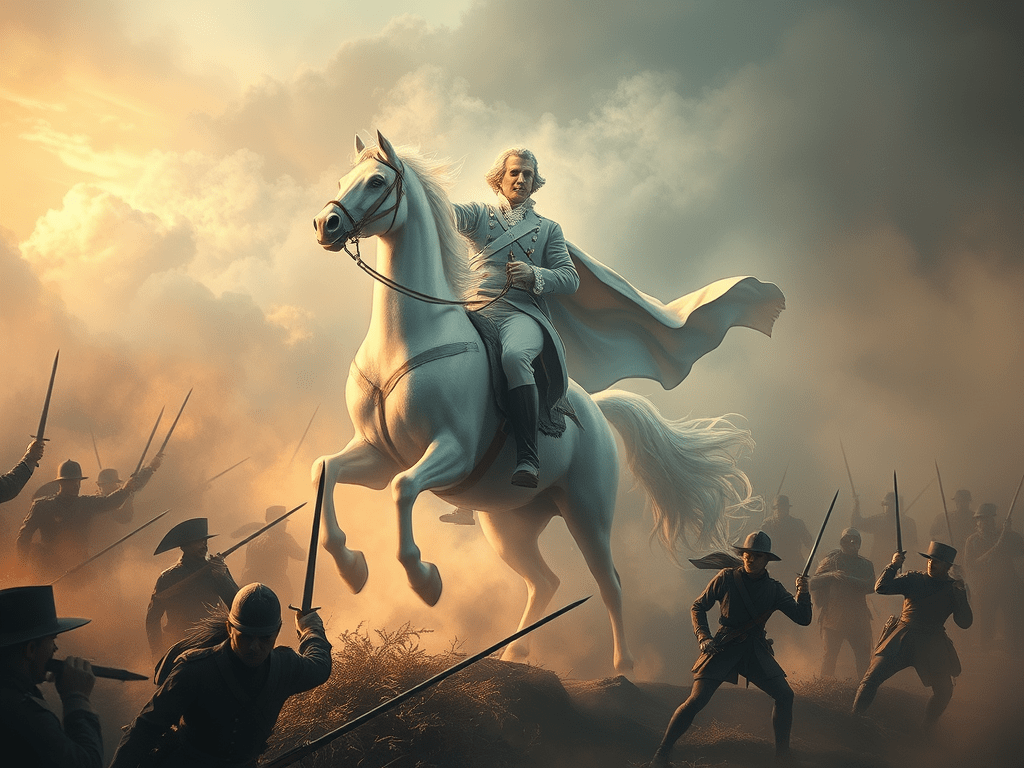
According to several eyewitness accounts and later retellings, a spectral figure—draped in Revolutionary War garb—appeared on the battlefield. This figure, it was said, looked exactly like George Washington, the Founding Father and first president of the United States. He rode a great white horse, his face stern but composed, his sword drawn and pointed toward the enemy. He uttered only a few words, but their effect was electrifying.
Was it a ghost, a hallucination, or something more symbolic? This is the story of how America’s most revered figure may have returned from the grave at the country’s darkest hour.
Setting the Stage: Gettysburg, July 1863
The Battle of Gettysburg was not merely a clash of armies; it was a test of the nation’s survival. Confederate General Robert E. Lee had brought his troops into Union territory for the second time, hoping to break Northern morale and possibly force political recognition from Britain or France. The Union Army of the Potomac, led by newly promoted General George G. Meade, moved swiftly to intercept.
From July 1 to July 3, the two armies clashed in and around the town of Gettysburg. The battle’s terrain was crucial—rocky hills like Cemetery Ridge, Round Top, and Seminary Ridge became centers of brutal combat. The fate of the Union often seemed to hang by a thread, especially during the Confederate charge on July 2 and the infamous Pickett’s Charge on July 3.
In this cauldron of chaos, with morale plummeting and the fate of the war teetering, strange tales began to emerge among the ranks. Some Union soldiers claimed they had seen something impossible—an apparition from another era.
The Phantom Appears: “It Was Him, I Swear”
Among the units stationed near Little Round Top, particularly the 20th Maine Infantry led by Colonel Joshua Chamberlain, several soldiers claimed to witness a bizarre event in the early morning hours of July 2. The air was thick with smoke from skirmishes the previous day. As they prepared for renewed assault, a hush reportedly fell across the tree line.
Out of the mist, a figure on horseback appeared. Dressed in the blue-and-buff uniform of a Continental Army general, he wore a tricorn hat and sat atop a striking white steed. Eyewitnesses said he seemed to radiate a faint glow, even in the early dawn light. Most chilling of all, he bore a striking resemblance to the iconic images of George Washington that adorned public buildings, currency, and recruitment posters.
One unnamed soldier in a postwar letter recounted:
“He was tall, composed, regal. He raised his sword and said clearly, ‘Press on, boys! Press on for Liberty!’ And just as quick, he vanished into the trees.”
Other reports added that his presence brought a strange calm to the area. Cannon fire briefly paused. Birds, silent until then, chirped. It was as though time had stilled, and a divine signal had been given.
Spiritualism and the Civil War: Fertile Ground for Ghost Stories
To modern ears, a ghostly sighting on the battlefield might sound like pure folklore. But in 1863, belief in spirits and the afterlife was widespread and surprisingly mainstream.
The Civil War, with its immense loss of life and its intrusion into nearly every American household, sparked a national obsession with spiritualism. Seances were common, particularly among the grieving. Prominent families—even the Lincolns—participated in attempts to contact the dead. Mediums toured cities, and publications like The Spiritual Telegraph and Banner of Light circulated widely.
Amid this environment, the idea of a dead hero returning to offer guidance didn’t just feel possible—it felt plausible. For soldiers surrounded by death, the boundaries between the natural and supernatural were porous. Many interpreted dreams, strange weather, or battlefield visions as divine or ghostly communication.
In that context, seeing Washington—whether as a ghost or a symbolic vision—was part of a broader culture trying to make sense of carnage and find purpose in suffering.
The Washington Cult: Mythmaking in Real Time
George Washington was not merely admired—he was venerated. By the 1860s, he had become almost a demigod in American civic religion. Paintings portrayed him bathed in heavenly light, literature described him in biblical terms, and children were taught to revere him as the moral compass of the republic.
For both North and South, Washington represented the legacy of the American Revolution. The Confederacy often invoked him as a fellow Virginian and alleged advocate of states’ rights. But the Union had a more potent claim: they fought to preserve the nation Washington had helped forge.
Indeed, during the Civil War, Washington’s image appeared in recruiting posters, banknotes, and rally speeches. President Lincoln frequently quoted Washington, presenting the war as a continuation of the Founders’ vision. To see his ghost at Gettysburg, then, was not just a supernatural moment—it was a profound affirmation that the Union cause was righteous.
The Man Behind the Myth: Reverend John Richards’ Account
While many of the accounts were oral and secondhand, one written source stands out: a memoir titled Reflections from the Rear Lines, attributed to Reverend John Richards, a chaplain in the Army of the Potomac.
Though the memoir’s authenticity is debated among historians (as no verified first edition has been conclusively found), the manuscript was cited in several 19th-century periodicals. In it, Richards describes a chilling episode during the night of July 1:
“We were weary, frightened, and unsure. Then a vision appeared from the haze. He looked every inch the general from ’76. He raised his sword and shouted—‘Liberty, still!’—before fading away like smoke. My men swore it gave them courage.”
Richards claimed that the tale spread rapidly, passed from regiment to regiment. Some officers dismissed it as battlefield delusion, while others quietly welcomed the morale boost it inspired.
Military Morale and the Power of Belief
The psychology of war plays a powerful role in how soldiers perceive reality. Facing exhaustion, terror, and the constant proximity of death, the human brain seeks comfort. Shared hallucinations or mass suggestion are not uncommon in high-stress combat environments.
But even if the ghost wasn’t real in a literal sense, its impact was undeniable. Whether through coincidence or inspiration, Union forces held their ground on July 2 and launched a fierce counterattack on July 3. The Confederate defeat was catastrophic, and Lee never again attempted a major offensive into the North.
To soldiers and citizens alike, the ghostly tale became a symbol of moral victory. Washington—America’s first and greatest general—had returned, not just in spirit but in purpose, to defend the very idea of the Union.
Historical Skepticism: Fog, Fear, and Fatigue
Of course, not all historians give credence to the tale. Modern experts in psychology and military history argue that battlefield hallucinations are well-documented. Sleep deprivation, dehydration, shock, and extreme emotion can cause the brain to fabricate powerful visions.
Moreover, figures resembling Washington may have been accidentally conjured by shadow, smoke, or even actual humans in old uniforms (some ceremonial officers occasionally donned 18th-century garb for symbolic reasons).
Skeptics also point out that much of the legend emerged years or even decades after the war—prime conditions for embellishment, nostalgia, and the romanticization of trauma.
Still, even the most cynical historians concede that the tale speaks volumes about what Americans needed to believe in 1863.
Legacy of a Legend: Washington Still Marches On
Today, the story of George Washington’s ghost at Gettysburg endures. It’s told on ghost tours, dramatized in documentaries, and whispered among Civil War buffs. Even the National Park Service has fielded questions about it during battlefield tours.
Visitors have reported odd occurrences—horse hooves in the night, eerie lights near Little Round Top, or sudden cold gusts on hot days. While no empirical evidence has surfaced, the legend lives on in collective memory.
In literature, the story has inspired short fiction, poetry, and even a stage play. In classrooms and forums, it serves as an example of how myth and history often walk side by side—especially when a nation is struggling to define itself.
Conclusion: Ghost or Guiding Spirit?
So, did George Washington really appear at Gettysburg?
The answer may depend less on the evidence and more on the meaning. Whether born of superstition, psychological need, or divine intervention, the vision served a powerful role. It gave hope where there was none, clarity amid confusion, and courage in a time of despair.
If Washington’s ghost marched again, it was not to frighten, but to remind Americans of their better angels. He wasn’t just the leader of the past—he was a beacon for the future.
Sources
- Davis, William C. Battle at Gettysburg. Stackpole Books, 1995.
- Holzer, Harold. Lincoln and the Power of the Press. Simon & Schuster, 2014.
- Taylor, Troy. Haunted Civil War: Ghosts and Paranormal Tales from America’s Deadliest Conflict. Whitechapel Press, 2006.
- The Gettysburg Times, July 1893, Anniversary Folklore Edition.
- Keller, Morton. America’s Three Regimes: A New Political History. Oxford University Press, 2007.
 History in 5 Minutes or less
Leave a comment