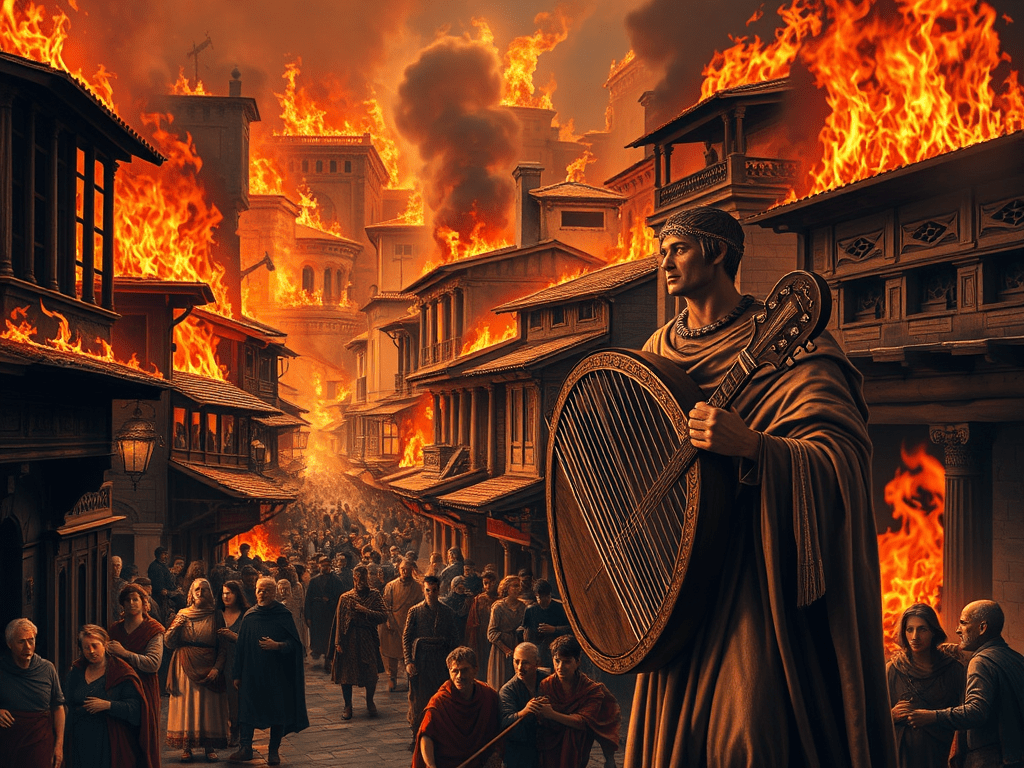
The Night Rome Burned: An Empire Engulfed in Fire
In the early hours of July 18, 64 AD, a faint spark near the Circus Maximus, Rome’s sprawling chariot-racing stadium, turned into a catastrophe that would become one of the most infamous events in ancient history. The city, dense with wooden buildings, narrow streets, and flammable materials, was a tinderbox waiting to ignite. Once the fire began, it quickly spiraled out of control. With high winds and no fire brigade to stop it, flames leapt from roof to roof, devouring everything in their path.
The fire raged for six days and seven nights, spreading across Rome’s fourteen districts. When it was finally extinguished, three districts were completely annihilated, while seven others were severely damaged. Thousands were left homeless. The city was reduced to rubble, smoke, and ash. The psychological toll was just as devastating: temples, sacred places, family homes—all gone.
The people demanded answers. They wanted someone to blame. And standing at the center of power—detached, theatrical, and increasingly unpopular—was Emperor Nero.
The Man Behind the Myth: Nero’s Rise and Fall from Grace
Born Lucius Domitius Ahenobarbus in 37 AD, Nero’s path to power was paved by ambition and intrigue. He was adopted by Emperor Claudius and renamed Nero Claudius Caesar, eventually ascending to the throne at age 16. At first, his reign seemed promising. With guidance from his tutor Seneca, military commander Burrus, and his mother Agrippina the Younger, Nero’s early years were stable and even progressive. Taxes were lowered, slavery was moderated, and public performances flourished.
But power changed Nero. He grew increasingly enamored with art, poetry, theater, and performance. He sang, acted, raced chariots, and viewed himself not just as emperor, but as a divinely inspired artist. This artistic obsession was unsettling to Rome’s aristocracy, who believed the emperor’s role was to lead, not entertain.
By the time of the Great Fire, Nero’s relationship with his advisors had deteriorated. His mother was dead—possibly murdered on his orders. Seneca was withdrawing from politics. Nero was increasingly isolated, surrounded by sycophants who fed his fantasies. In this context, when the flames engulfed Rome, it was easy for the public to believe their strange, theatrical emperor had something to do with it.
Fiddle While Rome Burns? The Origins of a Historical Lie
The image of Nero playing a fiddle while Rome burns is one of the most persistent—and misleading—legends in history. The fiddle, as we know it, wasn’t invented until the 11th century. The confusion likely stems from mistranslations of ancient texts. What Nero may have played was a kithara, a kind of Greek lyre.
Ancient historians like Cassius Dio and Suetonius accuse Nero of watching the fire from his palace and performing a dramatic song about the destruction of Troy. This image, though compelling, lacks credible evidence.
More reliable is the account by Tacitus, a Roman senator and historian known for his cautious tone. Tacitus reports that Nero was in his villa in Antium, over 30 miles from Rome, when the fire broke out. Upon hearing the news, he rushed back to the capital and personally organized relief efforts. He opened the Field of Mars and even parts of his own palace to house the displaced. He ordered grain to be shipped in from Ostia and sold it at reduced prices to stave off famine.
Tacitus—no friend of Nero—admits there was “no evidence” that Nero started the fire. Yet, the rumor stuck. The idea of a megalomaniac emperor casually performing as his people burned was too symbolic to resist.
Who Benefited from the Blaze? Rebuilding Rome, Rewriting Legacy
One reason the accusations against Nero gained traction was because he quickly used the devastation as an opportunity to remake the city. He unveiled a bold urban renewal plan: Rome would be rebuilt with wider boulevards, regulated building heights, brick and stone construction, and fire-resistant materials. These were modern improvements that made the new Rome far safer—but also eerily convenient.
At the center of this rebuilt Rome rose Nero’s most ambitious project: the Domus Aurea, or Golden House. This palace wasn’t merely a home—it was a monument to extravagance. It featured gold-plated ceilings, precious stones, fountains, a rotating banquet hall, and even an artificial lake. The property was so enormous that it swallowed up large portions of what used to be public land.
To many Romans, this was proof of guilt. Why else would Nero build a luxurious palace right in the middle of a recently incinerated city? Was it just opportunism—or was it part of a larger, sinister plan to destroy old Rome and build a new one in his image?
Nero Finds a Scapegoat: The Birth of Christian Martyrdom
As rumors swirled and tensions mounted, Nero knew he needed a scapegoat. He turned his wrath on a small, increasingly visible religious sect: the Christians. Christianity, barely three decades old at the time, was still considered a fringe Jewish cult. Early Christians were secretive, refused to worship Roman gods or the emperor, and spoke of a kingdom beyond this world. Their refusal to integrate made them suspect.
In a masterstroke of political manipulation, Nero declared that Christians had started the fire. The public, desperate for closure, bought it. What followed was one of the first major state-sponsored persecutions of Christians.
Tacitus, no sympathizer to Christians himself, still recorded the horror of Nero’s punishments:
“They were torn apart by dogs, crucified, or burned alive to serve as human torches to illuminate the night.”
Nero hosted these gruesome displays in his own gardens, turning human suffering into spectacle. For Christians, this was a turning point. They went from being obscure outcasts to martyrs, remembered for their suffering and steadfast faith in the face of imperial brutality.
The Psychological Profile of an Emperor: Artist or Tyrant?
What kind of man uses tragedy as theater? Nero’s behavior can’t be understood purely through the lens of politics. He was a man obsessed with performance, applause, and legacy. He didn’t just want to rule Rome—he wanted to dazzle it. His ego wasn’t just large; it was fragile, constantly demanding affirmation.
Nero entered chariot races, performed in public dramas, and forced senators to sit through his poetry. He competed in Greek festivals, where judges—coerced or bribed—awarded him crowns and titles. He believed that greatness wasn’t measured in military conquest, but in artistic achievement.
To the Roman elite, this wasn’t just odd—it was dangerous. Emperors were supposed to be serious men, descended from gods, upholding the traditions of the Republic. Nero shattered those expectations and in doing so, made powerful enemies.
After the fire, he leaned further into his artistic identity. The rebuilt Rome was a canvas, and he was its painter, architect, and poet-king.
The Fall of Nero: Empire Against the Artist
Despite his efforts to reshape the city and deflect blame, Nero’s popularity continued to plummet. His building projects drained the treasury, and his persecution of Christians alienated parts of the population. Military legions began to rebel. In 68 AD, the governor of Hispania, Galba, declared himself emperor.
Nero fled the city, wandering outside Rome in disguise. When he learned that the Senate had declared him a public enemy, he panicked. With few loyalists remaining, he ultimately committed suicide in a villa outside the capital.
His last words, according to legend, were:
“Qualis artifex pereo!” – “What an artist dies in me!”
With Nero’s death, the Julio-Claudian dynasty came to an end. Rome descended into a year of chaos and civil war, known as the Year of the Four Emperors. The shadow of Nero’s legacy lingered over the empire for generations.
Myth vs. Reality: Separating the Smoke from the Fire
So—did Nero really burn Rome?
Modern historians agree: probably not. The accounts of his involvement are based on rumor, hindsight bias, and political motivations. While Nero’s behavior was certainly flamboyant and at times disturbing, the fire itself was likely an accident, made catastrophic by poor urban planning.
However, perception shapes legacy. Nero’s eagerness to rebuild, his grotesque new palace, and his theatrical response to crisis ensured that the public would forever link him to the flames. He became a symbol—not just of tyranny, but of vanity, cruelty, and artistic delusion.
Yet, he was also a man ahead of his time: rebuilding a fireproof Rome, championing the arts, and challenging norms of leadership. In a world that wanted Caesar, Nero tried to be Apollo—and the world rejected him for it.
Sources:
- Tacitus, Annals, Book XV
- Suetonius, The Twelve Caesars: Nero
- Cassius Dio, Roman History, Book 62
- Champlin, Edward. Nero (Harvard University Press, 2003)
- Shotter, David. Nero (Routledge, 2005)
- Barrett, Anthony A. Rome Is Burning: Nero and the Fire That Ended a Dynasty (Princeton, 2021)
- Goodman, Martin. Rome and Jerusalem: The Clash of Ancient Civilizations (Vintage, 2008)



 History in 5 Minutes or less
Leave a comment