
Prelude: When Physics Became Dangerous
Picture this: the late 1930s. Europe is on edge, dictators are roaring, and meanwhile, in quiet labs, scientists are tinkering with the building blocks of the universe.
Then—boom, metaphorically at first—German scientists Otto Hahn and Fritz Strassmann split the atom. Lise Meitner, forced into exile because she was Jewish, helped explain what had happened: nuclear fission. One neutron could split a uranium atom and unleash a chain reaction.
Physicists around the world immediately felt their stomachs drop. Leo Szilard, a Hungarian émigré, knew exactly what this meant: if you could harness that reaction, you could build a bomb more powerful than anything the world had ever seen. And worse—the Nazis might get there first.
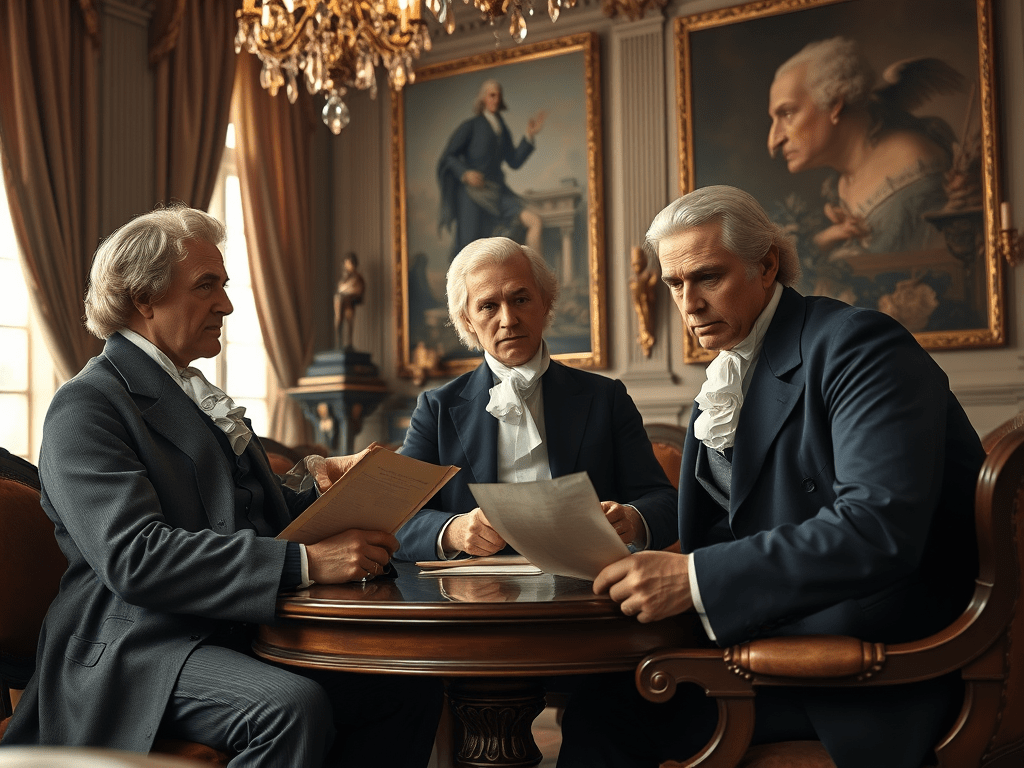
That’s why Szilard drafted a letter, signed by Albert Einstein, and sent it to President Franklin D. Roosevelt in 1939. The message was simple but urgent: we have to start working on this before someone else does.
Building the Unthinkable: The Manhattan Project
What started as cautious lab work quickly turned into one of the biggest military projects in history: the Manhattan Project.
General Leslie Groves, the no-nonsense Army Corps of Engineers officer who had just overseen the Pentagon’s construction, was put in charge. He wasn’t a scientist, but he knew how to build big things fast. His choice to lead the science side was J. Robert Oppenheimer—a brilliant, complicated theoretical physicist with a knack for bringing geniuses together.
This wasn’t just one lab. It was a web of secret cities and massive facilities.
- Oak Ridge, Tennessee: uranium enrichment plants so large they looked like futuristic factories.
- Hanford, Washington: reactors producing plutonium in guarded isolation.
- Los Alamos, New Mexico: a desert mesa turned into a hub for designing and assembling the bombs.
Tens of thousands of people worked on the project, most of them with no idea what they were building. The secrecy was so tight that families in Oak Ridge would joke about working for “Uncle Sam’s laundry service.”
Two Bombs, Two Paths
At Los Alamos, the scientists weren’t building a bomb — they were building two.
The first, Little Boy, was basically a “gun.” One piece of uranium-235 would be shot into another until the material went supercritical. It was conceptually simple but required a staggering amount of enriched uranium.
The second, Fat Man, was trickier. Plutonium, the new element bred in Hanford’s reactors, couldn’t be used in a gun design because it was too unstable. Instead, scientists had to invent something radical: an implosion. They would surround a plutonium core with explosives arranged like a perfect sphere, detonate them at the same instant, and crush the core into critical mass. This required precision detonators, new mathematics, and a lot of nervous trial and error.
If Little Boy was “brute force,” Fat Man was “delicate genius.”
Trinity: Lighting Up the Desert
By July 1945, the implosion design was ready for a trial run. Out in the New Mexico desert, in a place with the eerie name Jornada del Muerto (“Journey of the Dead Man”), the scientists prepared the first nuclear test.
They called it Trinity.
At dawn on July 16, a plutonium bomb sat on a steel tower, waiting. Scientists huddled in bunkers miles away, some wearing welding goggles, some shielding their eyes with sunscreen and welder’s glass. Oppenheimer later remembered a line from Hindu scripture: “Now I am become Death, the destroyer of worlds.”
At 5:29 a.m., the desert lit up brighter than the sun. The shockwave rattled windows 100 miles away. A mushroom cloud boiled upward, changing history forever.
The bomb worked. Too well.
The Decision: How to Use the Bomb
With Germany defeated, the war raged only in the Pacific. Japan showed no sign of surrender, even after months of firebombing raids that had already leveled Tokyo and other cities. American planners feared an invasion (Operation Downfall) would cost hundreds of thousands of U.S. lives and millions of Japanese casualties.
So what to do with the bomb?
Some scientists urged a demonstration—set it off on an empty island with Japanese officials watching. Others, including the military brass, argued that only actual use against cities would shock Japan into surrender. The Franck Report, written by a group of Manhattan scientists, pleaded for caution. But the Interim Committee, a panel advising President Truman, recommended use without warning.
In the end, Truman approved the strike. He later wrote that he believed the bombings saved countless lives by ending the war quickly. But even at the time, not everyone agreed. It was a choice with no good answers, only consequences.
Hiroshima: August 6, 1945
On a clear Monday morning, a B-29 bomber named Enola Gay flew over Hiroshima. At 8:15 a.m., the crew dropped Little Boy.
There was a flash. A fireball brighter than a thousand suns. A shockwave that flattened nearly every building for miles. And then fire—fire that devoured entire neighborhoods.
Tens of thousands of people were killed instantly. Many more died in the hours and days that followed, from burns, injuries, and radiation. Survivors described a city turned to ash, with shadows of people burned into walls.
Nagasaki: August 9, 1945
Just three days later, another B-29, Bockscar, carried Fat Man toward Kokura. Heavy clouds forced a change of plan; the plane turned toward Nagasaki.
At 11:02 a.m., the plutonium bomb exploded over the industrial city. The valley geography spared parts of Nagasaki, but the destruction was still horrific. Another tens of thousands perished.
That same day, the Soviet Union declared war on Japan, launching a massive invasion into Manchuria. For Japan’s leaders, the combined shock was overwhelming. Emperor Hirohito broke precedent, stepping in to overrule his military advisors. In a recorded speech broadcast on August 15, he told the nation it was time to endure the unendurable: surrender.
Aftermath: Victory, Horror, and Reflection
The bombings ended the war. But they also opened a wound that has never fully healed.
Survivors, known as hibakusha, carried scars both physical and emotional. Many faced cancers, chronic illness, and social stigma. Their testimonies—of light, fire, and unbearable loss—stand as reminders of the human cost of nuclear weapons.
In America, many celebrated the end of the war. Yet even among the scientists and leaders, there was unease. Oppenheimer told Truman he felt he had “blood on his hands.” Einstein, who had signed the 1939 letter that kickstarted the project, later said he regretted his small role in unleashing nuclear war.
Legacy: Living in the Nuclear Age
The atomic bomb didn’t just end World War II. It began the nuclear age.
In 1949, the Soviet Union tested its first bomb. A spiraling arms race followed, leading to hydrogen bombs thousands of times more powerful than those dropped on Japan. The Cold War was built on nuclear deterrence: peace by the threat of mutual destruction.
At the same time, movements for arms control and disarmament grew. Treaties limited testing, tried to prevent proliferation, and sought to reduce arsenals. Yet the shadow of Hiroshima and Nagasaki remained. Every mushroom cloud test, every Cold War standoff, carried echoes of those first two cities.
And that’s the paradox we still live with: the bomb was created in fear, used in war, and has since acted as both a threat and, strangely, a deterrent against further world war.
Conclusion: Flash, Shadow, and Memory
The atomic bomb was science’s greatest breakthrough and humanity’s darkest weapon, rolled into one. It ended one war but launched an era of anxiety, diplomacy, and moral reckoning.
Oppenheimer once described physicists as having “known sin” after Trinity. That captures it perfectly. Once the atom was split, the world could never be put back together the same way.
The flash over Hiroshima and Nagasaki wasn’t just the end of World War II. It was the beginning of a new world—one where every decision about war, peace, and technology carries the weight of what we learned in August 1945.
Sources & Further Reading
- Richard Rhodes, The Making of the Atomic Bomb (Simon & Schuster, 1986). — Comprehensive narrative history, Pulitzer Prize winner.
- Kai Bird and Martin J. Sherwin, American Prometheus: The Triumph and Tragedy of J. Robert Oppenheimer (Knopf, 2005). — Biography focusing on Oppenheimer and the science/politics at Los Alamos.
- Barton J. Bernstein, “The Atomic Bomb and the End of World War II,” Political Science Quarterly (useful essays on the political debate).
- The Franck Report (June 1945) — Manhattan Project scientists’ recommendations on using the bomb; primary-source perspective.
- Minutes and memoranda of the Interim Committee (July 1945) — U.S. government deliberations about use of the bomb.
- Eyewitness and medical accounts collected by the Radiation Effects Research Foundation and various hibakusha testimonies.
- John Dower, War Without Mercy — contextualizes U.S.-Japanese wartime relations and racialized perceptions that influenced decision-making.
 History in 5 Minutes or less
Leave a comment