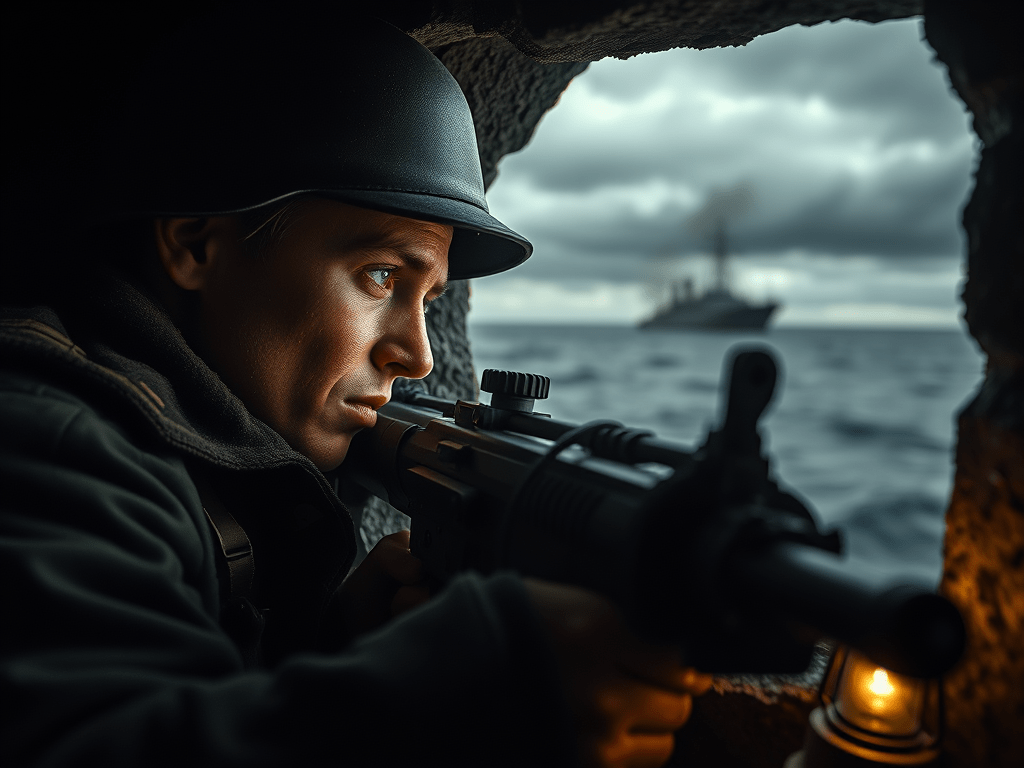
A Gunner in the Dark
It was 5:00 a.m., June 6, 1944.
The young German gunner pressed his cheek against the cold steel of his MG-42. He had barely slept in days, the salty wind cutting through the bunker like knives, his ears ringing from the constant crash of waves against the Normandy coast.
At first, he thought he was imagining it — the low rumble in the distance. A storm? No, it was steady. Growing louder. The others stirred, uneasy, their cigarettes trembling in the flickering light. He peered through the narrow slit of the bunker and froze.
The sea was alive.
Far on the horizon, dark shapes rose in the gray dawn. Hundreds of them. Then thousands. Ships — more than he could count. The Atlantic Wall, the vast line of fortifications Hitler had promised would keep Europe safe, was about to face its moment of truth.
The Fear of Invasion
The Wall began not with concrete but with fear. By late 1941, Hitler’s armies had swept across Europe — but he knew it couldn’t last forever. Britain still stood, battered but unbroken, and America had just entered the war. Sooner or later, the Allies would return to the continent.
Hitler’s mind, paranoid and calculating, conjured visions of mass landings. He ordered the creation of “Festung Europa” — Fortress Europe. The Atlantic coastline, stretching from Norway’s frozen fjords down to the sunny beaches of southern France, would be transformed into an unbreakable barrier of bunkers, minefields, and artillery.
No expense would be spared. The Führer called for a wall of steel and stone that would make Caesar jealous, a modern Hadrian’s Wall designed not to keep barbarians out, but to keep Allied armies from setting foot on German-held soil.
The Engineers of Fortress Europe
The task fell to Organization Todt, the Nazi construction corps infamous for autobahns and concentration camps. Led first by Fritz Todt and later Albert Speer, the organization marshaled an army of engineers, architects, and — most importantly — slave laborers.
From 1942 onward, Europe echoed with the clang of hammers and the roar of cement mixers. Forced workers from France, the Netherlands, and Eastern Europe dug trenches, poured foundations, and hauled steel under the eyes of German overseers. Many never returned home.
Concrete became the true weapon of the Atlantic Wall. The Germans poured an estimated 17 million cubic meters of it into bunkers and gun casemates. These fortresses, some with walls several meters thick, were designed to shrug off Allied naval bombardments. To Hitler, concrete was eternal; every bunker was a monument to his belief in permanence.
Inside the Defenses
The Wall was not a continuous line but a patchwork of deadly zones. Along key beaches and ports, defenses bristled.
- Machine-gun nests covered every likely landing spot.
- Artillery bunkers held captured French guns and massive German cannons, their barrels pointed toward the sea.
- Mines, barbed wire, and “Rommel’s asparagus” — wooden stakes planted in fields and beaches to wreck gliders and landing craft — littered the coast.
- Flamethrower bunkers and anti-tank obstacles waited to trap any force that managed to get ashore.
But between these strongpoints lay gaps — long stretches of sand, cliff, or marsh defended by little more than patrols and luck. The Wall was formidable, but not flawless.
Life Behind the Wall
For the soldiers manning the defenses, the Wall was both fortress and prison.
They lived in damp bunkers, concrete tombs that smelled of oil, sweat, and mildew. Meals were thin rations, often stale bread and watery soup. Hours stretched into days of boredom — broken only by sudden inspections, target practice, or the occasional Allied air raid.
Some were veterans from the Eastern Front, grateful for the relative quiet. Others were terrified teenagers or men conscripted from occupied countries, unsure who they were really fighting for.
And everywhere, rumors swirled: the Allies were coming. But when? And where?
The Allies Take Notice
The Wall was no secret. From the air, Allied reconnaissance planes photographed every bunker and trench. Resistance fighters risked their lives smuggling sketches and reports.
In London, planners studied maps with a mixture of dread and determination. The Wall looked impregnable — at least on paper. Allied commanders knew a frontal assault would be bloody, but there was no other choice. To liberate Europe, they would have to break it.
To deceive the Germans, the Allies launched Operation Fortitude, a web of lies and illusions. Fake armies under General Patton gathered in Kent, complete with inflatable tanks. Double agents whispered false reports to the Germans. The aim was simple: convince Hitler the invasion would fall at Pas-de-Calais, not Normandy.
And incredibly, it worked.
Rommel Arrives
In late 1943, Hitler sent one of his most celebrated commanders to inspect the defenses: Field Marshal Erwin Rommel, the “Desert Fox.”
Rommel had seen the power of Allied air superiority in North Africa. He knew the Wall, as it stood, would not hold. The Allies would not politely land at ports; they would come in force, by sea and air. Rommel demanded changes.
He ordered beaches sown with mines, obstacles, and steel “hedgehogs” that would tear open landing craft. He wanted the coast transformed into a killing zone, a porcupine bristling with steel. His famous warning to Berlin was stark: “The war will be won or lost on the beaches.”
But even Rommel’s urgency could not overcome bureaucracy. Hitler’s obsession with central control meant many coastal guns were tied to his personal authorization. Troops lacked fuel, ammunition, and the freedom to maneuver. Fortress Europe was powerful — but rigid.
The Calm Before the Storm
By spring 1944, the Atlantic Wall stretched for 2,600 miles. German propaganda boasted it was impenetrable. Posters showed soldiers smiling from bunkers, their eyes fixed on the sea.
Yet those inside the Wall knew better. Supplies were thin. Morale was low. And Allied bombing raids grew heavier with each passing week. Bridges, rail lines, and fuel depots were shattered. The Wall was strong — but was it strong enough?
Rommel himself grew uneasy. Touring the beaches of Normandy in May 1944, he saw holes in the defenses. He tried to plug them, but time was short. On June 5, he left for Germany to visit his wife on her birthday. He would not be at the front when the storm broke.
D-Day: The Test of the Wall
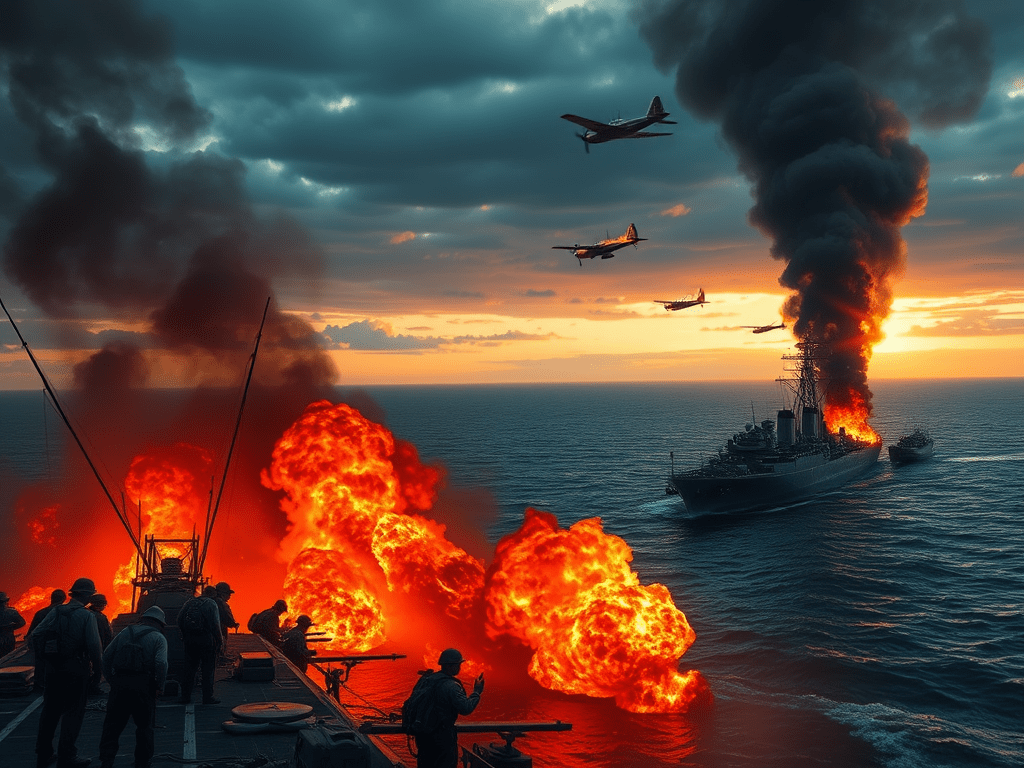
Back in the bunker, the young gunner could not take his eyes from the horizon. The sea was filled with shadows — destroyers, transports, landing craft. Above, the drone of engines grew louder as Allied bombers swept overhead.
Suddenly, the darkness split open. Naval guns thundered, the earth shook, and the bunker rattled as shells slammed into the coast. Dust filled his lungs; his ears screamed with pain.
Through the haze, he saw shapes moving toward the beach — landing craft grinding forward despite the obstacles and mines. The Wall was firing back: machine guns raked the sand, mortars boomed, artillery screamed. But still they came.
Men poured from the boats, stumbling, falling, running. The gunner squeezed the trigger, the MG-42 roaring to life, cutting arcs across the shoreline. Yet the tide of men did not stop. More and more, wave after wave.
By dawn, the Atlantic Wall was bleeding. By nightfall, it was broken.
The Wall Falls
The myth of Fortress Europe crumbled in a single day. Despite killing thousands, the Wall failed to hold.
At Omaha Beach, the cost was horrific — but the Americans clawed their way inland. At Sword, Juno, and Gold Beaches, British and Canadian troops broke through. By evening, Allied soldiers stood on French soil in strength.
The young gunner’s fate is unknown — one of countless men swallowed by history. But his fear, his desperation in that bunker, embodied the truth: the Atlantic Wall, for all its concrete and cannons, could not stop the Allies.
Epilogue: Legacy of Concrete
Remnants of the Atlantic Wall still stand today — silent bunkers on French beaches, rusting gun emplacements on cliffs, cracked concrete swallowed by dunes.
They are not monuments to German power, but to its limits. No wall, no matter how vast, can resist forever when men are determined to break it.
The Atlantic Wall was Hitler’s monument to paranoia. On June 6, 1944, it met courage, sacrifice, and overwhelming force. And it crumbled.
Sources
- Ambrose, Stephen E. D-Day: June 6, 1944: The Climactic Battle of World War II. Simon & Schuster, 1994.
- Beevor, Antony. D-Day: The Battle for Normandy. Viking, 2009.
- Zaloga, Steven J. The Atlantic Wall (1): France. Osprey Publishing, 2007.
- Speer, Albert. Inside the Third Reich. Macmillan, 1970.
- Ford, Ken. D-Day 1944 (1): Omaha Beach. Osprey Publishing, 1996.

 History in 5 Minutes or less
Leave a comment