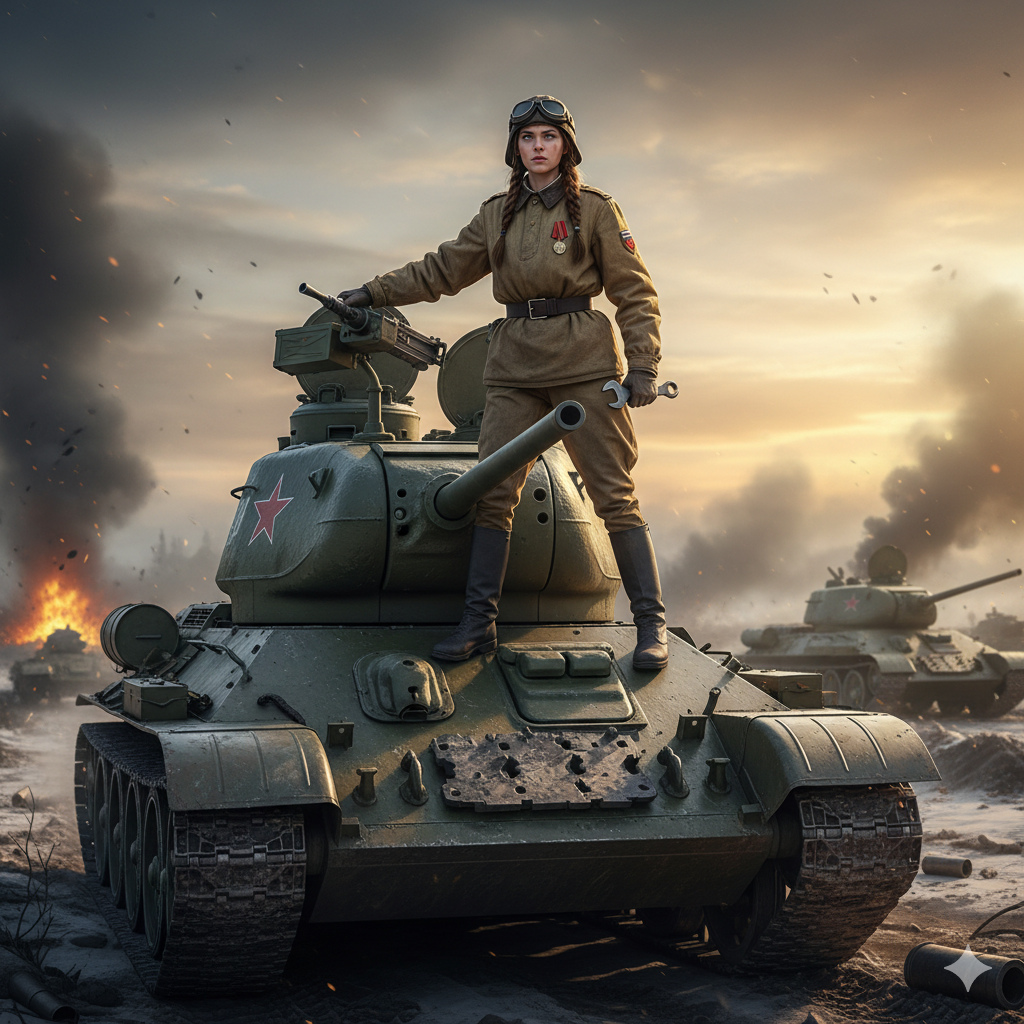
A Promise Written in Steel and Fury
The clatter of tools, the hiss of steam, and the stink of oil filled the Siberian factory floor when Maria Oktyabrskaya stepped forward with a stub of chalk in her gloved hand. Men stopped working. The foreman went silent. The T-34’s armor plate still gleamed from final polishing as she pressed her palm to the cold steel and wrote four words that cut sharper than any blade:
“Боевая подруга” — The Fighting Girlfriend.
She wasn’t christening a machine. She was issuing a declaration—to the Nazis, to Stalin, to fate itself. They had taken her husband. Now she would return the favor in tank treads and fire.
Just two years before, Maria had been a wife, a factory worker, a woman who understood service but not yet vengeance. War changed that. Widowhood forged it. And a telegram sealed it.
What followed was one of the most astonishing true stories of the Eastern Front: the only woman to buy her own tank, name it after herself, learn to drive it into combat, and make the Wehrmacht regret ever hearing her name.
Maria Before the War: A Soldier’s Wife with a Soldier’s Mind
Maria was born in Crimea in 1905, into a family of peasants. She didn’t grow up with power, money, or fame—but she did grow up with grit. As a young adult, she worked in a cannery, then became a telephone operator, and joined the Military Wives Council, where she learned basic military skills and even became familiar with small arms.
In 1925, she married Ilya Oktyabrsky, an officer in the Soviet Army. Unlike many military wives of the era, Maria didn’t want to simply wait at home. She trained in military support roles, drove trucks, and became skilled in vehicle maintenance—abilities that would become legendary later.
Still, nothing could prepare her for the message she received in 1941: Ilya had been killed battling the Germans near Kyiv.
She was devastated—and then she got angry.
The Letter that Shook the Kremlin
Rather than mourn quietly, Maria decided she would fight the enemy herself. But she didn’t just volunteer.
She sold everything she owned, gathered her savings, and sent 170,000 rubles—a massive sum—to Josef Stalin, with a proposal:
Build a tank with the funds. Let her drive it into battle to avenge her husband.
The request was astonishing. But the symbolism? Too perfect for Soviet propaganda to ignore.
Stalin approved.
Her T-34 tank was constructed and christened at her request: “The Fighting Girlfriend.”
Maria, then 37 years old, was assigned to the 26th Guards Tank Brigade of the 2nd Guards Tank Corps as both a driver and mechanic.
Her commanders were skeptical. Her crew was stunned. But no one would doubt her for long.
Training the Hard Way
Unlike many wartime volunteers given symbolic roles, Maria didn’t ride in the back for the cameras. She trained at a Siberian tank school and earned her spot on the crew through raw endurance and mechanical skill.
Her crew included:
- Sergeant Nikolai Yegorov (commander)
- Gunner Alexander Malkin
- Loader Gennady Yaskovets
- And Maria—the driver and mechanic
At first the men treated her like a mascot. Then the battlefield changed their minds.
Fire in Smolensk: Baptism in Blood
Her first combat mission came in autumn 1943, near Smolensk during the drive to push the Germans westward. The attack was ferocious, with dug-in Wehrmacht forces and anti-tank positions raining hell on advancing armor.
Maria didn’t flinch.
She drove straight through machine gun fire, skillfully maneuvering around obstacles, and helped the crew knock out artillery positions and a nest of German infantry.
When the tank took damage to its tracks, Maria did the unthinkable: she jumped out under fire and repaired it—with bullets snapping overhead. Her crew begged her to stay inside but she ignored them and got the job done.
She returned to the driver’s seat as if she’d just stretched her legs.
That act silenced any doubts about her.
The Legend Grows
After the battle, Maria was promoted to the rank of Sergeant. Soviet newspapers picked up her story and soon the “Fighting Girlfriend” became a national symbol of vengeance and resilience.
But Maria wasn’t interested in fame—she wanted more combat.
The Final Advance: Vitebsk, 1944
In January 1944 near Vitebsk, during the Soviet advance toward Belarus, Maria’s crew was assigned to a fast assault against entrenched German units.
Again, she drove with skill and fury, reportedly crushing German machine gunners and clearing a path for infantry. Her crew took out several enemy positions, including an anti-tank gun that could have decimated the column behind them.
Then disaster struck.
While engaging enemy forces, the tank was hit. The shell didn’t destroy the vehicle, but it damaged communications and halted the left track. Once again, Maria climbed out to repair it under fire.
But this time, artillery found its mark.
An exploding shell sent shrapnel tearing across the field.
Maria was struck in the head.
Her comrades pulled her back inside, but she had lost consciousness. She was evacuated to a field hospital, then to Smolensk, but her wounds were catastrophic.
After two months in a coma, she died on March 15, 1944.
She was 38 years old.
Hero of the Soviet Union
On August 2, 1944, Maria Oktyabrskaya was awarded the title Hero of the Soviet Union, the USSR’s highest honor, along with the Order of Lenin.
She now rests in the Heroes’ Remembrance Garden in Smolensk.
Her tank “The Fighting Girlfriend” served through the war with other drivers, though none left the mark that she did.
Why She Mattered
Maria’s story shattered gender expectations, even in a country that employed hundreds of thousands of women in combat-support roles. Unlike snipers like Pavlichenko or pilots of the Night Witches, Maria carved a unique niche—a frontline tanker who funded and operated her own war machine.
She represented:
- Personal vengeance turned patriotic duty
- Working-class sacrifice
- Female combat capability
- Symbolism fused with skill
Her acts were not staged photo ops. They were witnessed, recorded, and remembered by her crew and commanders alike.
Her legacy stands alongside other iconic Soviet women of WWII, but none fought quite the way she did.
Sources
- “Tankovy Desant” – Soviet WWII Tank Forces Archives
- Soviet Military Records, Central Archive of the Russian Ministry of Defense
- Pravda articles (1943–44) on “Boevaya Podruga”
- “Soviet Women in Combat,” by Anna Krylova
- Interviews with veterans of the 26th Guards Tank Brigade (compiled postwar)

 History in 5 Minutes or less
Leave a comment