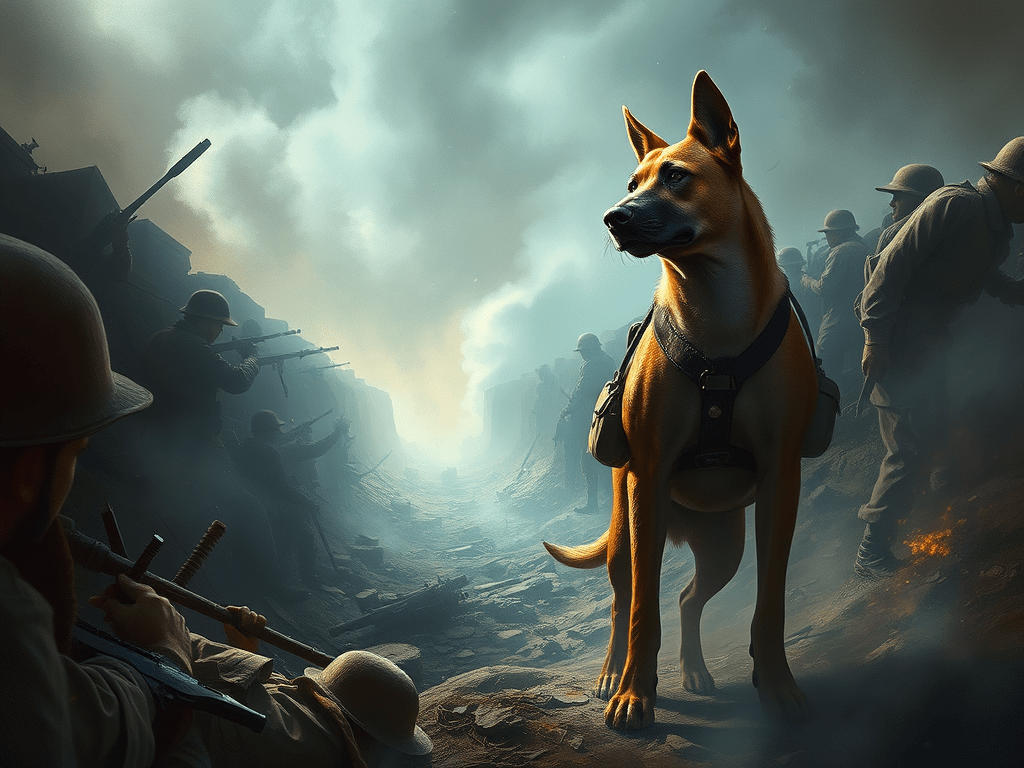
The thunder of artillery shook the ground. Smoke rolled through the trenches, thick and choking. Men scrambled for their gas masks — and in the chaos, a small brindle dog barked furiously, tugging at their uniforms, warning them to take cover. When the shells burst, that little dog was still there, standing his ground in the fog of war.
That dog was Sergeant Stubby — stray, soldier, spy-catcher, and perhaps the most unlikely hero in all of World War I.
A Stray Walks Into History
Before he became a decorated veteran, Stubby was nobody’s dog.
It was the summer of 1917, and the campus of Yale University in New Haven, Connecticut, was filled with the sounds of marching boots and shouted orders. The newly formed 26th “Yankee” Division was training for the war raging across Europe. The smell of gun oil and sweat hung in the air.
And then — out of nowhere — trotted a scruffy, stump-tailed mutt with a brindle coat and bright, intelligent eyes. No one knew where he’d come from. Maybe he’d wandered off the streets. Maybe he’d followed the scent of food and company. Whatever the reason, he found his way onto that training field — and into history.
Private J. Robert Conroy, a young soldier with a soft spot for strays, took an immediate liking to him. The dog had a compact, muscular build and an uncanny awareness of his surroundings. The men called him Stubby, for his short tail.
At first, he was just a mascot — a friendly distraction in a world preparing for war. But Stubby had a soldier’s soul. He followed drills, barked in time with the bugle, and even learned to salute by raising his paw. The men adored him.
As one soldier later said, “Stubby was one of us — just shorter and hairier.”
Stowaway to the Front
When the time came for the 26th Division to ship out to France, Conroy couldn’t leave Stubby behind. So he did what any soldier with a loyal friend would do — he smuggled him aboard the SS Minnesota.
Stubby hid below decks, tucked under blankets and inside duffel bags, surviving on scraps and charm. But his secret didn’t last long. When the commanding officer discovered the dog, Conroy braced for punishment.
Then Stubby, perhaps sensing the danger, stood up on his hind legs and snapped a paw to his forehead in a perfect salute.
The officer laughed. “He’s in,” he said.
And with that, Private Stubby unofficially joined the U.S. Army.
Into the Inferno
When the 26th Division reached France in 1918, they were thrown straight into the meat grinder — the trenches of Chemin des Dames, where the air stank of mud, death, and gas.
For Stubby, this was a new kind of world: the constant roar of artillery, the rattle of machine guns, the acrid smell of cordite. At first, he was terrified — but so were the men. Over time, Stubby adapted, learning to duck at the first whistle of incoming shells and to lie flat when machine guns opened up.
Then came his first act of heroism.
During a German gas attack, Stubby’s sharp nose detected the poison long before the humans noticed. He sprinted through the trenches, barking frantically and biting at soldiers’ coats, waking them up and warning them to put on their masks. His quick reaction saved dozens of lives that night.
From that day forward, Stubby was more than a mascot. He was a watchdog, alarm system, and guardian angel rolled into one.
A Hero’s Scars
War leaves its mark on everyone — even dogs.
Not long after his first gas warning, Stubby was caught in another attack and inhaled the deadly fumes. His fur was singed, his eyes burned, and he struggled to breathe. Medics treated him at a field hospital, where wounded soldiers found comfort in his presence.
Stubby didn’t moan or whimper; he wagged his tail. And soon, he began to visit the hospital tents, bringing morale to broken men. The nurses said he seemed to know who needed comfort most.
When he recovered, the troops crafted him a special uniform from a blanket — a makeshift coat to keep him warm and to mark him as one of their own. Later, the coat would be covered in medals, ribbons, and unit patches, each telling a story of bravery.
Stubby the Messenger
By the summer of 1918, the dog who had once lived on scraps had become a veteran of battle.
Stubby carried messages between trenches, sprinting across shell-scarred ground under fire. His small size and speed made him a harder target than any human runner. He delivered dispatches, carried medical supplies, and helped medics find wounded soldiers by barking to alert rescuers.
The men began to joke that Stubby was “the only one who volunteered for every mission.”
His fame spread beyond his unit. French soldiers greeted him with cheers, calling him le petit soldat américain — “the little American soldier.” Even the Germans heard rumors of the Yankee dog who never flinched.
But the legend truly took off one fateful day near Seicheprey.
The Day Stubby Caught a Spy
It was early morning. Mist hung over the no man’s land. Stubby was wandering behind the lines when he heard a faint rustling in the tall grass. His ears perked. His nose twitched.
Then he saw it — a man crawling, wearing a German uniform, sketching the Allied trenches.
Without hesitation, Stubby lunged. He grabbed the man by the seat of his pants and bit down hard, refusing to let go. The spy screamed, trying to shake him off, but Stubby dragged him toward the American lines, growling like a demon.
The startled soldiers rushed over — and realized that their dog had just captured a German spy.
The enemy soldier was arrested, and Stubby became an instant hero. The unit’s commanding officer “promoted” him on the spot to Sergeant Stubby, making him the first dog in U.S. history to earn a military rank.
As one soldier wrote home, “Our mutt just made more arrests than most MPs.”
From the Trenches to the Parade Ground
Stubby fought through 17 battles and four major campaigns, including the brutal Aisne-Marne and Meuse-Argonne offensives. He faced shrapnel, gas, and endless shellfire — but he never left his men.
At Château-Thierry, his bravery caught the attention of local villagers, who crafted him a fine leather coat decorated with Allied flags. By war’s end, that coat was covered in so many medals and honors that Stubby practically jingled when he walked.
He was, by all accounts, the most decorated war dog in American history.
When the Armistice came on November 11, 1918, Stubby marched proudly with the men he’d served beside. He’d been through hell with them — and survived.
Homecoming Hero
When the 26th Division returned to the U.S. in 1919, Stubby was no longer just a dog. He was a national celebrity.
He marched in victory parades in Boston, New York, and Washington, D.C., wearing his uniform of medals. Crowds cheered, waving flags and tossing flowers. Newspapers across the country ran stories about him.
At one parade, President Woodrow Wilson personally greeted Stubby, calling him “a brave little warrior.” Later, he met Presidents Harding and Coolidge as well — three presidents for one dog.
Stubby even received lifetime memberships in veteran organizations like the American Legion and the Red Cross. At meetings, he would sit quietly beside Conroy, tail wagging, as veterans swapped stories of the front.
College Days and Football Fame
When J. Robert Conroy enrolled at Georgetown University to study law, Stubby went with him. There, he became the school’s unofficial mascot, beloved by students and faculty alike.
Stubby would trot proudly across the football field at halftime, carrying the ball off in his mouth or performing tricks for roaring crowds. He was an instant legend on campus — the little war dog who’d gone from the trenches of France to the cheers of college football.
Conroy often said Stubby had “the heart of a soldier and the spirit of a showman.”
The Final March
As the years passed, Stubby grew older but never lost his spark. He appeared in parades, visited veterans’ hospitals, and starred in newsreels. Children loved him. Veterans saluted him. He was, in every sense, America’s dog.
On March 16, 1926, Stubby died peacefully in Conroy’s arms. He was believed to be around ten years old.
Conroy was devastated, but he ensured Stubby’s memory would live on. He had his companion preserved and displayed — uniform and all — at the Smithsonian Institution in Washington, D.C., where visitors can still see him today in the National Museum of American History.
His coat, covered in medals, remains one of the museum’s most beloved artifacts — a tangible reminder that heroes come in all shapes, sizes, and species.
Stubby’s Lasting Legacy
Stubby’s story became the foundation for what would become the modern U.S. military K9 program. The Army saw firsthand how dogs could detect gas, locate the wounded, and boost morale — all lessons learned from one scrappy stray.
Today’s military working dogs — from bomb-sniffing Labradors to patrol German Shepherds — trace their lineage back to Stubby’s pioneering service.
Beyond the battlefield, Stubby stands as a symbol of loyalty, courage, and friendship. He represents the bond between man and animal — a bond forged not by command, but by love.
And in a war remembered for its cruelty and loss, Stubby’s story shines like a small, defiant flame of hope.
The Spirit of a Soldier
In the mud of France, Stubby was never just a pet. He was a brother-in-arms — loyal when men faltered, fearless when the world fell apart.
He had no rank, no rifle, no words. But when the gas came, when the shells fell, when the wounded cried out — Stubby was there.
A hundred years later, his story still moves us because it reminds us what heroism truly is: not the absence of fear, but the refusal to abandon those who need you most.
Stubby never understood the politics of the war, the strategies, or the borders. He only understood friendship. And that, in the end, was enough to make him immortal.
Sources
- Bausum, Ann. Sergeant Stubby: How a Stray Dog and His Best Friend Helped Win World War I and Stole the Heart of a Nation. National Geographic, 2014.
- Smithsonian National Museum of American History: “Sergeant Stubby: The War Dog.”
- Connecticut State Library Archives: “Stubby: The Dog, The Legend.”
- American Battle Monuments Commission: “Stories of Service: Sergeant Stubby.”
- PBS American Experience: “Stubby, The Dog Who Became a Sergeant.”
 History in 5 Minutes or less
Leave a comment