
The Fever Pitch of 1790: Two Nations Under One Roof
The year 1790 began with the United States operating less like a cohesive republic and more like a loose collection of highly skeptical, debt-ridden states. The temporary capital, New York City, was a pressure cooker where political factions—still embryonic but vicious—clashed daily. The central conflict paralyzing the new government boiled down to two seemingly unrelated issues: money and location.
In one corner stood the ambitious, sharp-eyed Secretary of the Treasury, Alexander Hamilton. A self-made man with an almost fanatical belief in centralized power and commercial growth, Hamilton saw the nation’s crippling debt—incurred during the Revolutionary War—not as a burden, but as the raw material for greatness. His sweeping Financial Plan aimed to bind the states to the federal government forever.
The most controversial element of this plan was Assumption. Hamilton proposed that the federal government should assume, or take over, the entire war debt of all thirteen states. The total was staggering, over $25 million. Hamilton’s logic was brilliant: pay off the debt, establish national credit, and give wealthy investors a permanent stake in the success of the U.S. government.
In the other corner were the agrarian philosopher, Secretary of State Thomas Jefferson, and his close ally, Congressman James Madison. Hailing from Virginia, the South’s most influential state, they recoiled at Hamilton’s vision. They feared a powerful, centralized, and monarchical-leaning government. The Assumption plan was seen as a naked grab for power, rewarding Northern speculators who had bought up cheap debt certificates from war veterans and punishing Southern states (like Virginia), which had already paid down the majority of their own debts.
The debate wasn’t just political; it was profoundly personal. The men who had fought together now faced a legislative standoff that threatened to dissolve the Union less than two years after the Constitution was ratified.
The Architectural Divide: Hamilton vs. Jefferson
To understand the ferocity of the Compromise of 1790, you must first appreciate the men involved.
Alexander Hamilton (The Visionary): Small in stature but towering in intellect, Hamilton was a whirlwind of energy. He saw the world in economic terms: banks, tariffs, manufacturing, and strong credit. He had a deep mistrust of the common man and an absolute faith in institutional strength. He was a creature of the city, driven by the pace of commerce and impatient with philosophical debate. When his plan stalled in Congress, Hamilton was frantic. His entire vision for the republic—a modern, dynamic state—was deadlocked, defeated by a block of Southern votes marshaled by James Madison.
Thomas Jefferson (The Philosopher): Tall, elegant, and reserved, Jefferson was Hamilton’s temperamental opposite. He was a champion of the independent farmer and mistrusted all forms of concentrated power, especially financial power. He had just returned from a long diplomatic post in France and found himself thrown into the mess of the nascent American government. He was horrified by the intensity of the legislative fighting and genuinely concerned that the Union would crumble over a balance sheet.
James Madison (The Strategist): The quiet, studious “Father of the Constitution” was Jefferson’s lieutenant in the House of Representatives. Madison led the charge against Assumption. He argued with tireless legal precision, but the result was the same: Southern votes blocked Hamilton’s bill, leaving the Treasury Secretary’s grand plan in ruins and the future of American credit hanging by a thread.
The legislative session ground to a halt. Hamilton’s Assumption bill failed in the House by a handful of votes in June 1790. The North seethed; the South celebrated. It was clear: one side would have to yield, but neither had the political capital to do so.
The Two Hot Potatoes: Debt and Domicile
The second crisis was equally volatile: the location of the permanent national capital.
For years, Congress had been meeting in New York, and the Northern states desperately wanted the capital to stay there, or at least in a major commercial center like Philadelphia. They felt it was essential for governance to be near the financial markets.
The Southern states, however, viewed a Northern capital with profound suspicion. They felt it would entrench Northern financial interests and isolate the Southern, agrarian way of life. They were determined to place the capital in a Southern location, preferably on the banks of the Potomac River, which bordered Virginia and Maryland—a location rich in political symbolism and far from the “corrupting” influence of Northern finance.
Congress had been debating the Residence Act—the bill that would fix the capital’s location—for months. Every state jockeyed for position, offering incentives and threats. The Residence Act, much like the Assumption Act, was stuck in legislative purgatory.
It was into this boiling political cauldron that Thomas Jefferson decided to step as the mediator.
The Dinner Invitation
Jefferson, observing the deadlock and sensing the existential danger to the Union, later recounted the moment in his journals. He described finding Hamilton “so sick and so disconsolate” that he feared for his colleague’s health. Hamilton confirmed the worst: his plan had failed, his reputation was ruined, and he saw “a dissolution of the Union as inevitable.”
Jefferson, the conciliator, saw an opportunity not for political victory, but for peace. As he rode to see President Washington, he encountered Hamilton walking “homeward, dejected, and discust.”
“What a calamity it is,” Jefferson is reported to have said, “that with this great government, established at the expense of so much labor and blood, we should be broken up by a single question of finance!”
He proposed a simple solution: a private meeting to discuss the matter like gentlemen, not political gladiators. The venue would be his rented home at 57 Maiden Lane, New York—a neutral ground, a dinner table, away from the venom of the Congressional chambers.
And so, one muggy June evening, the stage was set for what would become known to history as the Dinner Table Bargain.
The Feast of Compromise
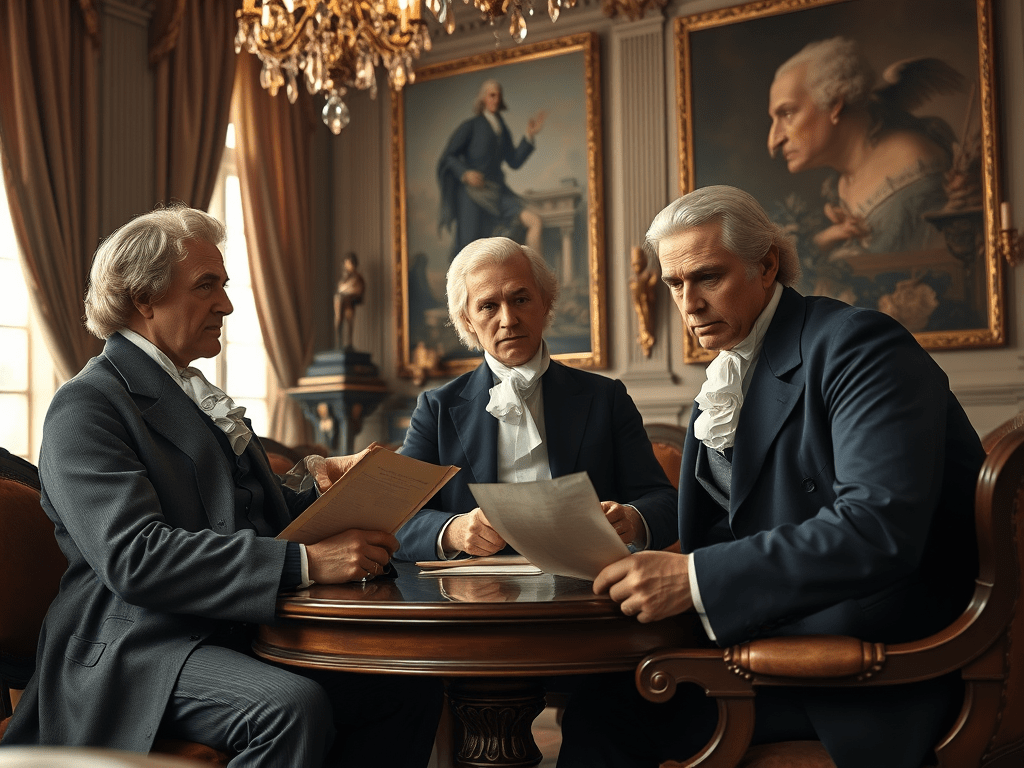
The attendees were only three: Thomas Jefferson, the host and mediator; Alexander Hamilton, the desperate Treasury Secretary; and James Madison, the key Congressional vote-wrangler.
The evening began with the typical Southern hospitality Jefferson insisted upon, the conversation likely starting light—perhaps discussing French politics or the latest news from Monticello. But the purpose was deadly serious.
Hamilton laid out his case for Assumption with passion and logic. The national honor was at stake. Without a unified national debt, America could not borrow, could not trade, and could not command respect abroad. He needed Madison to switch just a handful of votes.
Madison, the intellectual giant, countered with the principles: the unfairness to Virginia, the speculators, and the danger of giving the federal government too much control.
Jefferson listened, guided, and adjudicated. He understood both men’s arguments, but his priority was the survival of the government itself. He presented the two issues—Assumption and the Capital—as two halves of a single, necessary deal.
The terms of the bargain were starkly simple:
- Assumption Passes: Hamilton’s plan would be rescued. Madison would agree not to actively oppose the Assumption bill and would find two or three Southern votes in the House to ensure its narrow passage.
- The Capital Moves South: In exchange, Hamilton would secure Northern votes for the Residence Act, ensuring that the permanent capital would be located on the Potomac River.
The bargain wasn’t instantaneous or easy. Madison was reluctant, seeing it as yielding a principle for a geographical prize. Hamilton hated the idea of moving the capital away from the commercial heart of the North. But both men understood the stakes: the alternative was national disintegration.
By the end of the evening, a handshake sealed the deal. The details were left vague enough for all parties to save face, but the core agreement was firm.
The Residence Act and The Act Funding the Public Debt
Jefferson immediately set to work on his end, persuading two reluctant Virginia congressmen, Alexander White and Richard Bland Lee, to change their votes.
The political maneuvering was masterful. The Residence Act was voted upon first and passed easily. The capital would first move to Philadelphia for a ten-year residency, giving a decade of stability and a convenient transition period. Crucially, in 1800, the seat of government would permanently relocate to a federal district ten miles square, carved out of land ceded by Virginia and Maryland on the Potomac.
A few weeks later, in August 1790, the Act Funding the Public Debt—the Assumption bill—came up for a vote. True to the bargain, Madison remained neutral, and the two Virginian votes appeared. The bill passed by a tiny majority.
The relief in Hamilton’s office was palpable. His entire financial system was now law. The United States had established its credit, and the foundation for the Bank of the United States was laid.
The Compromise of 1790, the Dinner Table Bargain, had succeeded. The nation’s finances were secured, and the geographical location of its power center was decided.
Legacy and Irony of the New City
The irony of the compromise was profound, especially for Thomas Jefferson. He later reflected that he had been “duped” by Hamilton, stating that he was “a stranger to the ground” and “was made a tool for forwarding the purposes of the Secretary of the Treasury.” This moment is often cited as the origin of the deep, personal political enmity between Hamilton and Jefferson, setting the stage for the rise of America’s first political parties (Federalists and Democratic-Republicans).
Yet, the capital did move. In 1800, the entire federal government—officials, papers, and employees—picked up and moved to the muddy, sparsely populated plot of land on the Potomac. John Adams was the first president to reside in the newly built White House. The city, named in honor of the first president, became Washington, District of Columbia.
The Compromise of 1790 was the moment American politics learned to walk. It demonstrated that even in the face of bitter, ideological warfare, the survival of the Union could be—and had to be—purchased through pragmatic, backroom deal-making. It was the birth of American bipartisanship, defined by two men who fundamentally distrusted each other, yet recognized a greater, shared necessity.
Sources
- Jefferson, Thomas. Autobiography. (Primary source detailing Jefferson’s account of the meeting and his later regret.)
- Chernow, Ron. Alexander Hamilton. (A definitive modern biography that explores Hamilton’s desperation and political strategy.)
- McDonald, Forrest. Alexander Hamilton: A Biography. (Excellent analysis of the economic and political necessity of the Assumption plan.)
- Freeman, Joanne B. Affairs of Honor: National Politics in the New Republic. (Contextual reading on the political culture and personal rivalries of the era.)
- The Statutes at Large of the United States of America: The Residence Act (1790) and The Act Funding the Public Debt (1790). (The official legislative documents passed as a result of the compromise.)
- Flexner, James Thomas. George Washington and the New Nation, 1783-1793. (Explores Washington’s influence and preference for the Potomac location.)





 History in 5 Minutes or less
Leave a comment