The year is 264 BCE. Imagine the Mediterranean not as a placid blue highway, but as a vast, unforgiving prize. On its eastern shores, a fledgling Republic named Rome, hungry and aggressive, had just devoured the last of the Italian peninsula. On its southern shores, the mighty Carthaginian Empire—rich, seafaring, and ancient—watched with cool, calculating eyes.
This wasn’t just a political disagreement; it was a cosmic clash of cultures. Rome, the resilient land-wolf driven by citizenship and legionary discipline, stood poised against Carthage, the sophisticated sea-eagle whose power rested on trade, mercenaries, and naval supremacy. The stage was set for a three-part tragedy, a conflict so brutal it would reshape the map of the world forever: The Punic Wars.
Part I: The Fight for Sicily (The First Punic War, 264–241 BCE)
The initial spark that ignited this rivalry was, of course, entirely ridiculous. It concerned a band of Italian mercenaries, the Mamertines (Sons of Mars), who had seized the city of Messana on the northeastern tip of Sicily. When they needed help against the Syracuseans, they called both Rome and Carthage.
Carthage, already dominating Western Sicily, arrived first. Rome, seeing an opportunity to expand outside the Italian boot and—more importantly—to check Carthaginian expansion, arrived second. Neither side would leave. This was the moment of truth. Rome and Carthage, who had been uneasy allies against Pyrrhus of Epirus just decades earlier, were now staring down their own spears.
The initial years were a land war fought in Sicily, and here, the Roman legions excelled. But Carthage’s power was the sea. They operated sleek, fast galleys called quinqueremes, whose three tiers of rowers made them unstoppable battering rams. Rome had virtually no navy.
The Invention of the Crow
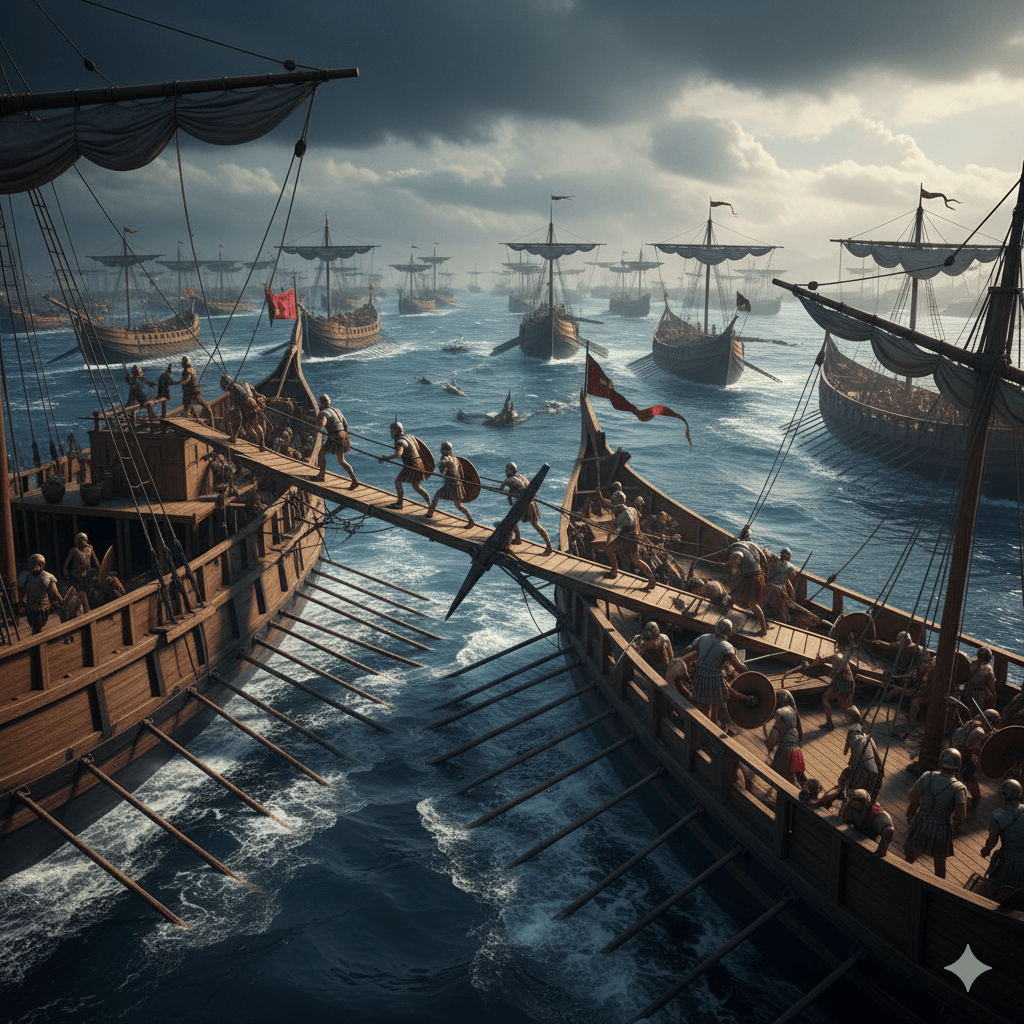
The Romans, however, had an entirely Roman solution: they refused to accept the rules of naval engagement. They designed a revolutionary, ridiculous, and ultimately brilliant device called the corvus, or “crow.”
Imagine a giant, hinged drawbridge with a massive metal spike (the beak of the crow) at the end. When a Roman ship approached a Carthaginian vessel, they would drop the corvus, spearing and locking the enemy ship in place. Instantly, the sea battle became a land battle. Roman legionaries would stream across the bridge and engage in hand-to-hand combat, turning the enemy’s strength (naval maneuvering) into Rome’s strength (infantry discipline).
The corvus won crushing victories for Rome, most notably at the Battle of Mylae (260 BCE). But Roman luck soon turned sour. The sea proved a harsher enemy than Carthage; massive storms repeatedly decimated the inexperienced Roman fleets, sinking thousands of men and ships.
After two decades of exhausting, brutal struggle, characterized by legendary endurance from generals like Hamilcar Barca on the Carthaginian side, the final blow came in 241 BCE. Rome, leveraging its seemingly endless manpower and superior economic staying power, won the Battle of the Aegates Islands. Carthage, financially ruined and unable to maintain its mercenary armies, sued for peace.
The Price of Peace: Carthage surrendered Sicily, paid a crippling indemnity, and promised never to attack Rome or its allies. Rome, now mistress of a foreign province, tasted its first truly global power.
Part II: The Shadow of the Alps (The Interwar Period and Hannibal’s Wrath)
The peace was fragile—a twenty-three-year intermission before the second act. Carthage suffered greatly. A brutal mercenary revolt erupted, which Hamilcar Barca, a brilliant and furious general, savagely suppressed. This period solidified the hatred that would define the next war.
Hamilcar, consumed by a need for vengeance, took his young son, Hannibal, to Spain. According to legend, he made the nine-year-old boy swear an oath before the altar: never to be a friend of Rome. The oath would be kept.
In Spain, the Barcid family carved out a new economic empire to replace Sicily, centered on mining and silver. The Romans watched, uneasy, eventually drawing a line at the Ebro River: Carthage could expand south of the Ebro, but north of it was Rome’s sphere.
The Spark: Saguntum and the Great March
In 219 BCE, Hannibal, now a commander of supreme charisma, tactical genius, and iron will, besieged the city of Saguntum, a Roman ally south of the Ebro. Rome demanded he back off. Hannibal refused. This was not a military necessity; it was a deliberate provocation. Hannibal wanted the war, and he wanted it on his terms.
The Second Punic War (218–201 BCE) began with what remains one of the most audacious military feats in history: Hannibal’s March.
He gathered an army of about 90,000 men, 12,000 cavalry, and—famously—37 war elephants. Ignoring the Roman expectation that he would fight by sea, Hannibal began a nearly impossible trek through the Pyrenees, across Southern Gaul (France), and, crucially, over the treacherous, snow-choked Alps.
The journey was a nightmare. Local tribes attacked relentlessly; men and animals slipped to their deaths on icy passes; the cold was unimaginable. By the time Hannibal descended into the plains of Northern Italy, his army was reduced to fewer than 30,000 men. But they were alive, they were loyal, and they were ready.
Part III: The Year of the Disaster (The Second Punic War, 218–201 BCE)
Hannibal’s presence in Italy was a catastrophic shock to Rome. The very idea of an enemy army traversing the Alps had been considered absurd. Rome scrambled to recall its legions.
Trebia, Trasimene, and Terror
Hannibal’s early battles were demonstrations of tactical artistry.
- Trebia (218 BCE): He used the cold river and a hidden cavalry ambush to rout the Roman army, slaughtering 26,000 men.
- Lake Trasimene (217 BCE): Hannibal executed a perfect morning fog ambush, trapping a massive Roman force against the lake shore and massacring almost the entire army. The Roman consul, Gaius Flaminius, fell in battle.
Rome was paralyzed by fear. The Senate appointed Quintus Fabius Maximus as dictator. Fabius understood he could not defeat Hannibal in open battle. He adopted a strategy of attrition, following Hannibal closely, burning crops, and refusing to engage directly—earning him the nickname Cunctator (“The Delayer”). This strategy was militarily sound but politically unpopular; Romans saw it as cowardice.
Cannae: The Anvil and the Hammer (216 BCE)
Driven by popular outrage and impatience, the Roman Senate appointed two new consuls and assembled the largest army in Roman history—nearly 86,000 men—to finally crush Hannibal at the village of Cannae.
Hannibal was outnumbered, but he saw the Roman arrogance as an opportunity. He placed his weakest infantry in a shallow crescent at the center and his veteran African infantry on the flanks.
When the Roman legions charged, pushing the Carthaginian center back, they believed they were winning. They drove deeper and deeper into the trap. Then, the Carthaginian center stopped, and the veteran African flanks—the hammer—swung inward, while Hannibal’s heavy cavalry sealed the Roman rear—the anvil.
What followed was not a battle but a butchery. In a single afternoon, Hannibal inflicted the single worst defeat in Roman history. Up to 70,000 Roman soldiers were killed or captured. Rome lost a quarter of its fighting population. The phrase “Hannibal ad portas!” (Hannibal is at the gates!) became the cry of terror in the city.
Scipio’s Counterpunch
Hannibal remained in Italy for another decade and a half, unable to take Rome itself, but turning many of its allies against it. But while Hannibal fought a war of attrition, a new Roman star was rising: Publius Cornelius Scipio (later Africanus).
Scipio was a young, brilliant general who understood Hannibal’s genius was not invincible. He convinced the Senate to allow him to take the war to Carthage’s backyard: Spain. Scipio systematically dismantled the Carthaginian power base there, demonstrating tactical brilliance that rivaled Hannibal’s own.
In 204 BCE, Scipio launched his most audacious plan: an invasion of North Africa. This was the masterstroke. It forced Carthage to recall its unstoppable general from Italy.
The Final Showdown: Zama (202 BCE)
Hannibal, now relying on a motley crew of mercenaries and new Carthaginian levies, faced Scipio near Zama. Scipio’s army was disciplined and motivated.
Hannibal began the battle by unleashing his 80 war elephants. Scipio, anticipating this, arranged his legions in columns, creating corridors for the elephants to charge harmlessly through. The Roman skirmishers then drove the beasts out to the flanks where they were dealt with.
The final phase was a direct infantry clash. It was brutal, but when Scipio’s cavalry, led by his Numidian ally Masinissa, returned from routing the Carthaginian horse, they smashed into Hannibal’s rear.
This time, the Roman hammer fell on the Carthaginian anvil. Hannibal was utterly defeated. He fled the field, having lost a battle for the first and only time.
The Second Peace: Carthage was stripped of its colonies, forced to disarm its fleet (except for ten ships), and forbidden from waging war without Roman consent. Rome had won, but the cost was nearly unbearable.
Part IV: The End of an Empire (The Third Punic War, 149–146 BCE)
For the next fifty years, Carthage slowly, painfully, tried to rebuild its trade and prosperity. Rome, meanwhile, grew increasingly powerful, wealthy, and paranoid.
The defining voice of this paranoia belonged to Marcus Porcius Cato (Cato the Elder). No matter what the topic of debate was in the Senate, Cato would conclude his speeches with the same, terrifying phrase: “Carthago delenda est.” (Carthage must be destroyed).
When Carthage finally retaliated against the continuous provocations of the Numidian King Masinissa (a Roman ally), Rome used the act as a pretext. In 149 BCE, Rome demanded that the Carthaginians abandon their city and resettle inland. This was a non-starter. The citizens of Carthage chose to fight.
The resulting three-year siege was a grim spectacle of desperation and Roman brutality. The Carthaginians, cornered, fought house-to-house and street-to-street. When the Romans finally breached the walls, they slaughtered the population, enslaved the survivors, and completely razed the city, brick by brick.
The legend that the Romans sowed the earth with salt to forever render it infertile is likely a later invention, but the reality was equally final: Carthage was gone. Its territory became the Roman province of Africa.
The Legacy of the Phoenix
The Punic Wars were the crucible that forged the Roman Empire. Rome had faced annihilation and emerged not just victorious, but utterly dominant in the Western Mediterranean. The wars gave Rome Sicily, Spain, and North Africa. They gave Rome a permanent navy and solidified its reputation for unwavering resolve.
However, the wars also had a dark side. The vast influx of slaves and war booty destabilized Roman society, driving small farmers off their land and contributing to the social unrest that would plague the Republic for centuries.
Ultimately, the Punic Wars answer the question: What happens when two mighty powers fight until the end? Only one remains. Rome’s victory was total, absolute, and ensured its destiny as the master of the Mediterranean world—a power that would endure for another five centuries.
Sources:
- Livy (Titus Livius): Ab Urbe Condita (From the Founding of the City). Books 21–30 cover the Second Punic War in detail and form the primary literary source for the period, offering a Roman perspective.
- Polybius: The Histories. Books 1–3 are invaluable, as Polybius was a Greek historian writing shortly after the events and aimed for strict historical accuracy, providing a more balanced view of the wars, especially the First Punic War and the Carthaginian perspective.
- Goldsworthy, Adrian. The Fall of Carthage: The Punic Wars 265–146BC. Cassell, 2003. (A modern, comprehensive military history).
- Hoyos, Dexter. Hannibal’s Dynasty: Power and Politics in the Western Mediterranean, 247-183 BC. Routledge, 2003. (Focuses heavily on the Barcid family).
- Miles, Richard. Carthage Must Be Destroyed: The Rise and Fall of an Ancient Civilization. Penguin Books, 2011. (Offers a detailed look at the Carthaginian culture and struggle).


 History in 5 Minutes or less
Leave a comment