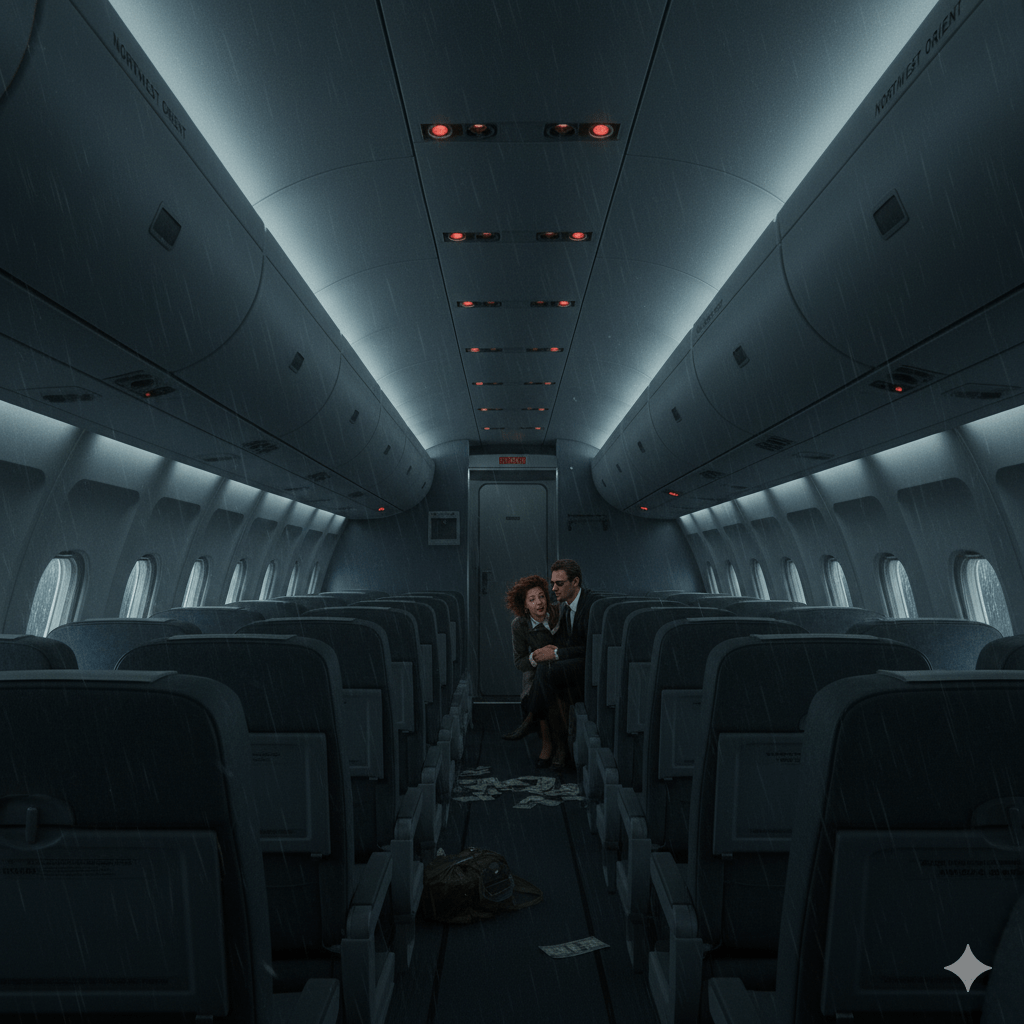
The Quiet Man on the Day Before Thanksgiving
The date was Wednesday, November 24, 1971—the day before Thanksgiving. The air in Portland, Oregon, was thick with the predictable pre-holiday rush, a hum of anticipation and hurry. But amidst the clamor at Portland International Airport, a single, unassuming figure stepped up to the Northwest Orient Airlines counter. He paid cash for a one-way ticket on Flight 305 to Seattle. His name, he said, was Dan Cooper.
He was the definition of nondescript: a man in his mid-forties, perhaps six feet tall, dressed in a black business suit, a crisp white shirt, and a dark clip-on tie. He looked every bit the quiet, professional traveler—the kind of man you’d forget the moment he passed through the gate. Boarding the Boeing 727, Cooper settled into seat 18C in the back of the cabin. He ordered a bourbon and soda, lit a cigarette, and watched the Pacific Northwest coastline recede beneath the wings. For the 36 other passengers and the crew, it was just a routine 30-minute hop.
But for Cooper, it was the opening act of a legend.
The atmosphere in the cabin was relaxed as the 727 climbed to cruising altitude. The jet, a state-of-the-art marvel of the day, featured a distinctive design element that would soon become central to this unfolding drama: the aft-mounted air stairs, a staircase that could be lowered from beneath the tail section, even in mid-flight. Cooper knew this detail. He had studied the machine.
After the wheels were up and the seatbelt sign was off, Cooper beckoned the flight attendant nearest him, 23-year-old Florence Schaffner. He handed her a handwritten note, folded neatly. She initially assumed it was a lonely businessman’s phone number and slipped it unread into her pocket. Cooper leaned in, his voice calm but firm, the kind of quiet authority that demanded attention. “Miss,” he said, “you’d better look at that note. I have a bomb.”
Schaffner retrieved the note. Written in neat, all-caps script, it was terrifyingly concise. Cooper then requested that she sit next to him. When she did, he opened his cheap attaché case just enough for her to peer inside. What she saw was a mass of red cylinders—dynamite or flares, it didn’t matter—wired to a large battery. It was compelling enough evidence. Cooper was not bluffing. He was making a statement. This was not a moment of panic; this was meticulous, cold-blooded theater. He demanded that she deliver his specific instructions to the cockpit immediately.
The Note and the Negotiation: $200,000 and Four Chutes
The captain, William Scott, received the relayed demands. They were precise and non-negotiable, demonstrating a startling familiarity with both aviation logistics and FBI procedures:
- $200,000 in “negotiable American currency.” Specifically, twenty-dollar bills.
- Four parachutes. Two primary and two reserve.
- A fuel truck standing by in Seattle for immediate refueling upon landing.
Captain Scott immediately alerted air traffic control, who in turn contacted the FBI. Thus began the largest and most intensive manhunt in American history, known officially as the FBI’s “Northwest Hijacking” case, or NORJAK.
While the aircraft circled the skies over Puget Sound—a deliberate delay to allow authorities time to assemble the ransom—Cooper remained unnervingly polite. He ordered another bourbon and soda. He paid for his drinks. When Florence Schaffner, and later, flight attendant Tina Mucklow, sat with him, he insisted they be comfortable. He spoke calmly, never threatening them directly, but maintaining absolute control. He described the geographical layout of Tacoma, pointing out sites from his window seat, reinforcing the impression of a local man or at least one familiar with the terrain.
The $200,000 ransom was quickly gathered by the Seattle-First National Bank, consisting of 10,000 twenty-dollar bills. Every single bill’s serial number was meticulously photographed and recorded on microfilm, creating a massive paper trail the FBI hoped would eventually lead them to the hijacker. The money weighed roughly twenty-one pounds—a significant, bulky load to carry, especially when jumping out of an airplane.
The parachutes proved slightly more difficult. Authorities scrambled to find four non-military, civilian-grade parachutes to meet the demand precisely. In a subtle but crucial misstep that would become a key forensic detail later, the authorities provided four standard parachutes, two of which were non-functional dummy chutes that had been rendered useless and sewn shut for instructional purposes. Cooper, in his professional calm, inspected the delivery upon landing. Did he notice the flaw? Did he know he was handed two duds? The man who had meticulously planned every other detail certainly missed, or ignored, this critical detail, suggesting a possible lack of genuine skydiving experience.
After nearly two hours of circling, the Boeing 727 finally descended toward Seattle-Tacoma International Airport (Sea-Tac).
The Seattle Layover: A Brief Exchange
At 5:39 p.m., Northwest Orient Flight 305 touched down on the Seattle tarmac. The tarmac was eerily quiet, swarming discreetly with FBI agents. Cooper insisted on strict adherence to his rules: no sudden movements, no tricks. He instructed the pilot to taxi the plane to a remote, brightly lit area of the runway, preventing any close approach by law enforcement.
The exchange was tense and efficient. Cooper ordered that the passengers—all 36 of them—be released in exchange for the ransom money and parachutes. The transfer was made by a Northwest Orient operations manager, who delivered the heavy satchel of currency and the canvas bags containing the chutes.
As the passengers departed, Cooper maintained his hostages: Captain Scott, First Officer Rataczak, Flight Engineer Calloway, and the remaining flight attendant, Tina Mucklow. With the passengers safely off the plane, Cooper directed the plane to be refueled—a process he oversaw, watching through the cockpit windows as the fuel trucks did their work. He was preparing for the final, most audacious phase of his escape.
Once the fueling was complete, Cooper laid out his final, detailed flight plan:
- Destination: Mexico City.
- Altitude: No higher than 10,000 feet.
- Airspeed: No faster than 100 knots (approximately 115 mph).
- Configuration: Landing gear lowered and wing flaps deployed to maintain the slow speed.
- Aft Airstairs: Lowered and ready for descent.
This extremely slow, low-altitude flight path was strategically chosen to maximize the difficulty for any potential pursuit and to make the jump survivable. At this point, the man the world would soon know as D.B. Cooper—the “D.B.” being a media error after a Portland reporter confused the alias Dan Cooper with a known local figure—had secured his objective and was now dictating the terms of his vanishing act. The plane took off again at 7:40 p.m., heading south into the black, rainy night.
The Second Leg: Into the Dark Abyss
The Boeing 727, designated N467US, lumbered south toward Reno, its intermediate refueling stop en route to Mexico City. The flight crew was confined to the cockpit, instructed to stay behind a closed door. Cooper, now alone with Tina Mucklow in the cabin, ensured his privacy. He tied the heavy bag of $20 bills to his body using the nylon shroud line from one of the unused parachutes.
Sometime around 8:00 p.m., Cooper ordered Mucklow to join the rest of the crew in the cockpit. He was securing the final moments of his planned solitude. He gave Mucklow strict instructions not to open the cockpit door, regardless of what she heard. She complied, sealing herself with the rest of the crew behind the solid cockpit door.
The man in seat 18C, the quiet businessman, transformed into the lone skydiver. He cinched a parachute harness, likely the better of the two functional chutes, to his frame. He then moved to the rear of the cabin, the heavy satchel of $20 bills his constant companion. He used the plane’s internal controls to lower the aft airstairs.
In the cockpit, a warning light suddenly flashed: Aft Airstairs Open.
Captain Scott immediately realized what was happening. He radioed Cooper, asking if he needed any assistance, hoping to buy time. Cooper did not respond. At approximately 8:13 p.m., the crew felt a sudden, distinct upward movement of the tail section, accompanied by a subtle change in cabin pressure. They knew the jump had occurred.
Cooper had stepped off the lowered stairs of the jet, likely somewhere over the rugged, heavily forested wilderness of Southwestern Washington, near the Lewis River and Lake Merwin. He plummeted into a night that was moonless, rainy, and bitterly cold. The jet was flying at an altitude of approximately 10,000 feet and an airspeed of 190 miles per hour, meaning the initial wind blast would have been severe, even dangerous.
The Leap of Faith and the Silent Descent
The decision to jump from a moving aircraft in a civilian suit, loafers, and a business coat, into a turbulent, pitch-black night, was perhaps the most reckless element of Cooper’s meticulously planned crime. His flight parameters—low altitude, slow speed—were optimized for a safe jump, yet the environmental conditions were the opposite. The wind chill at that altitude and speed was far below freezing, and the rugged terrain below was a mix of dense forest, steep canyons, and fast-flowing, frigid rivers.
If Cooper was indeed an experienced paratrooper, he made critical mistakes. He failed to notice the reserve parachute was sewn shut. He chose an unsteerable canopy for his jump. He didn’t wear a helmet, or protective gear, or even suitable clothing for the harsh impact and subsequent survival. This led the FBI to later theorize that Cooper was likely not a military veteran, or at the very least, he was deeply out of practice. The jump, for all its cinematic flair, was a suicidal gamble.
Did he survive? This single question launched 50 years of speculation. The FBI’s initial estimate of the drop zone was calculated based on wind patterns, placing the potential landing spot in a remote, mountainous area near Ariel, Washington.
Two F-106 fighter jets, scrambled to follow the 727, were flying too high and too far away in the dark to spot Cooper’s black silhouette descending into the darkness. No one saw the parachute deploy. No one heard a landing. The plane continued flying until it finally landed in Reno, Nevada, where the crew confirmed the astonishing truth: D.B. Cooper was gone. All that remained was his clip-on J.C. Penney tie, a few cigarette butts, and an unparalleled air of mystery.
The Case File: NORJAK and the Vanishing Man
The FBI, embarrassed and determined, launched NORJAK, an investigation that would run for 45 years and become one of the longest cold cases in the Bureau’s history. For weeks, hundreds of agents and National Guard troops scoured the initially defined drop zone. They trekked through the dense, unforgiving woods, often in deep snow and driving rain. They found nothing: no body, no parachute, no shred of clothing, and certainly no cash. The woods, they concluded, had simply swallowed him whole.
The physical evidence left on the plane was minimal but critical. The key artifact was the black, clip-on necktie. This tie, later traced to a JCPenney store, provided the FBI with DNA evidence in the early 2000s, though the partial profile gathered has never led to a positive identification. The tie also contained trace elements of rare, specialized metals, including unalloyed titanium, used almost exclusively in high-tech environments like aerospace manufacturing (such as Boeing, based nearby) or certain chemical plants. This suggested Cooper may have been an engineer, scientist, or industrial worker.
The other major piece of evidence was the ransom money itself. The serialized bills were released to financial institutions and the public. For years, the FBI pursued every false lead, from a man attempting to purchase a car with a serial-matched twenty in 1977, to thousands of false alarms reported by amateur sleuths. The money, it seemed, was as effectively buried as the man who stole it.
The Treasure of Tina Bar: A Twist of Fate
Then, nine years later, in February 1980, the woods coughed up a clue.
Eight-year-old Brian Ingram was digging a fire pit on the banks of the Columbia River, at a spot known as Tina Bar (sometimes reported as Tena Bar), roughly 20 miles downstream from Cooper’s estimated jump zone. His shovel struck something hard: three deteriorating bundles of $20 bills, still secured by their original rubber bands. The total amount recovered was $5,800.
The serial numbers matched the ransom paid to Cooper in 1971.
The discovery immediately reignited the case. The money’s location, however, fundamentally contradicted the initial FBI search parameters, which focused miles upstream and inland. The bills were badly decomposed and caked with river-muck, suggesting they had been buried and exposed to the corrosive effects of the river flow.
The prevailing theory suggested two possibilities:
- Drift: Cooper landed in or near the Columbia River and the money somehow detached, flowing downstream to be deposited at Tina Bar.
- Reroute: The landing zone was much farther south and west than initially thought, placing Cooper closer to the Columbia River system.
Subsequent geological and forensic analysis in the 2000s, particularly a study of the diatoms and micro-organisms found on the recovered bills, suggested the money was deposited at Tina Bar no later than 1974. This complicated the original “drift” theory, as it meant the money may have been buried long before 1980, possibly by the hijacker himself. The question remained: If the money made it that far, where was the other $194,200? The rest of the ransom, along with Cooper’s suit, briefcase, and parachute, remains missing to this day.
The Pantheon of Suspects: Who Wore the Tie?
Over the decades, the FBI investigated over a thousand persons of interest, but the absence of a body or a clear money trail ensured the mystery endured. A few primary suspects have dominated the narrative:
- Richard Floyd McCoy Jr.: A Vietnam veteran, skydiver, and former Green Beret who committed an almost identical, but smaller-scale, airplane hijacking just five months after Cooper’s jump. He also escaped by parachute. Despite his perfect profile, the FBI ultimately eliminated him, largely because he didn’t match the descriptions provided by the flight attendants. However, new evidence, including a modified parachute possibly belonging to McCoy, has recently surfaced, renewing interest.
- Robert Rackstraw: A former Army paratrooper with a criminal past, Rackstraw was frequently investigated by the FBI. While he had the skillset and the chaotic background, he was also eliminated as a primary suspect, though many citizen sleuths still believe he was the man.
- Kenneth Christiansen: A former Northwest Orient flight mechanic and bartender with an interest in aviation and a heavy-drinking habit, he was put forward as a suspect in 2007. His physical appearance was a good match for the composite sketch, and he had intimate knowledge of the Boeing 727. He also paid for his family’s house with cash shortly after the hijacking.
No DNA link has ever been confirmed, and no suspect has ever been definitively charged. In 2016, the FBI officially suspended the active investigation into NORJAK, citing the need to prioritize other resources. They did, however, promise to analyze any new physical evidence related to the parachutes or the ransom money.
The case of D.B. Cooper remains the only unsolved skyjacking in U.S. history. Whether he was a master criminal who vanished into a new life or a doomed amateur who perished on impact in the black Cascade wilderness, Dan Cooper successfully pulled off the ultimate disappearing act, forever etching his name into the annals of American folklore.
Sources
- Federal Bureau of Investigation (FBI): D.B. Cooper Hijacking Case File (NORJAK).
- FBI Website Articles and Press Releases: Documenting the timeline, evidence (tie, money), and the closure of the active investigation in 2016.
- News Archives (The Oregon Journal, The Seattle Times): Contemporary reporting on the hijacking, the search efforts, and the origin of the “D.B. Cooper” name.
- Forensic Research: Studies on the trace elements (titanium) on Cooper’s tie and the diatom analysis on the recovered ransom money (Tina Bar).
- Books and Documentaries: Comprehensive works detailing the flight crew’s testimony, the specifics of the 727’s airstairs, and the primary suspect profiles (e.g., Richard McCoy, Robert Rackstraw).
 History in 5 Minutes or less
Leave a comment