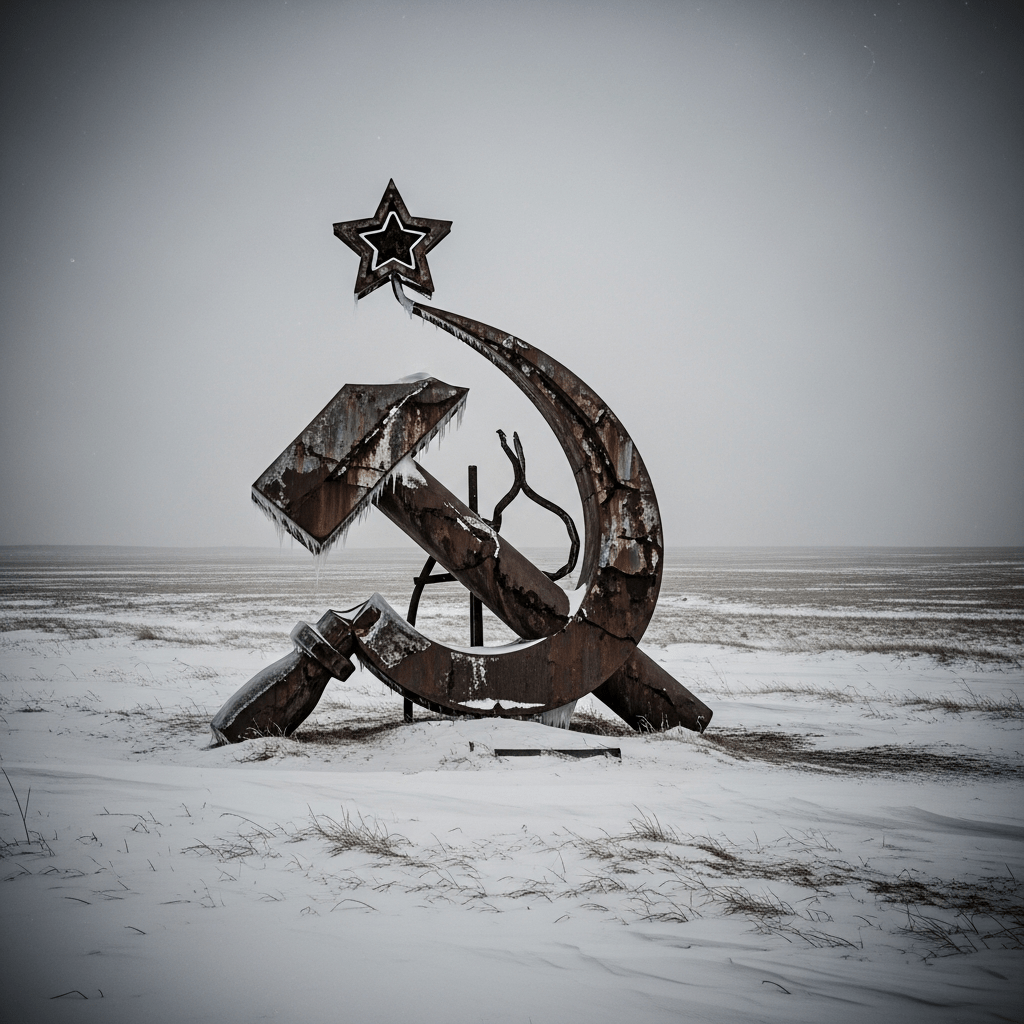
Introduction: The Empire of Illusion
To understand the sudden, chaotic collapse of the Soviet Union in 1991, we must first look back to the two decades that preceded it. This era, stretching from the mid-1960s to the mid-1980s, was the USSR’s great paradox: on the outside, it was a colossal, intimidating military superpower that had reached parity with the United States; on the inside, it was dying a slow, terminal death from a peculiar kind of bureaucratic sclerosis.
This wasn’t a time of violent purges or mass upheaval, but rather an Age of Lead—heavy, grey, motionless, and poisonous. The state did not collapse; it simply decomposed. The seeds of change were not planted by reformers but by a generation of hardliners who demanded stability above all else, unintentionally choking the life out of the communist dream they were trying to protect.
Welcome to the Soviet Union’s Era of Stagnation.
The Gerontocracy and the Long Sunset of Leonid Brezhnev
Our story begins in 1964 with the ousting of Nikita Khrushchev and the ascension of Leonid Ilyich Brezhnev . Brezhnev, with his thick eyebrows, deep growl, and chest perpetually rattling with medals, was the embodiment of the status quo. He came to power promising one thing: predictability. After Khrushchev’s erratic “hare-brained schemes,” the Party elite, the Nomenklatura, desperately wanted to be left alone.
Brezhnev delivered. His rule established a Gerontocracy—rule by the aged. The average age of the Politburo (the Soviet Union’s supreme governing body) constantly crept upward. It was a club of old men who had survived Stalin, weathered Khrushchev, and were now determined to enjoy the fruits of their loyalty. There was no rotation, no young blood, and absolutely no room for radical ideas. This inertia was intentional.
The Social Contract of Stagnation: Brezhnev forged an unwritten bargain with the Soviet populace and its elite:
- To the Elite (Nomenklatura): Your power, perks, and privileges (like access to special stores, foreign goods, and private dachas) are secure. In return, you will not challenge the Party’s direction or engage in economic experimentation. Corruption, so long as it remained discreet, was tacitly accepted.
- To the People: We will provide you with guaranteed low prices, full employment (even if it means a factory has ten times the workers it needs), and basic housing. In return, you will feign belief in the ideology and stay out of politics.
The implicit joke of the era was: “We pretend to work, and they pretend to pay us.”
The Poison Pill: Economic Stagnation and Gosplan’s Grip
The Soviet economic model was a monumental engine designed for one purpose: building heavy industry and winning wars. It excelled at producing tanks, rockets, and tons of steel. It failed spectacularly at producing quality consumer goods, adapting to technology, or efficiently utilizing resources.
The command economy was run by the mighty Gosplan (State Planning Committee), which attempted to centrally plan everything from the number of shoes produced in Ukraine to the amount of grain harvested in Kazakhstan.
The Problem of the Nail
The fundamental flaw of the command economy can be illustrated by “The Problem of the Nail.” A factory manager was given a quota to produce X tons of nails. If the quota was measured by weight, the factory produced a few massive, unusable steel spikes. If the quota was measured by number of pieces, the factory churned out millions of tiny, thin tacks. The manager met the plan, received his bonus, but the construction industry got useless products.
This misalignment—producing for a quota rather than for a customer’s need—meant massive systemic waste.
- The Technology Gap: While the US economy rapidly shifted into the computer, information, and microchip age, the USSR remained trapped in the age of steel and coal. The rigid Soviet system simply could not adopt or distribute the rapid, decentralized innovations that drove Western growth.
- Agricultural Disaster: Despite vast, fertile land, Soviet agriculture was chronically inefficient, burdened by collective farms (Kolkhozes and Sovkhozes). Year after year, the USSR, the largest country on earth, had to spend its valuable hard currency (primarily earned from oil) importing grain from the capitalist West to feed its own people.
The Oil Lifeline Snaps
For a time, this dysfunction was masked by a stroke of luck: rising global oil prices in the 1970s. The USSR, a major oil and gas exporter, enjoyed a massive influx of “petrodollars.” This money was used not for reform, but to sustain the failing system—subsidizing food, funding the military, and buying that necessary imported grain.
When oil prices plummeted in the early 1980s, the economic lifeline was brutally cut. The deep structural flaws of the command economy were suddenly exposed, setting the scene for an unavoidable crisis.
The Bleeding Wound: The Afghan Quagmire (1979-1989)
If the economic system was internally decaying, the Soviet-Afghan War became a fatal external drain on both the budget and the national spirit.
In December 1979, the Soviet Union intervened in Afghanistan to prop up a struggling, friendly communist regime. They expected a quick victory. They got a decade-long counter-insurgency war against fiercely motivated Mujahideen fighters, who were increasingly armed and funded by the United States (Operation Cyclone).
The Zinc Coffins
The war became known as the “Soviet Vietnam.” It was a hidden, unspoken conflict. The state media barely reported casualties, but the truth filtered back through returning soldiers and, most heartbreakingly, through the ubiquitous “Cargo 200”—the military code for bodies being transported home in zinc-lined coffins.
- The Financial Cost: The war cost billions of rubles, siphoning precious resources away from civilian needs and economic investment.
- The Moral Cost: It shattered the faith of a generation. Young men were sent to fight a brutal, pointless war in the name of a distant ideology that felt increasingly hollow. It was the first time since World War II that the public widely and privately questioned the decisions of the Kremlin.
The war was a decisive failure. It stained the honor of the Red Army, severely damaged the USSR’s international image, and became a symbol of the old, failing leadership’s stubborn, self-destructive decision-making.
The Ideological Fade-Out and the Rise of Samizdat
By the 1980s, Soviet communism was no longer a living ideology; it was a dead language spoken only by Politburo members. Marxism-Leninism became a ritualistic chant devoid of meaning.
Life in the Queue
The reality of Soviet life was defined by shortages and queues. If you saw a line stretching down the street, you joined it first, and only asked later what was being sold. A typical Soviet supermarket was a desolate landscape, where the few available items were rationed, poorly packaged, or ridiculously expensive.
This created the flourishing Black Market (Tolchok or Blat). Everything from foreign cigarettes and Western music (often recorded on homemade tapes called roentgenizdat on discarded X-ray film) to decent shoes and spare car parts moved through unofficial channels. The informal economy was often more efficient and reliable than the state-run one. This further eroded respect for the socialist system.
The Secret Press (Samizdat)
While the official press (Pravda) churned out endless, boring praise for the Party, an underground literary and political movement flourished: Samizdat (literally “self-publishing”). Dissidents like Andrei Sakharov and Aleksandr Solzhenitsyn secretly typed and retyped forbidden texts, passing them hand-to-hand. This quiet but resilient resistance kept the flame of free thought alive and provided a moral alternative to the Party’s lies.
The Interregnum: The Old Guard’s Last Gasp (1982–1985)
Brezhnev died in 1982, marking the end of the long Era of Stagnation. What followed was a swift, chaotic two-and-a-half years known as the Interregnum, demonstrating just how profoundly the system had seized up.
Yuri Andropov: The Reformer from the KGB
The successor was Yuri Andropov (1982–1984), the former head of the KGB. Surprisingly, Andropov recognized the rot. He began an anti-corruption campaign and tried to enforce labor discipline, even sending KGB agents to public baths and theaters during working hours to catch shirking employees. He was a reformer, but a harsh one. His tenure was cut short by kidney failure; he only ruled for 15 months.
Konstantin Chernenko: The Return to Stagnation
Following Andropov, the Politburo chose Konstantin Chernenko (1984–1985). Chernenko was a career Brezhnev loyalist—old, frail, and visibly ill. He was literally carried to state functions. His time in office was a pathetic return to inaction, demonstrating to the world and to the Soviet people that the Party could not even successfully choose a healthy leader, let alone run a global empire.
Chernenko died after just 13 months. The Soviet Union had buried three leaders in three years. The final straw for the Politburo was the sheer spectacle of repeated state funerals. They knew the world was laughing, and more importantly, they knew the system was a joke.
In March 1985, the Party had no choice but to skip a generation. The old men finally cleared the path for a new face, a younger man with energy and an idea for change. The time for stagnation was over. Enter: Mikhail Gorbachev.
Sources
- Zubok, Vladislav M. A Failed Empire: The Soviet Union in the Cold War from Stalin to Gorbachev. (2007) – Excellent for geopolitical and internal political analysis of the Brezhnev era.
- Taubman, William. Gorbachev: His Life and Times. (2017) – Detailed context on the stagnation that preceded his rule.
- Kenez, Peter. A History of the Soviet Union from the Beginning to the End. (2006) – Provides a clear overview of economic issues like Gosplan.

 History in 5 Minutes or less
Leave a comment