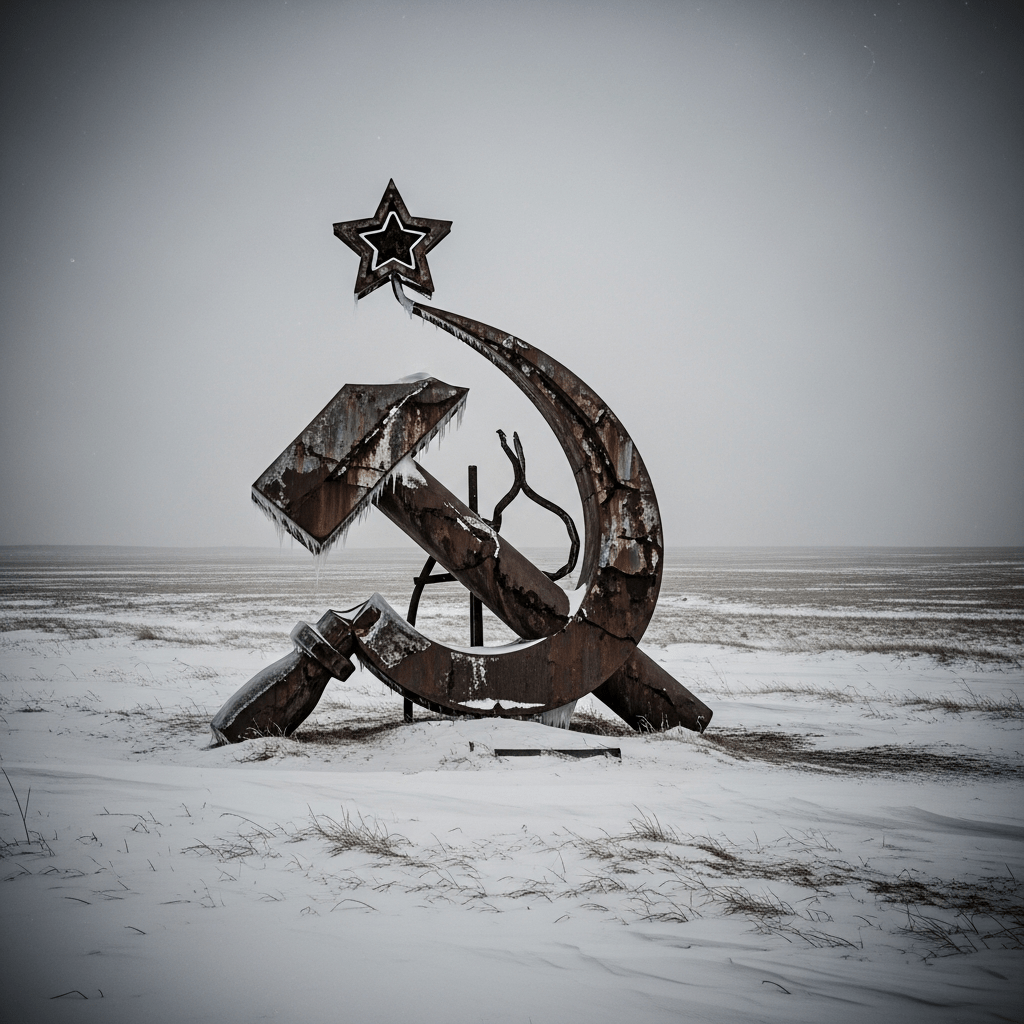
Introduction: The Empire Strikes Back… at Itself
By 1990, the Soviet Union was no longer a monolithic power; it was a contested space. The reforms of Perestroika had hollowed out the economy, and Glasnost had armed the population with historical truth and the vocabulary of freedom. The external empire was gone—the Berlin Wall was rubble, and the communist satellites were independent democracies.
The final conflict was now internal, characterized by a massive transfer of power away from the central Kremlin authority and into the hands of the fifteen Soviet Republics. This final act wasn’t a grassroots revolt against the state, but a political knife fight between two men: Mikhail Gorbachev, attempting desperately to redesign the Soviet flag, and Boris Yeltsin, who simply wanted to tear it down.
The Political Duel: Gorbachev vs. Yeltsin
Mikhail Gorbachev was a genius reformer but a disastrous politician. He was committed to democracy, but only a version where he remained in charge. He was trapped, attempting to steer a centralized socialist state toward a decentralized, semi-market union.
His rival, Boris Nikolayevich Yeltsin, was the ultimate populist opportunist. A former Party boss who had been purged by Gorbachev, Yeltsin brilliantly leveraged the anger unleashed by Glasnost. He spoke the language of the people—direct, angry, and demanding genuine freedom, not just Gorbachev’s controlled reform.
The Twin Power Centers
Yeltsin established a parallel state structure that directly undermined the USSR:
- Gorbachev’s Authority: President of the Soviet Union (a dissolving entity). He commanded the military and the KGB, but his political support was dwindling.
- Yeltsin’s Authority: In June 1991, Yeltsin was elected President of the Russian Soviet Federative Socialist Republic in a direct popular vote, making him the first democratically elected leader in Russian history. As Russia contained 75% of the Soviet Union’s territory, 60% of its population, and most of its natural resources, Yeltsin’s election gave him a legitimate mandate that Gorbachev simply lacked.
Yeltsin began advocating for the “sovereignty” of Russia, which was a brilliant political move: how can the USSR exist if its largest and most powerful component—Russia—declares itself sovereign? This political duel was rapidly pushing the state toward constitutional crisis.
The Baltic Way: Nationalism Tears the Fabric
The most immediate danger to the Union came from the periphery, specifically the three small Baltic republics: Lithuania, Latvia, and Estonia. Forcibly annexed by Stalin in 1940, these nations had a long, unbroken memory of independence and were determined to reclaim it.
Defiance and Violence
The Baltics led the charge of the “Parade of Sovereignties,” beginning with Lithuania, which declared its independence in March 1990. Gorbachev condemned the declaration, viewing the dissolution of the Soviet Union as unconstitutional. He tried to force them back into the fold using economic blockades.
When this failed, the Soviet military acted. In January 1991, a brief but brutal crackdown occurred. Soviet troops and KGB special forces stormed the television tower in Vilnius, Lithuania, killing fourteen civilians and injuring hundreds. A similar operation took place in Riga, Latvia.
These bloody events were the final awakening for the Russian people. They weren’t just fighting for their own nation; they were murdering other nations for their freedom. Yeltsin immediately flew to Tallinn, Estonia, and signed mutual defense agreements with the Baltic states, publicly defying Gorbachev’s central authority. The violence in the Baltics fatally discredited Gorbachev and pushed the republics, including Ukraine and Georgia, decisively toward full independence.
The Coup D’état: The Hardliners’ Last Stand
As Gorbachev tried desperately to negotiate a new, softer “Union Treaty” to save what little central control remained, the hardliners—the conservative military, the KGB, and the old guard of the Communist Party—could take no more.
The Plotters Strike
On the eve of the Union Treaty signing, August 19, 1991, the plotters struck. They formed the State Committee on the State of Emergency (GKChP), locking Gorbachev and his family in their holiday villa in Crimea.
The GKChP announced that Gorbachev was “too ill” to govern and that they were restoring order to prevent the country from collapsing. Tanks rolled into Moscow and major cities. The goal was to reassert central control, reverse Glasnost, and crush the independence movements.
Yeltsin on the Tank
The coup failed for three key reasons:
- Massive Public Defiance: Thousands of Muscovites poured onto the streets to defend the Russian White House (the Russian parliament building), establishing barricades. They were unwilling to give up their hard-won freedom.
- Yeltsin’s Leadership: Boris Yeltsin rushed to the White House, and in the defining moment of his career, he climbed atop a tank sent by the plotters and addressed the crowds . He publicly denounced the GKChP as treasonous and illegal, transforming the defense of the White House into a defense of democracy itself.
- Military Defection: Crucially, many military units and the majority of the KGB’s field operatives refused to open fire on civilians. The Soviet security apparatus, the ultimate pillar of the system, fractured.
The coup collapsed after just three days. The plotters were arrested, and Gorbachev was returned to Moscow.
The Final Knife Twist: The Death of Central Authority
Gorbachev returned from Crimea deeply shaken. He still believed he could save the Union, but his authority was shattered beyond repair.
The August Coup proved two things to the republics:
- The Center is Dangerous: The only way to guarantee safety from the hardliners was complete independence.
- The Center is Weak: The central government (Gorbachev) could not even protect itself, let alone its subjects.
In the wake of the coup, independence declarations came in a flood: Ukraine, Belarus, Moldova, Azerbaijan, Uzbekistan, and others all declared immediate sovereignty.
Yeltsin sealed Gorbachev’s fate by signing decrees that effectively stripped the Communist Party of the Soviet Union (CPSU) of its power on Russian territory, nationalizing its assets and banning its activities. The Party that had ruled Russia for 74 years vanished overnight.
The Belovezha Accords: Signing the Death Certificate
By December 1991, Gorbachev was the president of a country that existed only on paper. Yeltsin had the real power, controlling the infrastructure, taxes, and resources of Russia.
On December 8, 1991, Yeltsin met secretly with the leaders of Ukraine (Leonid Kravchuk) and Belarus (Stanislav Shushkevich) at a hunting lodge in the Belovezha Forest.
The purpose of the meeting was not to discuss a new union but to officially end the old one. They signed the Belovezha Accords—a short, stark document that declared:
“The USSR, as a subject of international law and a geopolitical reality, is terminating its existence.”
They replaced the Union with the symbolic Commonwealth of Independent States (CIS), which was little more than a post-divorce coordinating committee. The empire was dissolved. It was the decision of the largest republics, not the action of the central government, that brought down the USSR.
The Final Flag: Christmas Day 1991
Gorbachev initially denounced the Belovezha Accords but realized he had no political or military means to enforce his will. He was defeated.
On December 25, 1991, at 7:00 p.m., Mikhail Gorbachev appeared on state television for the last time. In a somber, nationally televised speech, he formally resigned as President of the Soviet Union, handing control of the nuclear codes to Boris Yeltsin. He lamented that he had failed to preserve the Union but proudly noted that his reforms had brought democracy and ended the Cold War.
The Red Flag Falls
Minutes later, at 7:32 p.m., the definitive symbol of the Soviet experiment was broadcast live: the red flag, emblazoned with the golden hammer and sickle, was lowered from the flagpole atop the Kremlin for the final time. In its place, the white, blue, and red tricolor flag of the Russian Federation was raised.
The Cold War was over. The 74-year-old experiment in communism had ended, not in a massive war, but in a quiet, nationally televised flag-lowering ceremony. Millions celebrated the promise of freedom, but they also inherited a frightening vacuum of power, economic devastation, and geopolitical uncertainty that would shape the next three decades of global history.
Sources
- Remnick, David. Lenin’s Tomb: The Last Days of the Soviet Empire. (1993) – A vivid, human narrative of the collapse, particularly strong on the Yeltsin/Gorbachev dynamic and the August Coup.
- Kotkin, Stephen. Armageddon Averted: The Soviet Collapse 1970–2000. (2008) – Excellent for understanding the political contingency and the significance of the Belovezha Accords.
- Sakwa, Richard. The Rise and Fall of the Soviet Union, 1917-1991. (1999) – Good for the constitutional implications of the republics’ sovereignty declarations.
 History in 5 Minutes or less
Leave a comment