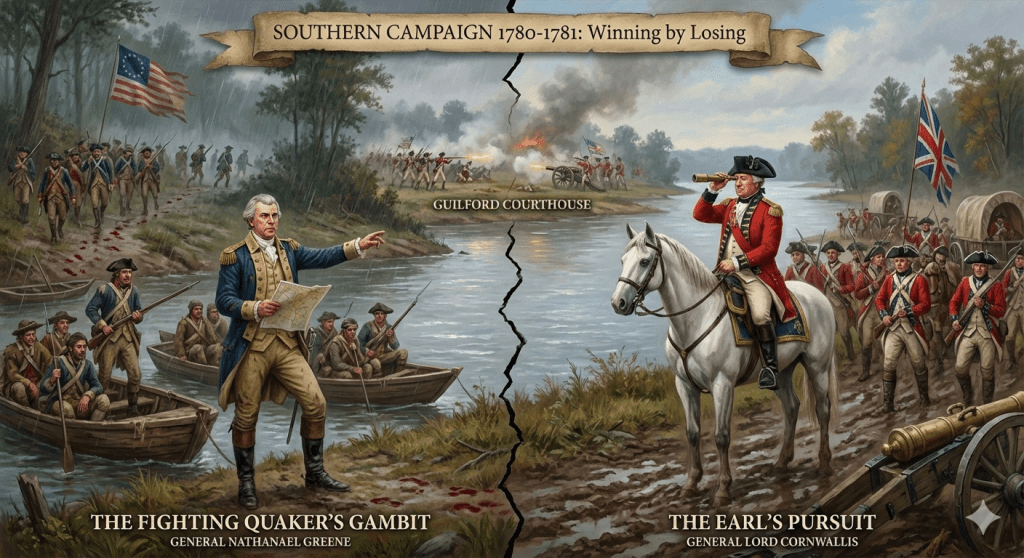
In 1780, the American Revolution wasn’t just dying; it was being buried under a pile of British red coats in the swampy heat of South Carolina. The Continental Army had been humiliated at Charleston—the greatest American defeat of the war—and then absolutely pulverized at the Battle of Camden.
The “Southern Strategy” was working. King George III’s generals believed that if they could just lop off the rebellious Southern colonies, the rest of the “United” States would collapse like a poorly made house of cards. They had the momentum, the men, and the most feared commander in the British Empire: Lord Charles Cornwallis.
To stop him, George Washington didn’t send a flashy cavalier or a grizzled veteran of European wars. He sent a self-taught, limping, former Quaker from Rhode Island who had never commanded an independent army in his life.
His name was Nathanael Greene, and he was about to prove that sometimes, the best way to win a war is by losing almost every single battle.
The Fighting Quaker and the Aristocrat
Nathanael Greene was an unlikely hero. Raised in a strict Quaker household, he was technically “read out” of the faith for his interest in military affairs. He had a stiff knee that gave him a permanent limp and a persistent asthma cough that made him sound like he was constantly on the verge of a cold. But what he lacked in physical grace, he made up for in a mind that worked like a clockwork engine. He spent his youth devouring books on military strategy, teaching himself the art of war while working in his family’s foundry.
Facing him was Lord Charles Cornwallis. Cornwallis was the “Gold Standard” of British aristocracy and military might. He was aggressive, intelligent, and utterly tired of this “unnatural” rebellion. He viewed the American South as a collection of loyal subjects being bullied by a few ragtag rebels. He intended to “liberate” the Carolinas with cold steel and overwhelming force.
When Greene arrived in Charlotte, North Carolina, in December 1780, he found a “shadow” of an army. There were barely 800 men fit for duty, many without shoes, and almost all without food. If he had marched directly at Cornwallis, the war would have ended in an afternoon.
So, Greene decided to do something “insane.” He broke the first rule of warfare: Never divide your force in the face of a superior enemy.
The Great Divide and the Cowpens Shock
Greene split his tiny army. He sent half under the command of “Old Wagoner” Daniel Morgan to threaten the British outposts in the backcountry, while Greene took the rest to eastern South Carolina.
This move drove Cornwallis crazy. He couldn’t advance into North Carolina without leaving his flank wide open to Morgan. He was forced to split his own army, sending his most brutal subordinate, Banastre “The Butcher” Tarleton, to hunt Morgan down.
On January 17, 1781, at a place called the Cowpens, the “Butcher” finally caught the “Wagoner.” It was supposed to be a slaughter. Instead, Morgan pulled off a tactical masterpiece—a double envelopment that virtually wiped out Tarleton’s command.
When the news reached Cornwallis, he was devastated. Legend says he leaned so hard on his sword that the blade snapped. He had lost his light infantry and his scouts. Now, he wasn’t just fighting for the South; he was fighting for his reputation. He burned his own heavy baggage trains—destroying his army’s comfort and food supplies—to turn his soldiers into a fast-moving pursuit force.
The chase was on.
The Race to the Dan: A Masterclass in Misery
What followed was one of the most grueling military maneuvers in history: The Race to the Dan.
Greene knew he couldn’t fight Cornwallis yet. He needed to lure the British away from their supply bases in South Carolina and deep into the rugged terrain of North Carolina. The goal was the Dan River, which sat on the border of Virginia. If Greene could cross it, he would be safe and could gather reinforcements. If Cornwallis caught him, the revolution was over.
For weeks, the two armies sprinted across the red clay of the Carolinas. It rained incessantly. The roads turned into thigh-deep bogs of freezing mud. Greene’s men were barefoot, leaving bloody footprints in the slush. They slept for only three or four hours a night, eating raw corn because they didn’t have time to build fires.
Cornwallis was right on their heels. The British “vanguard” was often so close they could see the American “rearguard” through the trees. But Greene had a secret weapon: Boats.
Greene had pre-ordered his scouts to collect every flat-bottomed boat along the river routes. As the Americans reached each river—the Catawba, the Yadkin, the Deep—they hopped into boats and paddled across just as the British arrived at the banks to find the water rising and the boats gone.
On February 14, Greene’s final troops crossed the Dan River into Virginia. When Cornwallis arrived at the shore hours later, he looked across the wide, churning water and realized he had been played. He had chased the Americans 200 miles, burned his supplies, and worn his boots to pieces, only to watch Greene wave at him from the other side.
The Showdown: Guilford Courthouse
Greene didn’t stay in Virginia for long. After resting and gathering reinforcements (including a bunch of gritty Virginia militia), his army grew to about 4,400 men. Cornwallis had about 1,900, but these were the “crème de la crème” of the British Army—professional killing machines who hadn’t lost a major fight in years.
Greene chose his ground carefully: Guilford Courthouse, North Carolina.
Greene used a “Three-Line” defense, a tactic he borrowed from Daniel Morgan.
- The First Line: North Carolina militia. Their job? Fire two shots and run.
- The Second Line: Virginia militia, hidden in thick woods. Their job? Make the British bleed for every inch.
- The Third Line: The “Continentals”—Greene’s professional soldiers. This was the steel at the back of the blade.
On March 15, 1781, the British emerged from the woods. They were tired, hungry, and outnumbered 2-to-1, but they attacked with terrifying discipline.
The first line fired their volleys and melted away. The British pushed into the thickets of the second line, where the fighting became a chaotic, muddy brawl. Musket fire was so intense that the woods filled with a blinding white smoke. Men fought with bayonets and clubbed muskets in the undergrowth.
Finally, the British broke through to the third line. Here, the fighting reached a fever pitch. The 1st Maryland Regiment—the elite of the American army—charged with bayonets, shattering the British guards. For a moment, it looked like Cornwallis was going to be captured or destroyed.
Then, Cornwallis did the unthinkable.
He saw his own men locked in hand-to-hand combat with the Americans. To save his army, he ordered his artillery to fire grapeshot (essentially giant shotgun blasts of iron balls) directly into the melee.
“But sir,” his officers protested, “you will kill our own men!”
“I know,” Cornwallis supposedly replied.
The blast cleared the field. It killed Americans, but it also mowed down dozens of British soldiers. The shock of the friendly fire caused the Americans to pause. Sensing his army was at its breaking point, Greene—true to his cautious nature—ordered a retreat. He didn’t want to risk his entire army on a single roll of the dice.
The British held the field. Technically, they won.
Winning by Losing
In the 18th century, the “winner” of a battle was the person who stayed on the field. So, Cornwallis claimed victory. But it was the most expensive “win” in British history.
Cornwallis had lost nearly 27% of his entire army in a single afternoon. Back in London, a member of Parliament, Charles James Fox, famously remarked: “Another such victory would ruin the British Army.”
Greene, meanwhile, had retreated just a few miles, regrouped, and was ready to fight again. He famously wrote to his friend:
“We fight, get beat, rise, and fight again.”
Cornwallis realized he couldn’t stay in the Carolinas. He had no supplies, his men were decimated, and the “loyalists” he expected to join him were nowhere to be found. They were too scared of the rebel “partisans” like Francis Marion (The Swamp Fox).
Exhausted and frustrated, Cornwallis abandoned the Carolinas and marched north into Virginia, seeking a port where he could be resupplied by the British Navy. He chose a little tobacco port called Yorktown.
We all know how that ended.
Greene’s Revenge: Reclaiming the South
While Cornwallis was marching toward his fate at Yorktown, Greene didn’t follow him. Instead, he turned his attention back to the British garrisons left behind in South Carolina and Georgia.
One by one, Greene—working alongside legendary guerilla leaders like Marion and Sumter—picked the British outposts apart. He didn’t always win the big battles here, either (looking at you, Hobkirk’s Hill and Eutaw Springs), but he made the British occupation so miserable and so costly that they eventually gave up.
By the end of 1781, the British were trapped in the coastal cities of Charleston and Savannah, unable to venture into the countryside. Greene had liberated the South, not with a grand “Braveheart” charge, but with a grueling, intellectual, and persistent war of attrition.
The Legacy of the Southern Campaign
Nathanael Greene is often the “forgotten” general of the Revolution because he didn’t have Washington’s charisma or the tragic flair of Alexander Hamilton. But many historians argue he was the finest strategist of the war.
He understood something that many generals fail to grasp: A battle is just a means to an end. He was willing to sacrifice his pride and even his win-loss record to ensure that, in the end, the British would run out of men, money, and the will to fight.
He took a broken, starving army and turned it into a ghost that haunted the British across a thousand miles of wilderness. He turned the South from a British stronghold into a graveyard for the King’s ambitions.
Nathanael Greene didn’t need to win a battle to win a war. He just needed to keep standing when everyone else had fallen down.
Sources for Further Reading
- “The Road to Guilford Courthouse” by John Buchanan. (The definitive account of the Southern Campaign).
- “Nathanael Greene: A Biography of the American Revolution” by Gerald M. Carbone.
- “1776” by David McCullough. (For context on Greene’s early relationship with Washington).
- National Park Service: Guilford Courthouse National Military Park archives.
- “The Southern Strategy: Britain’s Conquest of South Carolina and Georgia, 1775-1780” by David K. Wilson.

 History in 5 Minutes or less
Leave a comment