What if I told you that the very men who bled to birth the United States nearly strangled the infant nation in its cradle just three years after the British surrendered? What if I told you that the heroes of Bunker Hill and Saratoga were branded as “traitors” and “anarchists” by the same leaders they had helped put into power?
To understand how a group of desperate farmers ended up staring down the barrels of cannons manned by their own former comrades, we have to rewind the clock to 1783. The war was over, the celebration was loud, but the bill was finally coming due—and nobody had any change.
The Great Post-War Hangover
The victory at Yorktown was supposed to be the start of a golden age. Instead, it was more like the morning after a decade-long party where the host realizes they’ve lost the keys, the house is on fire, and the neighbors are all suing.
The American Revolution was an expensive endeavor. To pay for it, the Continental Congress and individual states had printed massive amounts of paper money. By 1786, that money was essentially worth less than the paper it was printed on. The phrase “not worth a Continental” became a common insult.
In Massachusetts, the situation was particularly toxic. The state was buried in debt, and the wealthy merchants in Boston, who had loaned money to the state government, wanted to be paid back—with interest. They controlled the state legislature, and they passed a series of aggressive tax laws. But there was a catch: these taxes had to be paid in “specie”—gold and silver.
For the farmers in the western part of the state, this was a death sentence. They lived in a barter economy. They traded eggs for grain and labor for lumber. They hadn’t seen a gold coin in years. When they couldn’t pay their taxes or their private debts to coastal merchants, the courts moved in.
Enter the Reluctant Rebel, Captain Shays
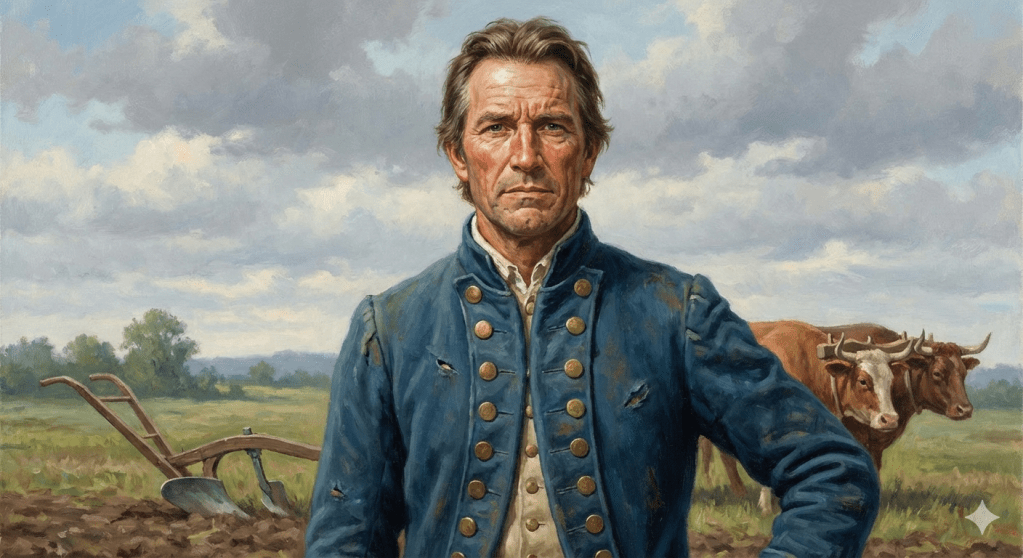
It was out of this desperation that a leader emerged, one who never sought the spotlight. Daniel Shays was a farmer from Pelham, Massachusetts. But before he was a farmer, he was a captain in the Continental Army. He was a true hero of the Revolution, a man who had fought bravely at Bunker Hill, Ticonderoga, and Saratoga. Lafayette himself had presented him with a ceremonial sword for his service.
Shays was not a fiery revolutionary looking for another fight. He was a man who just wanted to be left alone to till his land and raise his family. But as he watched his neighbors being dragged off to prison and their farms sold at auction, he couldn’t stand by. He became the reluctant face of a movement that was rapidly growing in the western counties. He wasn’t a general commanding an army; he was a respected neighbor leading a group of desperate men who felt they had no other choice.
From Petitions to Pitchforks
At first, the farmers tried to do things the “right” way. They held town meetings, they wrote petitions to the state legislature in Boston, and they pleaded for relief. They asked for the state to issue paper money that could be used to pay debts, for lower taxes, and for a temporary halt to the farm foreclosures. They called themselves “Regulators,” a term borrowed from earlier reform movements, to emphasize that they wanted to regulate the government, not overthrow it.
The response from Boston was a resounding “no.” The legislature, dominated by wealthy merchants who would lose money if paper currency was issued, dismissed the farmers’ concerns. They viewed the Regulators not as suffering patriots, but as dangerous anarchists who threatened the rule of law and the sanctity of property.
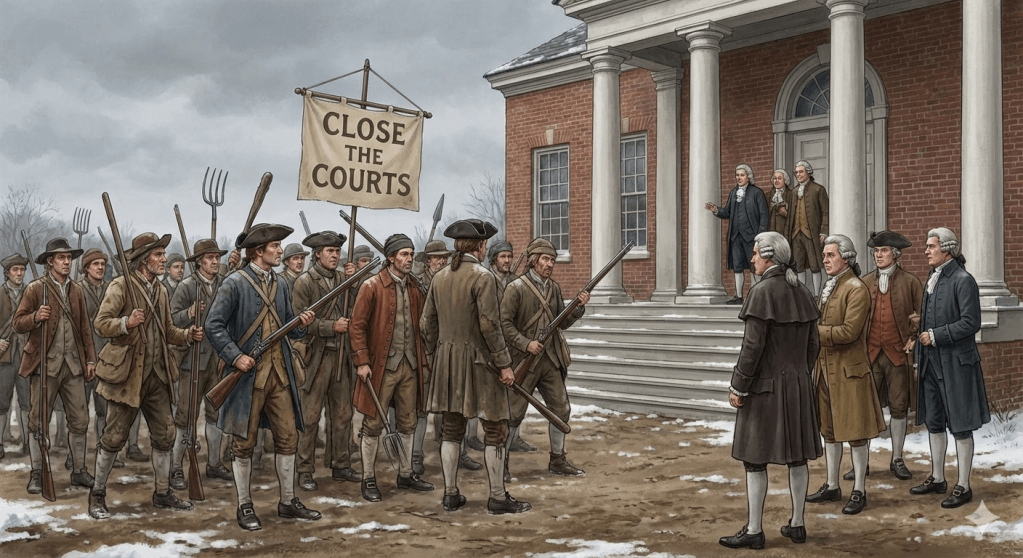
When their petitions were ignored, the farmers took matters into their own hands. In the late summer and fall of 1786, groups of armed men began to march on the county courts. Their logic was simple: if the courts couldn’t sit, they couldn’t process foreclosures or send anyone to debtors’ prison. In Northampton, Worcester, and other towns, hundreds of men, some with muskets and others with only hickory clubs and pitchforks, blocked the courthouse doors, forcing the judges to adjourn.
The Governor Strikes Back
The closing of the courts was the final straw for Massachusetts Governor James Bowdoin. A wealthy merchant himself, Bowdoin saw the Regulators as a direct threat to the authority of the state. He declared that their actions were “subversive of all law and government” and issued proclamations calling for their arrest.
But Bowdoin had a problem: the state militia in the western counties was unreliable. Many of the militiamen were farmers themselves and sympathized with the rebels. Some even joined their ranks. To crush the rebellion, Bowdoin would need a force he could count on. He turned to the wealthy merchants of Boston, who raised private funds to outfit an army of 4,400 men. To lead this force, Bowdoin appointed another Revolutionary War hero, General Benjamin Lincoln.
Showdown at the Springfield Arsenal
As Lincoln’s army prepared to march west, the rebel leaders made a desperate plan. They knew they were outgunned and ill-equipped. Their only hope was to seize the federal arsenal in Springfield, which held a massive stockpile of muskets, ammunition, and artillery. With those weapons, they might have a chance to force the government to negotiate.
On January 25, 1787, three separate rebel columns, led by Shays, Luke Day, and Eli Parsons, were supposed to converge on the arsenal. But a crucial message from Day to Shays was intercepted, and Shays’ column arrived alone. They found the arsenal defended by a smaller force of local militia under General William Shepard.
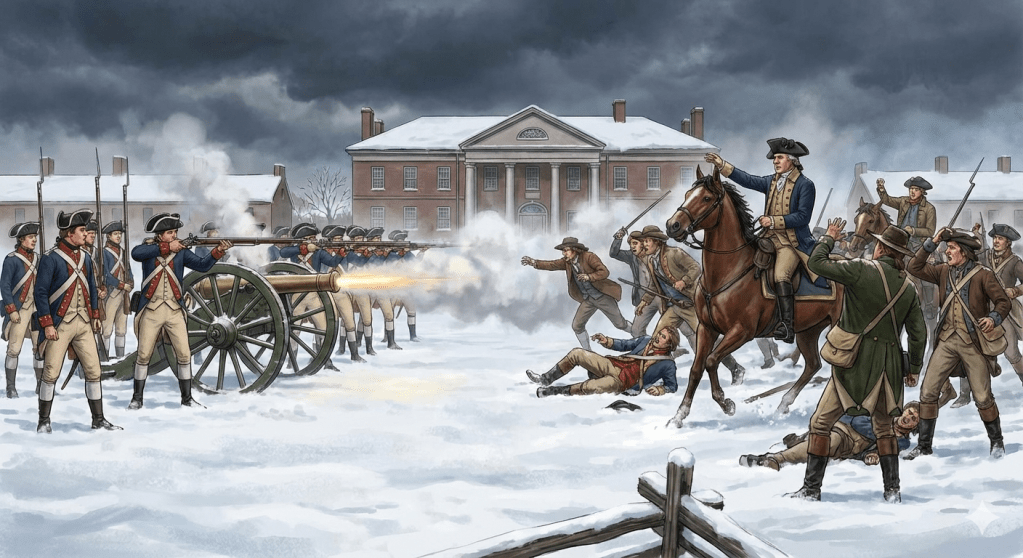
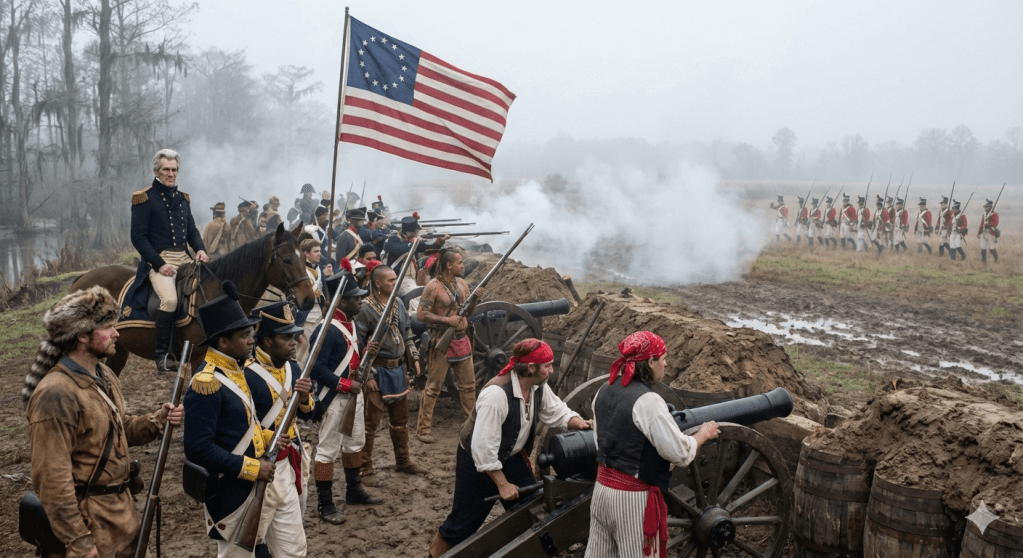
Shepard, another veteran of the Revolution, had no desire to fire on his former comrades. As Shays’ men advanced through the deep snow, Shepard ordered his troops to fire warning shots over their heads. The rebels, desperate and determined, kept coming. Shepard then gave the order to fire the cannons directly into their ranks.
The grapeshot tore through the rebel lines, killing four men and wounding twenty. The untrained farmers, many of whom had never faced artillery fire before, broke and ran. It was a slaughter, and the defining moment of the rebellion. The attack on the arsenal had failed, and with it, the rebels’ last best hope for success.
The Rebellion Crumbles, a Nation Awakens
After the disaster at the arsenal, the rebel army began to disintegrate. General Lincoln’s army pursued them relentlessly through a bitter winter storm. On the morning of February 4, Lincoln’s troops surprised the remnants of Shays’ force at Petersham after an all-night march, effectively ending the organized rebellion.
The leaders, including Daniel Shays, fled to neighboring states. In the aftermath, the government’s response was initially harsh. Several rebels were sentenced to death for treason, though only two were ultimately hanged. The majority were offered pardons if they laid down their arms and swore an oath of allegiance. In a twist of political fate, Governor Bowdoin was voted out of office in the next election, replaced by the more lenient John Hancock, who issued a general pardon for most of the insurgents. Daniel Shays himself was eventually pardoned and lived out the rest of his life in New York, receiving a federal pension for his service in the Revolution, not his rebellion.
Why This Still Matters
Shays’ Rebellion was a military failure, but it was a massive political success that changed the course of American history. The sight of armed farmers marching against their own government sent a shockwave of terror through the nation’s leaders. George Washington, who had been enjoying his retirement at Mount Vernon, was horrified. He wrote to a friend, “I am mortified beyond expression when I view the clouds that have spread over the brightest morn that ever dawned upon any country.”
The rebellion proved that the Articles of Confederation, the weak governing document that held the thirteen states together, was a failure. The national government had been powerless to raise an army to help Massachusetts put down the uprising, forcing the state to rely on a private mercenary force. It was clear to men like Washington, James Madison, and Alexander Hamilton that a stronger central government was needed to maintain order and protect property.
Just a few months after the snow had melted at the Springfield Arsenal, delegates from the states gathered in Philadelphia for the Constitutional Convention. The specter of Shays’ Rebellion hung over the proceedings, urging the framers to create a government with the power to tax, raise an army, and suppress insurrections. The result was the United States Constitution.
But the rebels’ influence didn’t end there. The fear of a powerful, distant government that had driven the farmers to take up arms also led to the demand for a Bill of Rights. The first ten amendments to the Constitution were added to protect the very individual liberties that Daniel Shays and his followers felt were being trampled upon.
Shays’ Rebellion is a timeless story. It’s about the tension between the need for order and the right to protest, between the power of creditors and the plight of debtors, and between the governing elite and the common people. It’s a reminder that the American Revolution was not just a war against a king, but an ongoing struggle to define what kind of nation we would become.
Sources:
- George Washington’s Mount Vernon. “Shays’ Rebellion.”
- UMBC Center for History Education. “Shays’ Rebellion.”
- Springfield Armory National Historic Site. “Rebellion at the Springfield Arsenal.”
- National Constitution Center. “On this day: Shays’ Rebellion was thwarted.”
- History.com. “How Shays’ Rebellion Changed America.”
- Britannica. “Daniel Shays” and “Shays’s Rebellion.”
- Wikipedia. “Shays’s Rebellion” and “Daniel Shays.”

 History in 5 Minutes or less
Leave a comment