William Wallace wasn’t actually a kilt-wearing, face-painted peasant who lived in a mud hut—in fact, if you met the real Wallace, he’d likely be wearing heavy chainmail and speaking refined French. But before we get to the knightly armor and the complex geopolitics, we have to talk about the time he was dragged through the streets of London behind a horse, strangled until he was nearly dead, and then eviscerated while he was still conscious.
Wait. That’s the end. Let’s rewind.
To understand how a second son of a minor Scottish landowner became the “Hammer of the English” and a global icon of freedom, we have to go back to a time when Scotland wasn’t just a country, but a prize in a very high-stakes game of medieval chess.
The King is Dead, Long Live the… Crisis?
The year was 1286, and Scotland was doing surprisingly well. Then, King Alexander III decided to ride his horse along a cliffside in the dark during a storm. Spoiler alert: the horse didn’t make the jump. Alexander died, his only heir (a young girl known as the Maid of Norway) died shortly after, and suddenly, Scotland had more “rightful” kings than it knew what to do with.
Enter Edward I of England, nicknamed “Longshanks” because he was exceptionally tall for the era. Edward was a brilliant lawyer, a terrifying general, and possessed the moral flexibility of a wet noodle. He offered to “arbitrate” who should be king. He picked John Balliol, treated him like a footstool for a few years, and then decided to just skip the middleman and invade Scotland himself.
By 1296, Scotland was a conquered province. The Stone of Destiny—the rock Scots kings sat on to be crowned—was stolen and hauled off to London. It looked like the end of Scotland.
A Giant Emerges (And Not Just in Height)
While the Scottish nobles were busy swearing oaths of fealty to Edward to save their estates, a man named William Wallace decided he’d had enough.
History is a bit hazy on Wallace’s early life, but we know he wasn’t a “commoner” in the way we think of it today. He was likely the son of a knight, Sir Malcolm Wallace. He was educated, probably by his uncles who were priests, which meant he knew Latin and French. He wasn’t just a brawler; he was a literate, strategic thinker.
The legend says the spark was personal. The English Sheriff of Lanark supposedly killed Wallace’s wife (or sweetheart), Marion Braidfute. Whether this is 100% true or 14th-century propaganda, the result was the same: Wallace didn’t just kill the Sheriff; he hacked him into pieces.
Suddenly, the “common folk” had a leader. Wallace didn’t fight like a traditional knight. He used the woods. He used the bogs. He used what we now call guerrilla warfare. While the “Great Cause” nobles were bickering, Wallace was burning English supplies and making the occupation very, very expensive.
The Miracle at Stirling Bridge
By 1297, the rebellion had teeth. Wallace joined forces with Andrew Moray, a northern noble who was just as capable but is often forgotten by history because he didn’t survive long enough to get a Hollywood movie.
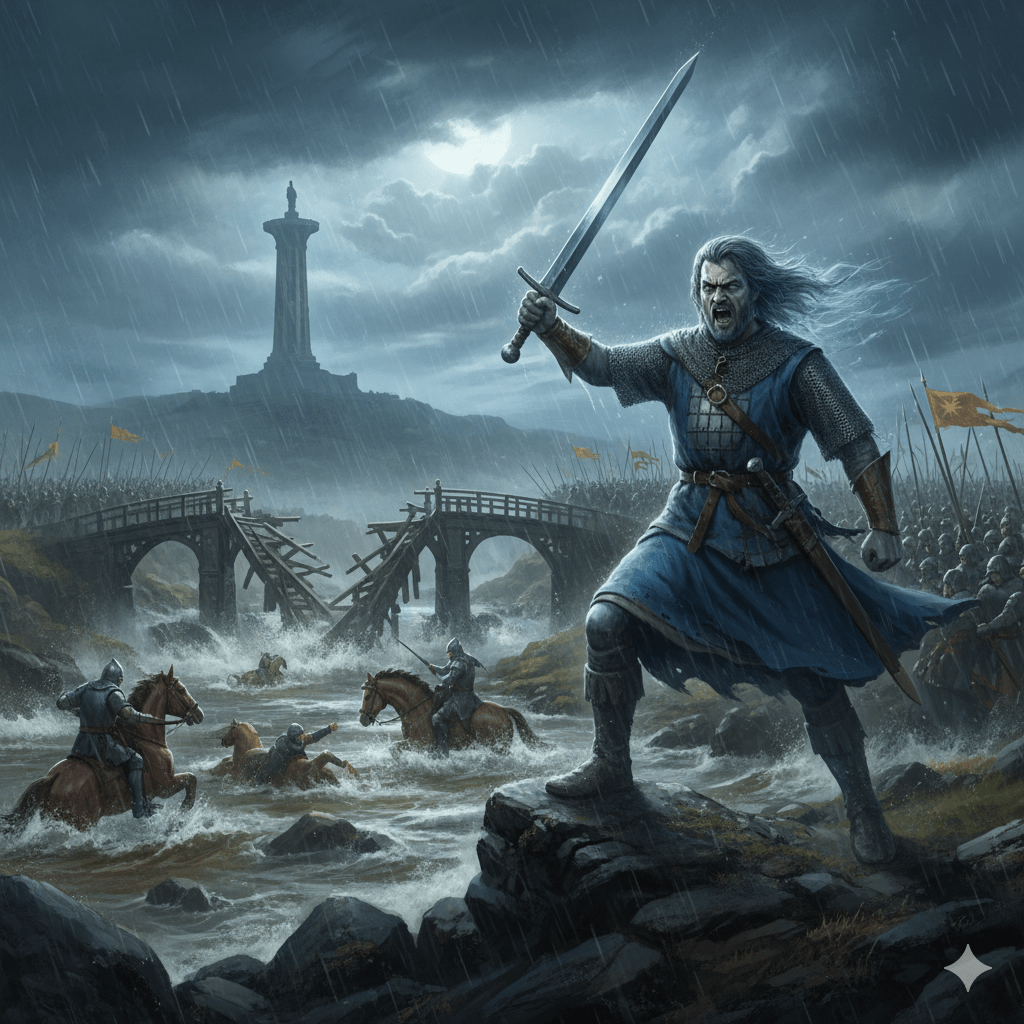
The English army, led by the Earl of Surrey and the hated tax collector Hugh de Cressingham, marched north to crush the “upstarts.” They met at Stirling Bridge. This wasn’t the wide stone bridge you see today; it was a narrow, wooden structure that could only accommodate two horsemen abreast.
The geography was the real hero here. The bridge crossed the River Forth into a loop of marshy, boggy ground. Wallace and Moray positioned their men on the Abbey Craig, watching as the English began their agonizingly slow crossing. The English Earl of Surrey actually slept in that morning, delaying the start, and then recalled his first wave of troops because he realized he hadn’t given the signal. It was a comedy of errors on the English side.
Finally, around 5,000 English and Welsh infantry and several hundred heavy cavalry crossed. Wallace waited until the English vanguard was committed to the soft ground but cut off from the rest of the army by the bottleneck of the bridge. Then, he gave the order.
The Scottish spearmen charged down the slope, cutting off the head of the bridge. The English heavy cavalry, the most feared weapon of the Middle Ages, found themselves in a nightmare. The ground was too soft for a charge, and they were hemmed in by the river. It was a slaughter. Sir Marmaduke Thweng was the only English knight of note to fight his way back across the bridge; the rest were drowned or butchered. Hugh de Cressingham was killed, and the Scots reportedly hated him so much they flayed his skin and made souvenirs out of it.
For the first time in history, a force of common infantry had decimated a professional army of knights. Wallace was knighted and named “Guardian of Scotland.” He was the man of the hour.
The Longshanks Strikes Back
Edward I was in France when he heard his army had been thrashed by a “nobody.” He was not amused. He gathered the largest army he could muster—including 12,000 infantry and the terrifying new weapon of the age: the English Longbow.
In 1298, the two sides met at Falkirk. Wallace used a defensive formation called a Schiltron. Imagine a giant human pincushion: hundreds of men in a tight circle, holding long spears (pikes) pointed outward.
For a while, it worked. The English cavalry charged and broke against the spears like waves against a cliff. But then, Edward ordered his longbowmen forward. It was the medieval equivalent of bringing a machine gun to a knife fight. The Scots were pinned down, unable to move without breaking formation, and were rained upon by thousands of arrows.
The Schiltrons collapsed. Wallace escaped, but his reputation was shattered. He resigned as Guardian, disappearing into the shadows of the Highlands and even traveling to France and Rome to seek diplomatic help for Scotland.
Betrayal and the “Trial” of the Century
For seven years, Wallace was a ghost. He was the most wanted man in the British Isles. Edward I offered massive rewards for his head, but the Scottish people kept him hidden—until 1305.
Sir John de Menteith, a Scottish knight who had turned his coat for Edward, betrayed Wallace near Glasgow. Wallace was captured in his bed and hauled to London in chains.
Edward wanted to humiliate him. He gave Wallace a “trial” at Westminster Hall, where Wallace was crowned with a wreath of laurel to mock his claim of being a “king of outlaws.” Wallace’s response was legendary:
“I cannot be a traitor, for I owe [Edward] no allegiance. He is not my Sovereign; he never received my homage; and whilst life is in this persecuted body, he shall never receive it.”
Edward, who didn’t take criticism well, sentenced him to the most brutal death allowed by law: to be Hanged, Drawn, and Quartered.
Why This Still Matters
You might think that killing Wallace ended the rebellion. In reality, it was Edward’s biggest mistake. By making Wallace a martyr, he gave the Scots a symbol that could never be killed. A year after Wallace’s death, Robert the Bruce took up the mantle, eventually winning Scottish independence at Bannockburn.
But why does a 700-year-old rebel matter today?
- The Concept of Liberty: Wallace’s struggle was one of the first times “national identity” was placed above feudal loyalty. He didn’t fight for a specific king; he fought for the Communitas (the community) of the realm.
- The Underdog Archetype: His story is the blueprint for every “rebel against the empire” story in modern fiction.
- Modern Politics: The figure of Wallace remains a potent symbol in the ongoing debates regarding Scottish independence and the United Kingdom’s constitutional makeup.
Sources
- Barrow, G.W.S. (1988). Robert Bruce and the Community of the Realm of Scotland. Edinburgh University Press.
- Fisher, Andrew. (2002). William Wallace. Birlinn. (Regarded as the definitive historical biography).
- Watson, Fiona. (1998). Under the Hammer: Edward I and Scotland, 1286-1306. Tuckwell Press.
- The Scotichronicon. (14th-century chronicle by Walter Bower).


 History in 5 Minutes or less
Leave a comment