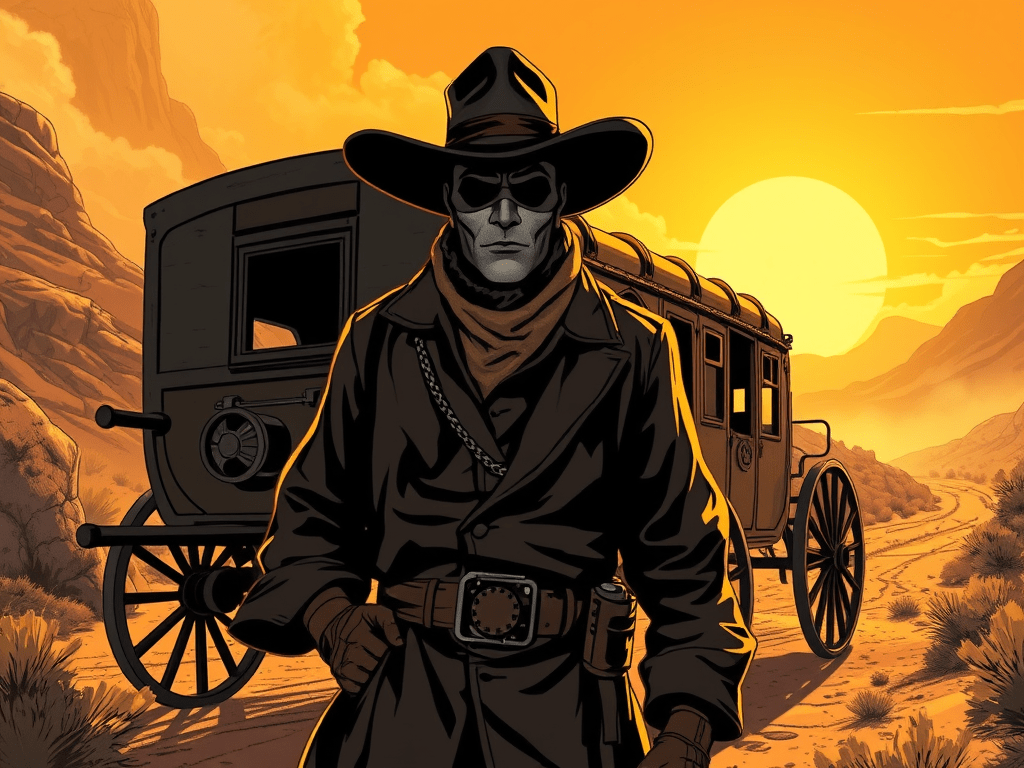
The story of Black Bart, or Charles E. Boles (later known as CE Bolton), is one of the most enduring legends of the American West—one that blends elements of mystery, crime, and even a touch of humor, thanks to his polite demeanor and poetic flair. His career as a stagecoach robber, spanning from the late 1870s to the early 1880s, represents one of the most audacious and enigmatic series of crimes in the Old West.
The Genesis of Black Bart: A Man Wronged
Charles E. Boles’s transformation into Black Bart is rooted in personal tragedy and financial hardship. Boles was a farmer, a man who sought to strike it rich in the Montana mining fields, much like thousands of other hopeful miners during the Gold Rush era. However, after a few years of moderate success, his dream was shattered when agents from Wells Fargo arrived on his mining property with an offer to buy him out. When Boles refused, Wells Fargo retaliated by cutting off the water supply to his land, making it impossible for him to continue mining. This deliberate sabotage drove Boles into a state of desperation and bitterness, and he never forgave Wells Fargo for ruining his livelihood.
Thus began the evolution of Black Bart, a man who sought revenge on the company that had destroyed his dreams. He became one of the most infamous stagecoach robbers in history—known for his discretion, gentlemanly manner, and avoidance of violence, unlike the typical outlaw of the era.
The Robberies: The Gentleman Bandit with a Poetic Touch
Boles’s first robbery occurred in July 1875, when he donned his signature disguise: a soiled duster and a flour sack over his head. This strange mask and his calm, almost courteous demeanor during the robbery earned him the nickname Black Bart (as well as “The Poet of the Sierra”). He was also notorious for his refusal to harm anyone. When he would rob a stagecoach, he would often make polite, civil demands, and his memorable statement to a hysterical woman—”Madam, I do not wish your money. In that respect I honor only the good office of Wells Fargo”—became part of his mystique.
Between 1877 and 1883, Black Bart committed an estimated 28 stagecoach robberies, always using the same tactics: a simple, efficient demand for the driver to throw down the lockbox, and the absence of any shots fired. Bart’s robberies were a blend of precision and politeness. The myth of Black Bart grew with each robbery, especially since he left no bloodshed in his wake, unlike the more violent bandits of the time. He became something of a folk hero, admired for his intelligence and restraint, even as his crimes were widely reported.
In addition to his smooth operations, Black Bart made sure to leave behind his calling card—a poem. These short rhymed verses were left behind at the scene of each robbery, often mocking Wells Fargo or commenting on his own crime in a poetic, almost literary fashion. His most famous poem, left behind after a robbery in February 1879, read:
“I’ve labored long and hard for bread,
For honor and for riches,
But on my corns too long you’ve tread,
You fine-haired sons of bitches.”
This added an air of mystery and intelligence to his persona—he was not just a common bandit, but someone who had a certain philosophical or artistic side to his life of crime.
The Downfall: The Final Robbery and the Pinkerton Investigation
In November 1883, Black Bart made what would become his final robbery—but this time, things didn’t go as planned. The stagecoach he targeted near Copperopolis, California, was prepared for his arrival. After demanding the lockbox and ordering the driver to halt, Bart struggled to open the box, which had been reinforced with new security measures. The driver, Reason McConnel, saw an opportunity to escape, knowing that Jimmy Rolleri, the passenger riding shotgun*, was nearby.
In the confusion, McConnel and Rolleri managed to grab a shotgun, and a shootout ensued. Rolleri fired the critical shot, and Black Bart was hit, leaving a blood trail as he fled the scene.
It was the beginning of the end for Black Bart. His robbery spree had caught the attention of the Pinkerton Detective Agency, which was now focused on tracking him down. The Pinkertons, already experts at investigating criminals, quickly began their search. It wasn’t long before James Hume, a seasoned lawman and detective with the Pinkertons, was sent to investigate the scene of the robbery.
The Evidence: The Laundry Mark That Led to His Capture
Hume’s team found several personal items at the scene, including a dirty handkerchief with a laundry mark in the corner. At first, Hume didn’t think much of it, but after further investigation, the laundry mark led to a laundromat in San Francisco—a place where Charles E. Bolton, under his alias, had been a regular customer.
When Hume traced the mark back to Bolton, he had a suspect. Bolton was a wealthy man who had made his fortune through his mining operations, but his connection to the robbery was now clear. The handkerchief found at the scene of the crime was the key to solving the mystery.
The Arrest and Trial
In November 1883, Charles E. Bolton was arrested and charged with the Copperopolis robbery. Upon questioning, he initially denied being Black Bart, claiming that someone must have stolen his handkerchief or that he had simply lost it. But the overwhelming evidence—including the matching clothes found in his possession and the handkerchief with the same laundry mark—led to his conviction.**
Bolton pled guilty to the charge of robbing the Wells Fargo stagecoach near Copperopolis and was sentenced to six years in San Quentin prison. During his time in prison, Bolton continued to deny being Black Bart, even though he had been living under the alias of CE Bolton for years.
The Escape and the Final Years
Bolton served just four years of his six-year sentence before being released from San Quentin in January 1888. Upon his release, the press was eager to interview him, particularly about his notorious alter ego, Black Bart. However, Bolton maintained that he was through with crime, stating, “I am through with crime.”
The final sighting of Black Bart (or Charles Bolton) came in February 1888, but after that, he seemingly disappeared from history. Some reports suggested that he died in 1914, while others claimed that he moved to Japan. The truth remains unknown, adding another layer of mystery to the legend of Black Bart.
Legacy
Charles E. Boles, as Black Bart, left an indelible mark on the history of the American West. His combination of politeness and intelligence, his gentlemanly demeanor, and his use of poetry made him an almost romantic figure in the annals of outlaws. Despite his criminal activities, he became a symbol of rebellion against the corporate powers of the time, particularly Wells Fargo, which had wronged him in his youth.
Even though his life of crime was short-lived and ended in his capture, the legend of Black Bart lives on—his polite robberies, his poetic crime notes, and the mystery surrounding his disappearance have solidified his place in American folklore as one of the most famous, albeit enigmatic, figures of the Old West.
*The term riding shotgun comes from A passenger riding on top of a stagecoach with a shotgun to deter would be robbers.
** Even though the fourth amendment to the US Constitution prohibits unreasonable searches and seizures, the practice was not uncommon in the 1800’s. It wasn’t until the supreme court case of Mapp V. Ohio in 1962 that the Fourth Amendment was routinely enforced.
Black Bart the legend begins. (n.d.). http://www.blackbart.com/legend.php






 History in 5 Minutes or less
Leave a reply to Erika Smith Cancel reply