The Day the Sky Fell (and the Government Trips over its Feet)
Would you believe me if I told you that the most famous “alien” in human history was actually a bunch of high-altitude balloons and a few crash-test dummies with a very bad sunburn? Or maybe you prefer the version where a silver saucer skipped across the New Mexico desert like a stone on a pond, leaving behind purple-etched metal and the secrets of the universe.
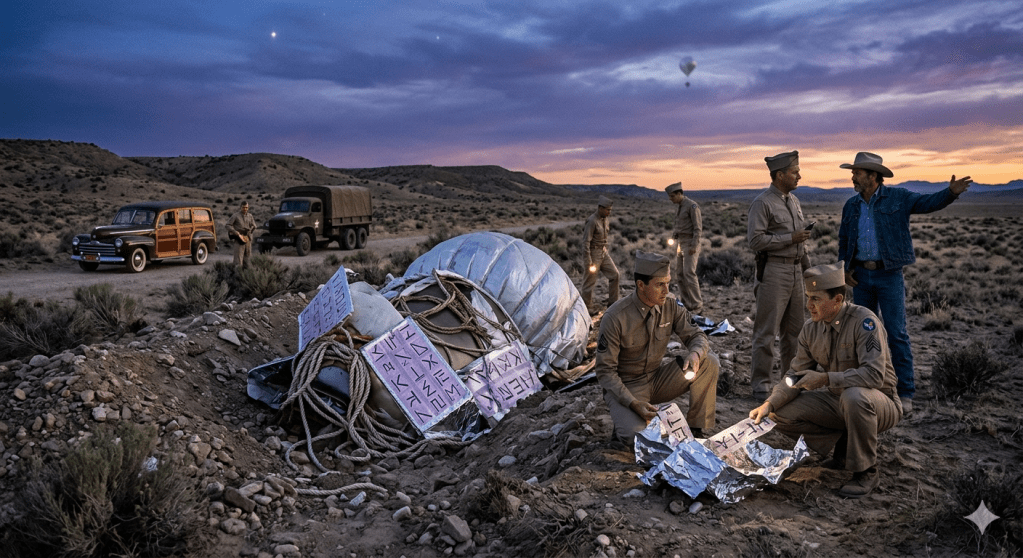
Actually, let’s rewind. Before the tinfoil hats and the “I Want to Believe” posters, there was just Mac Brazel—a rancher who was mostly annoyed that a localized thunderstorm had scattered a mess of rubber, tinfoil, and tough paper across his sheep pasture. He wasn’t looking for Martians; he was looking for a way to clear his field so his livestock wouldn’t eat the debris and die.
What happened next was a masterclass in military “oopsies” that birthed a modern mythology.
July 1947: The “Flying Disc” PR Disaster
In the summer of 1947, America was obsessed with the sky. Just weeks earlier, pilot Kenneth Arnold had reported seeing nine “saucer-like” objects over Mount Rainier. The “Flying Saucer” craze was officially in high gear. So, when Mac Brazel drove into Roswell with a truckload of weird scrap metal and told Sheriff George Wilcox about it, everyone’s brain went to the same place: Space.
The Sheriff called the Roswell Army Air Field (RAAF). Enter Major Jesse Marcel, an intelligence officer who looked at the debris and—depending on who you believe—either thought it was the coolest thing ever or just a weird weather balloon.
On July 8, 1947, the RAAF issued a press release that would change history. It didn’t mince words: “RAAF Captures Flying Saucer On Ranch in Roswell Region.”
The news went viral before “going viral” was a thing. It hit the wires and circled the globe. For about 24 hours, humanity knew the truth: We were not alone. And then, the military woke up with a massive hangover of regret.
The Great “Nevermind” of 1947
Within a day, the narrative flipped faster than a politician in an election year. General Roger Ramey, head of the Eighth Air Force in Fort Worth, Texas, called a second press conference. He invited the media in to see the “saucer.”
Except, it wasn’t a saucer. It was a pile of shredded neoprene, tinfoil, and balsa wood. Ramey explained that his boys at Roswell had made a silly mistake. It was just a Rayin weather balloon carrying a radar target.
Jesse Marcel was photographed kneeling next to the trash, looking significantly less than thrilled. The story died. For thirty years, Roswell was nothing more than a footnote in New Mexico history—a funny story about that one time the Air Force got a little too excited about a balloon.
Project Mogul: The Truth is More “Bond” than “Borg”
So, was it a weather balloon? Technically, no. But it wasn’t a spaceship either.
In 1994, under pressure from the GAO and the public, the Air Force finally declassified the real reason for the secrecy. It was called Project Mogul.
During the late 1940s, the US was terrified that the Soviets would develop an atomic bomb. We needed a way to detect Soviet nuclear tests from across the globe. Sound travels incredibly well in a specific layer of the upper atmosphere. Project Mogul used long “trains” of balloons—sometimes over 600 feet long—equipped with sensitive microphones to “listen” for the acoustic shockwaves of a Russian nuke.
The debris Brazel found—the “unbreakable” beams with “hieroglyphics”—were actually balsa wood struts reinforced with adhesive tape. And those “alien symbols”? The tape was manufactured by a toy company in New York that used floral and geometric patterns on its products during the war. To a rancher in the middle of a desert, industrial adhesive tape with purple flowers looked like Martian math.
Why did people start seeing Greys?
If it was just a balloon, why did the story explode again in the late 70s?
In 1978, UFO researcher Stanton Friedman interviewed a retired Jesse Marcel. Marcel dropped a bombshell: he claimed the debris he saw in 1947 wasn’t from Earth, and the stuff they showed the press in Fort Worth was a “switcheroo.”
Then came the “witnesses.” Suddenly, everyone in Roswell remembered seeing small, grey-skinned bodies being wheeled away on stretchers. The “Alien Autopsy” videos (later proven to be hoaxes) added fuel to the fire.
But there’s a terrestrial explanation for the “bodies” too. In the 1950s, the Air Force ran Project High Dive, dropping anthropomorphic crash-test dummies from high altitudes to test parachutes. While the dates don’t perfectly align with 1947, human memory is a fickle thing. After 30 years, memories of 1950s dummy drops likely fused with the 1947 balloon crash to create the legend of the Roswell Greys.
The Psychology of the Saucer
Why do we want it to be aliens? Because a weather balloon is boring. A top-secret spy project is scary but mundane. But a visitor from the stars? That changes everything.
Roswell became the “Ground Zero” for government mistrust. The fact that the military was lying (about Project Mogul) gave conspiracy theorists the “smoking gun” they needed to argue that the military was lying about everything. If they lied about the balloon, they must be hiding the bodies in Area 51.
Why This Still Matters
The Roswell incident isn’t just about whether or not ET phoned home. It matters because it marks the birth of the Modern Conspiracy Era.
- Transparency vs. Security: It shows the inevitable friction between a government’s need for “National Security” and the public’s right to know. When the government uses “the truth” as a variable, the public fills the gaps with myth.
- The Power of Folklore: Roswell is a modern myth. It provides a shared narrative that explains the unknown. In an age where we feel small, the idea that we are being watched or visited gives us a strange sense of importance.
- Critical Thinking: It serves as a permanent case study in Occam’s Razor. Which is more likely: a civilization traveled light-years across the vacuum of space only to crash into a New Mexico sheep ranch because of a thunderstorm, or a top-secret Cold War spy balloon fell down?
Roswell is the mirror we hold up to our own fears and curiosities. Whether you see a balloon or a saucer depends entirely on what you’re looking for.
Sources
- The Roswell Report: Fact vs. Fiction in the New Mexico Desert (United States Air Force, 1995).
- Pflock, Karl T. Roswell: Inconvenient Facts and the Will to Believe (Prometheus Books, 2001).
- Saler, Benson; Ziegler, Charles A.; Moore, Charles B. UFO Crash at Roswell: The Genesis of a Modern Myth (Smithsonian Institution Press, 1997).
- The National Archives: Records on Project Mogul and high-altitude balloon research.



Leave a Reply