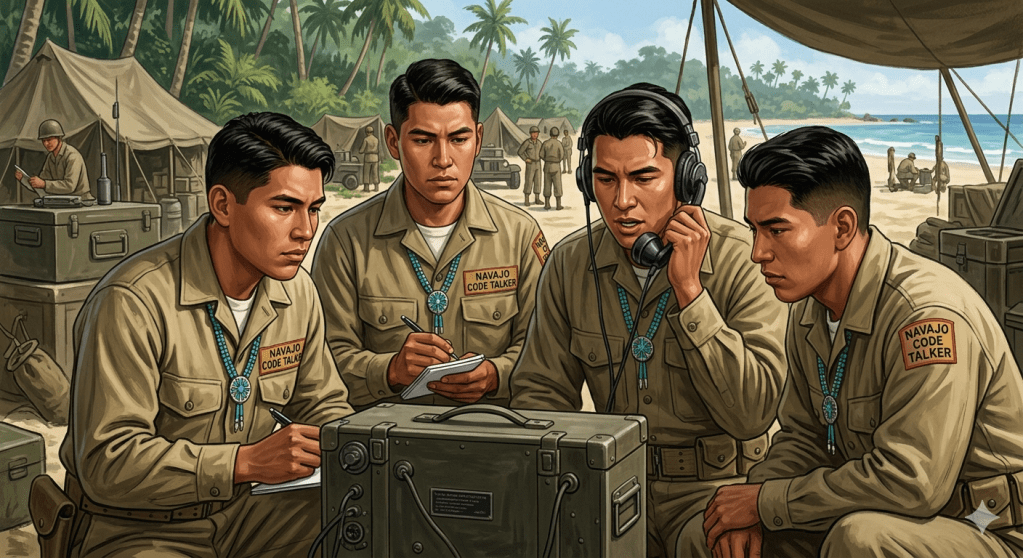
The Secret Weapon That Spoke in Wind and Lightning
Imagine being told that the fate of the Pacific Theater—and perhaps the entire democratic world—rested on your ability to describe a “fighter plane” as a “hummingbird” and a “battleship” as a “whale.” If you had slipped up just once, the secret code that the Imperial Japanese Army spent years trying to crack would have crumbled like dry desert sand. But for twenty-nine young Navajo men in 1942, this wasn’t a riddle; it was a matter of survival.
Before we get into how a language once banned by the U.S. government became its most powerful weapon, we have to understand the sheer desperation of the American military. By early 1942, the Japanese were intercepting and decoding American radio communications with terrifying ease. They were experts at English and often better at American slang than the GIs themselves. The U.S. was losing the communication war, and they needed a miracle.
A Visionary in the High Desert
The miracle didn’t come from a top-secret lab in Arlington. It came from Philip Johnston, a World War I veteran and the son of a missionary who had grown up on the Navajo Reservation. Johnston knew something the Pentagon didn’t: the Navajo language (Diné Bizaad) was an impenetrable fortress of syntax and tone.
Navajo is an unwritten, tonal language. It is so complex that a slight change in pitch can turn a word from “mother” to “mountain.” At the time, it was estimated that fewer than 30 non-Navajo people in the entire world—none of them Japanese—could speak it.
Johnston convinced the Marines to give him a pilot test. He brought a group of Navajo men to Camp Elliott, where they successfully encoded, transmitted, and decoded a three-line message in 20 seconds. The existing machines of the era took 30 minutes to do the same. The Marines were sold.
The First Twenty-Nine: Creating the Code
The original 29 recruits, the “First Twenty-Nine,” arrived at Camp Pendleton in May 1942. They weren’t just soldiers; they were cryptographers. Their task was to build a code within a language.
They couldn’t just speak “plain” Navajo. If they said the word for “tank,” a Japanese listener might eventually catch on if they saw a tank nearby. Instead, they used a double-layered system. They assigned Navajo words to represent letters of the English alphabet, and they created a specialized vocabulary for military terms.
The Bestiary of War
Because the Navajo language lacked technical military jargon, the recruits looked to nature:
| Military Term | Navajo Word | Translation |
| Fighter Plane | Da-he-tih-hi | Hummingbird |
| Dive Bomber | Gini | Chicken Hawk |
| Battleship | Lo-tso | Whale |
| Submarine | Besh-lo | Iron Fish |
| Grenade | Ni-ma-si | Potato |
| America | Ne-he-mah | Our Mother |
When a Code Talker wanted to spell out a specific name, like “Guadalcanal,” they used the alphabet system. To avoid patterns, they often had multiple Navajo words for a single English letter. For the letter “A,” they could use Wol-la-chee (Ant), Be-la-sana (Apple), or Tse-nill (Axe). It was a linguistic masterpiece that moved at the speed of thought.
From Boarding Schools to the Front Lines
There is a profound, biting irony in this story that shouldn’t be ignored. Just a few years prior, many of these same men had been sent to government-run boarding schools where they were beaten or had their mouths washed out with soap for speaking Navajo. The government had spent decades trying to “civilize” the “savage” out of them by erasing their culture.
Yet, when “Our Mother” (America) called, they didn’t hesitate. They brought their “forbidden” language to the bloody black sands of Iwo Jima and the humid jungles of Guadalcanal.
For the Navajo, the war was personal. Their culture emphasized the concept of Hózhó—a state of balance, harmony, and beauty. The Axis powers were the ultimate disruption of Hózhó. By using their sacred language to protect their land, they weren’t just fighting for the United States; they were fighting to restore balance to the world.
“Were It Not for the Navajo…”
The ultimate test of the code came during the Battle of Iwo Jima. In the first 48 hours of the invasion alone, six Navajo Code Talkers worked around the clock. They sent and received over 800 messages without a single error.
Major Howard Connor, the signal officer for the 5th Marine Division, famously stated:
“Were it not for the Navajo, the Marines would never have taken Iwo Jima.”
The Japanese were losing their minds. They had cracked every other code the Americans used, but the Navajo code remained a “ghost voice.” They even captured a Navajo soldier (who wasn’t a Code Talker) and tortured him to try and get him to translate the “nonsense” coming over the airwaves. He couldn’t do it. Even to a native speaker, the code sounded like a chaotic jumble of birds, fish, and fruits that made zero sense in a military context.
The Code Talkers were also in constant danger from their own side. Because of their physical features, they were often mistaken for Japanese soldiers in the chaos of jungle warfare. Several Navajo Marines were actually held at gunpoint by fellow Americans until their identity could be verified. To prevent this, the military eventually assigned some Code Talkers personal bodyguards—not just to protect them from the enemy, but to protect them from “friendly fire.”
The Long Silence
When the war ended in 1945, the Code Talkers didn’t return home to ticker-tape parades. They didn’t get to tell their wives or parents about the incredible things they had done. Instead, they were told their work was still Top Secret.
The military thought they might need the Navajo code for a future conflict, so the Code Talkers were sworn to silence. They returned to the reservation, many struggling with what we now call PTSD, and lived quietly as ranchers, teachers, and craftsmen. For 23 years, the world had no idea that a small group of Native Americans had been the “undecipherable” heartbeat of the Pacific war.
It wasn’t until 1968 that the code was finally declassified. Only then did the stories begin to trickle out. In 1982, President Ronald Reagan gave them their own day, and in 2001, the original 29 were finally awarded the Congressional Gold Medal.
Why This Still Matters
The story of the Navajo Code Talkers isn’t just a “cool history fact” for trivia night; it’s a masterclass in the value of diversity and the irony of history.
- Cultural Resilience: It proves that the very things a society tries to suppress are often the things that will eventually save it. The U.S. tried to kill the Navajo language; that language saved thousands of American lives.
- The Human Element in Tech: In an age where we rely on AI, encryption algorithms, and quantum computing, the most unbreakable code in history was purely human. It relied on shared culture, trust, and the nuances of the human voice.
- Recognition Matters: It serves as a reminder that history is often written by the victors, but the victories are often won by those the history books initially forgot. The Code Talkers teach us that patriotism isn’t just about following orders—it’s about bringing your whole, authentic self to the table, even when that self hasn’t always been welcomed.
The Navajo Code Talkers transitioned from a world where they were told their culture was “worthless” to a world where they realized their culture was “priceless.” They are the ultimate symbols of the “Warrior Protector” spirit, proving that the most powerful weapon on the battlefield isn’t a bomb or a gun—it’s a word spoken in the right tongue.
Sources
- Mead, Alice. Always Brave: The Story of the Navajo Code Talkers.
- National Museum of the American Indian. Navajo Code Talkers: World War II Fact Sheet.
- Nez, Chester. Code Talker: The First and Only Memoir By One of the Original Navajo Code Talkers of WWII.
- The United States Marine Corps History Division. The Navajo Code Talkers.
- Aaseng, Nathan. Navajo Code Talkers.


Leave a Reply