The Most Terrifying Sound You’ll Never Hear Twice
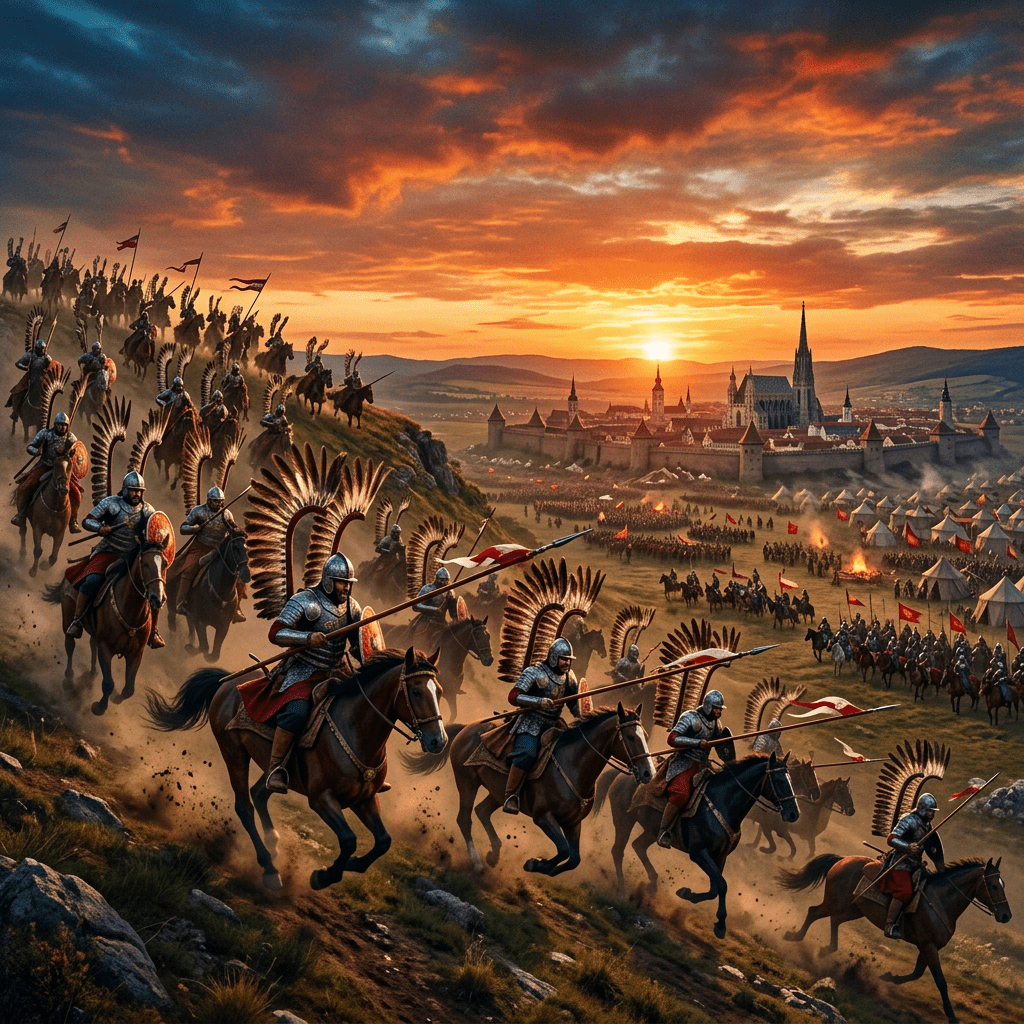
Imagine standing in a muddy field in 1683. To your left, the Ottoman Empire has spent months digging trenches, certain that Vienna—and by extension, Christian Europe—is about to fall. To your right, the horizon starts to shimmer. Then, a sound begins. It isn’t just the thundering of hooves; it’s a high-pitched, ghostly shriek that seems to tear the very air apart.
Wait—let’s rewind. Before we get to the screaming wings and the 20-foot lances, we need to understand how a group of noblemen from the Polish-Lithuanian Commonwealth became the closest thing the 17th century had to a superhero squad. They weren’t just soldiers; they were the “Angels of Death,” and for over a century, they didn’t just win battles—they ended them before the enemy could even blink.
From Light Cavalry to Heavy Metal
In the early 1500s, the “Hussar” wasn’t the tank-like juggernaut we picture today. Originally, they were light cavalry mercenaries from Serbia and Hungary—fast, agile, and relatively unarmored. They were the scouts and the skirmishers.
However, King Stephen Báthory of Poland had a vision. He looked at the heavy, slow-moving knights of the medieval past and the flimsy light cavalry of the present and thought, “Why not both?”
By the late 16th century, the Winged Hussars had evolved into a “heavy” cavalry unit that somehow maintained the speed of a “light” one. They were recruited from the Szlachta (the Polish nobility). These men were incredibly wealthy, and they had to be—they provided their own horses, armor, and weapons. This wasn’t a job; it was a high-stakes, high-fashion lifestyle.
The Kit: Form Meets Function
A Winged Hussar didn’t just walk into a blacksmith and ask for “armor.” He asked for a masterpiece.
- The Cuirass: Polished steel plates, often decorated with brass images of the Virgin Mary or Saint George.
- The Helmet: A szyszak (lobster-tail pot) that protected the neck while allowing for visibility.
- The Lance: This was their secret weapon. Known as a kopia, it was hollowed out to be lightweight but reached lengths of up to 20 feet (6 meters). This allowed them to outreach any infantry pike.
The Wings: Psychological Warfare or Just Flashy Fashion?
Now, let’s address the feathered elephant in the room: The Wings.
Wooden frames covered in eagle, swan, or ostrich feathers were attached either to the back of the armor or to the saddle. For decades, historians have debated their purpose. Was it just to look cool? (To be fair, they looked incredibly cool.)
There are three main theories, and the truth is likely a cocktail of all three:
- The Sound: When charging at full gallop, the vibration of the feathers in the wind created a strange, whistling hiss. In the chaos of battle, this “shriek” was designed to spook the enemy’s horses and unnerve the men.
- The Protection: Some argue the frames made it difficult for an enemy to use a lasso to pull the rider off his horse—a common tactic used by Tatar and Ottoman riders.
- The Vibe: Let’s be honest—if 3,000 men charging at you look like 10-foot-tall avenging angels, you’re probably going to drop your musket and run. It was elite branding.
The Charge of Kircholm: 82 Seconds of Chaos
To understand their power, we have to look at the Battle of Kircholm in 1605.
The Polish-Lithuanian forces were outnumbered three to one by the Swedish Empire. The Swedes had the latest muskets and a disciplined professional army. The Polish commander, Jan Karol Chodkiewicz, decided to bet everything on one card: a direct charge.
The Hussars didn’t just run blindly. They used a sophisticated “expanding” formation. They would start the charge with wide gaps between the horses so that enemy cannon fire and musketry would mostly pass through empty air. As they got closer—within the final 50 yards—they would tighten the ranks until their knees were literally touching.
At Kircholm, the Hussars smashed into the Swedish lines. Their 20-foot lances shattered the Swedish pikes, which were only 15 feet long. In a matter of minutes, the Swedish army collapsed. The Hussars suffered only about 100 casualties, while the Swedes lost thousands. It was a masterclass in momentum.
The “Hussar’s Hobby”: The Cost of Excellence
Being a Winged Hussar was the most expensive hobby in history. A single Hussar’s equipment—including his armor, his specialized lances (which broke after one use), and his stable of horses—could cost more than an entire village.
And the horses weren’t just any nags. They were a secret breed, a cross between heavy European breeds and agile desert stallions. Selling one of these horses to a foreigner was actually punishable by death. They were bred for “burst” speed and incredible endurance, capable of carrying a fully armored man for miles and then delivering a devastating sprint at the end.
Because they were nobles, they also dressed with “Oriental” flair. They often wore leopard, tiger, or bear skins over their armor. Imagine a man in shining steel, with giant feathered wings, draped in a leopard pelt, charging at you on a horse that costs more than your life. It was the ultimate “flex.”
Vienna 1683: The Greatest Cavalry Charge in History
If the Winged Hussars have a “Super Bowl” moment, it’s the Battle of Vienna.
By 1683, the Ottoman Empire had surrounded Vienna. The city was starving, the walls were crumbling, and the Grand Vizier Kara Mustafa was preparing for the final blow. The Holy Roman Emperor had fled. All seemed lost for Western Europe.
Then came King Jan III Sobieski of Poland.
He arrived with a relief force, but they were positioned atop the Kahlenberg hills, looking down at the massive Ottoman encampment. On September 12, after a day of grueling infantry fighting, Sobieski saw his opening.
He led the charge personally. Around 18,000 cavalrymen—the largest cavalry charge in human history—descended from the hills. At the tip of this massive spear were 3,000 Winged Hussars.
The sight was apocalyptic. The heavy thud of 72,000 hooves shook the ground. The sun glinted off thousands of steel breastplates. The Hussars tore through the Ottoman lines like a hot knife through butter. Within three hours, the Ottoman army was in full retreat, and the siege was broken. Sobieski famously paraphrased Caesar afterward: “Venimus, vidimus, Deus vicit” (We came, we saw, God conquered).
The Long Sunset
No empire or elite unit lasts forever. The very things that made the Hussars great eventually led to their downfall.
As the 18th century rolled around, firearms became more accurate and faster to reload. Artillery became more devastating. The “shock” value of a cavalry charge began to wane against disciplined squares of infantry with bayonets.
Furthermore, the Polish-Lithuanian Commonwealth began to fracture internally. The immense cost of maintaining the Hussars became unsustainable for a state in decline. By the mid-1700s, the Hussars had become more of a ceremonial guard—appearing at funerals and parades—rather than the frontline terrors they once were. They were officially disbanded in 1776, replaced by lighter, more modern “Uhlans.”
But they didn’t go quietly into the night. They left behind a legend that has arguably grown stronger in the centuries since their disappearance.
Why This Still Matters
You might wonder why we should care about guys with feathers on their backs from 400 years ago.
First, the Winged Hussars represent the pinnacle of the “Multi-Role” soldier. They proved that heavy armor didn’t have to mean slow movement, and that tradition could be successfully merged with cutting-edge technology (like their hollowed-out lances).
Second, they are a study in psychological warfare. Long before modern “psy-ops,” the Hussars understood that half of winning a battle is making the enemy believe they have already lost. The wings, the skins, the screaming lances—it was all designed to win the fight in the mind before the steel ever touched flesh.
Finally, they remain a symbol of national identity. For Poland, the Winged Hussars are a reminder of a time when the Commonwealth was a European superpower, a “Bulwark of Christendom” that stood between East and West. They represent the idea that even when outnumbered, a combination of elite training, superior gear, and sheer audacity can change the course of history.
Sources
- Brzezinski, Richard. Polish Armies 1569-1696. Osprey Publishing, 1987. (The gold standard for technical details on armor and tactics).
- Varvounis, Miltiades. Jan Sobieski: The King Who Saved Europe. 2012. (A deep dive into the Battle of Vienna).
- Sikora, Radosław. Husaria. Duma polskiego oręża. (The most comprehensive modern Polish research on hussar maneuvers).
- Davies, Norman. God’s Playground: A History of Poland. Columbia University Press.



 History in 5 Minutes or less
Leave a comment