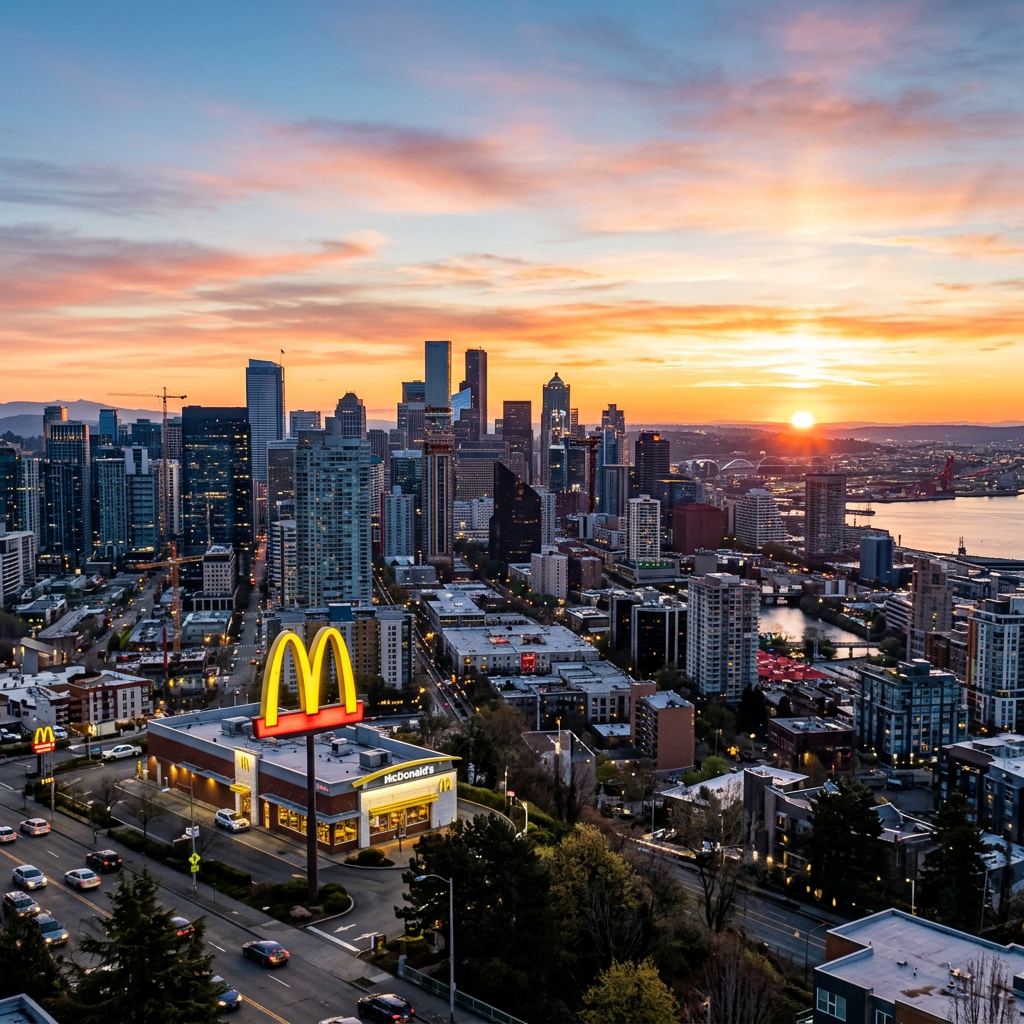
The Golden Empire: How a 52-Year-Old Salesman Built a Global Icon
What if the most successful business move you ever made didn’t happen until you were in your fifties? For most people, age 52 is a time to start slowing down, but for Ray Kroc, it was just the beginning of the first inning. He didn’t invent the fast-food concept, but he possessed a rare, visionary hunger that allowed him to take a localized success story and turn it into a global language of commerce.
To understand how he did it, we have to rewind to 1954, to a dusty parking lot in San Bernardino, California.
The Salesman’s Last Stand
In 1954, Ray Kroc was a quintessential American hustler. He had spent decades selling everything from Florida real estate to paper cups. His current venture was the Prince Castle Multi-Mixer, a machine that could churn out five milkshakes at once.
The business was tough, and the traditional soda fountain era was fading. But then, an unusual order came in from a small burger joint in California. They didn’t want one mixer; they wanted eight.
Intrigued, Kroc flew west to see what kind of operation could possibly need forty milkshakes running at the same time. He expected a fluke; instead, he found a revolution. He watched a line of customers move with the precision of a Swiss watch. There were no “carhops” or jukeboxes to distract from the mission—just a focused menu of burgers, fries, and shakes served in seconds.
The Brothers McDonald
The masterminds behind this “Speedee Service System” were Dick and Mac McDonald. They were New Hampshire natives who had moved to California, failed in the movie business, and pivoted to food. By the time Kroc met them, they were happy and successful, earning a comfortable $100,000 a year.
When Kroc suggested they expand, the brothers were hesitant. They had tried franchising before, but they hated the loss of quality control. Pointing to their home on the hill, they told Kroc, “That’s enough for us”.
Kroc, however, saw a brand that could be standardized across every town in America. He eventually convinced them to let him act as their exclusive franchising agent. The contract was rigid—the brothers kept final say over every physical change to the buildings—but Kroc was so convinced of the potential that he signed it anyway.
The Grind and the Golden Arches
Kroc opened his first McDonald’s in Des Plaines, Illinois, in 1955. He became a fanatic for consistency and cleanliness. He famously believed that if a restaurant was spotless, customers would trust the food. He would personally scrub chewing gum off the pavement to ensure the “Golden Arches”—a design the brothers had already conceived—represented a gold standard.
However, Kroc’s ambition was outstripping his bank account. Because of his narrow contract, he was making very little money despite the high volume of sales. He was building a massive brand on a razor-thin margin.
The Secret Sauce: Real Estate
The breakthrough came from a financial wizard named Harry Sonneborn. After looking at Kroc’s struggling books, Sonneborn gave him the advice that changed history: “You’re not in the burger business. You’re in the real estate business”.
Sonneborn’s strategy was to have Kroc’s company buy or lease the land under the restaurants. They would then sublease the land back to the franchisees. This provided the steady cash flow Kroc desperately needed and gave him the leverage to enforce his strict standards. If a franchisee didn’t follow the system, Kroc could evict them. This real estate model remains the core of McDonald’s corporate power today.
The Great Divorce
By 1961, the partnership between Kroc and the McDonald brothers had reached a breaking point. Kroc wanted to move faster; the brothers wanted to preserve their original pace. Kroc offered to buy them out entirely.
The price was $2.7 million—a massive sum that would net each brother $1 million after taxes. Kroc took out loans to make it happen, but the deal didn’t include the brothers’ original San Bernardino shop. They renamed it “The Big M,” but Kroc, now owning the name and the system, opened a brand-new McDonald’s just a block away. With the full weight of the new corporation behind it, the original shop was eventually forced to close. Kroc then officially began calling himself the “Founder,” cementing his role as the architect of the empire.
The Cultural Juggernaut
Through the 60s and 70s, Kroc scaled the brand with unmatched intensity. He leveraged the power of television, introducing Ronald McDonald in 1963 to appeal to the next generation of consumers.
He also fostered a culture where franchisees could innovate. Iconic items like the Big Mac and the Egg McMuffin weren’t invented at corporate headquarters; they were created by local owners in Pittsburgh and Santa Barbara. Kroc’s genius was his ability to recognize these hits and deploy them across thousands of locations with perfect consistency.
Why This Still Matters Today
- The Franchise Model: Kroc perfected the “business in a box,” a model used today by everyone from hotels to fitness centers.
- Consistency as a Brand: He proved that reliability is often more powerful than luxury. A Big Mac tastes the same in Tokyo as it does in Salt Lake City.
- Real Estate Strategy: McDonald’s remains one of the largest landholders in the world, proving that the “business behind the business” is the key to longevity.
- Late-Life Success: Kroc’s journey is a reminder that professional peaks can happen well into middle age, provided you have the drive to recognize a “Multi-Mixer” moment when it arrives.
Sources:
- Grinding It Out: The Making of McDonald’s by Ray Kroc
- McDonald’s: Behind the Arches by John F. Love
- The Real Founder: The Story of the McDonald Brothers by Lisa Napier





Leave a Reply