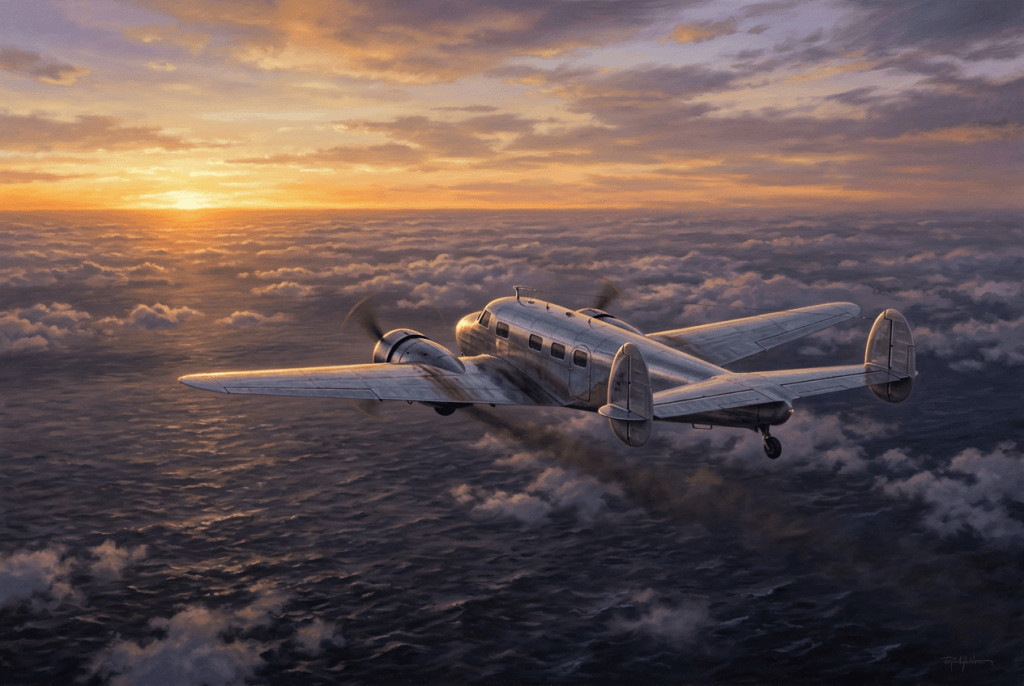
The Static on the Line
At 8:43 AM on July 2, 1937, somewhere over the relentless blue expanse of the central Pacific Ocean, a crackling, desperate voice cut through the radio room of the U.S. Coast Guard cutter Itasca: “We are on the line 157 337… We are running on line north and south.” Then, nothing—just the hiss of static and an empty sky where one of the most famous people on Earth had been a heartbeat before.
To understand how a woman who once dismissed airplanes as unimpressive contraptions of “rusty wire and wood” ended up vanishing into aviation’s greatest cold case, we have to rewind thirty-nine years to a bluff overlooking the Missouri River.
PBS
The Girl in Brown Who Walked Alone
Born on July 24, 1897, in Atchison, Kansas, Amelia Mary Earhart was never particularly interested in following the Victorian script written for young girls. While her maternal grandmother, Amelia Harres Otis, frowned upon unladylike behavior, young Amelia and her younger sister, Muriel, spent their childhoods climbing trees, hunting rats with a .22 rifle, and building a homemade roller coaster out of wooden planks and roller-skate wheels that she nailed to the roof of a tool shed. After testing the contraption and crashing violently into the dirt with a bruised lip and torn dress, she cheerfully announced to her sister, “Oh, Pidge, it’s just like flying!”
PBS
Behind the tomboy bravado, however, her early life was marked by quiet turbulence. Her father, Edwin Stanton Earhart, was a bright railroad attorney whose battle with alcoholism repeatedly cost him jobs and forced the family to uproot across Iowa, Minnesota, Illinois, and California. Amelia became fiercely self-reliant, keeping a scrapbook of newspaper clippings about women succeeding in traditionally male fields—from film directing to mechanical engineering. In her 1916 Chicago high school yearbook, beneath her photograph, the caption read: “A.E. — the girl in brown who walks alone.”
PBS+ 1
During World War I, while visiting her sister in Toronto, Amelia saw wounded soldiers returning from the trenches on crutches. She promptly dropped out of finishing school to work as a nurse’s aide at Spadina Military Hospital, scrubbing floors, dispensing medicine, and watching Royal Flying Corps pilots train nearby. It wasn’t until December 28, 1920, at an air meet in Long Beach, California, that the spark finally caught. Amelia paid ten dollars for a ten-minute sightseeing flight with pilot Frank Hawks. “By the time I had got two or three hundred feet off the ground,” she later wrote, “I knew I had to fly.”
“Just Like a Sack of Potatoes”
To pay for flying lessons in 1921, Earhart worked as a photographer, a stenographer, and a gravel-truck driver. Her instructor was Anita “Neta” Snook, a pioneering female aviator who taught her on a surplus Curtiss JN-4 “Canuck” biplane. Within six months, Earhart saved enough to buy her own secondhand Kinner Airster—painted bright canary yellow, which she naturally dubbed The Canary. By October 1922, she had flown it to 14,000 feet, setting a women’s altitude record, and in May 1923, she became only the sixteenth woman in the world to receive an international pilot’s license from the Fédération Aéronautique Internationale.
Yet financial reality grounded her in 1924 when her parents divorced. She sold The Canary, bought a bright yellow Kissel roadster, and drove her mother across the country to Massachusetts, taking a job as a social worker at Denison House in Boston. She loved teaching English to immigrant families, and flying seemed destined to remain a weekend hobby—until an ordinary afternoon phone call in April 1928 changed her life forever.
FAA+ 1
On the other end of the line was Captain Hilton Railey, acting on behalf of New York publisher George Palmer Putnam. A wealthy American heiress named Amy Phipps Guest had purchased a tri-motor Fokker F.VIIb/3m airplane named Friendship with the intention of becoming the first woman to fly across the Atlantic. When her family intervened and forbade her from making the perilous trip, Putnam searched for an American woman who possessed both aviation credentials and the poise to captivate the press.
Earhart fit the bill—down to her uncanny physical resemblance to Charles Lindbergh, which quickly earned her the nickname “Lady Lindy.” There was just one catch: because the plane had been outfitted with pontoons for water landings and Earhart had no instrument-flying experience, she wouldn’t actually be at the controls. Pilots Wilmer Stultz and Louis Gordon would fly the aircraft while she kept the flight log.
On June 17–18, 1928, Friendship fought through dense fog and icing conditions for 20 hours and 40 minutes before splashing down in Burry Port, Wales. Overnight, Amelia Earhart became an international sensation. Ticker-tape parades awaited her in New York, Chicago, and Boston. Yet Earhart refused to accept unearned credit. Speaking candidly to reporters, she brushed off the hero worship: “Stultz did all the flying—had to. I was just baggage, like a sack of potatoes.” Still, she added with a characteristic grin, “Maybe someday I’ll try it alone.”
Breaking the Glass Ceiling at 12,000 Feet
True to her word, Earhart spent the next four years turning celebrity into real aviation mastery. Managed by George Putnam—whom she married in February 1931 only after handing him a remarkably candid prenuptial letter refusing to accept “any medieval code of faithfulness” or surrender her independence—she wrote bestselling books, served as aviation editor for Cosmopolitan, and founded The Ninety-Nines, an international organization of licensed women pilots that still thrives today.
Earhart with her high-wing Lockheed Vega monoplane. Source: Keystone-France / Gamma-Keystone via Getty Images
She also bought a sleek, bright red Lockheed Vega 5B—a high-wing monoplane built for speed and long-range endurance. On May 20, 1932, five years to the day after Charles Lindbergh’s famous crossing, Earhart climbed into the Vega at Harbour Grace, Newfoundland, aiming for Paris.
Almost everything that could go wrong did. Just hours into the flight, a severe electrical storm battered the plane, her altimeter failed—leaving her blind to her height above the dark ocean—and ice formed heavily on the wings, sending the aircraft into a terrifying 3,000-foot spin before the warmer air near the waves melted the ice and allowed her to pull out. To top it off, a cracked manifold ring began spewing blue flames directly into the night air beside the fuselage. Realizing she couldn’t safely make Paris, she spotted a green pasture near Derry, Northern Ireland, and put the plane down in a cow field after 14 hours and 56 minutes in the air. When a startled farmhand walked up to the cockpit and asked if she had come far, Earhart replied simply, “From America.”
She became the first woman—and only the second person after Lindbergh—to fly solo nonstop across the Atlantic, earning the Distinguished Flying Cross from Congress and the Cross of the French Legion of Honor. Over the next three years, she shattered record after record: the first woman to fly solo nonstop across the United States, the first person to fly solo from Honolulu to Oakland, California, and the first to fly solo nonstop from Mexico City to Newark.
The Impossible Equatorial Gamble
By 1936, approaching her fortieth birthday, Earhart wanted one final, monumental challenge before stepping back from record-breaking flights. Others had flown around the world before, but they had done so in the Northern Hemisphere, taking shortcuts across narrower latitudes. Earhart wanted to circumnavigate the globe at its widest point—roughly 29,000 miles along the equator.
With financial backing from Purdue University, where she worked as a visiting career counselor for women, Earhart acquired a twin-engine, all-metal Lockheed Model 10-E Electra, custom-modified with extra fuselage fuel tanks. Because the route required pinpoint celestial navigation over vast stretches of featureless ocean, she hired Fred Noonan, one of the most accomplished aerial navigators in the world, who had pioneered Pan American Airways’ Pacific Clipper routes.
After an aborted first attempt in March 1937 ended in a ground loop crash in Hawaii, the repaired Electra departed Miami on June 1, 1937, heading east. Over the next month, Earhart and Noonan hopscotched across South America, Africa, India, Southeast Asia, and Australia, completing roughly 22,000 miles of the journey. On June 29, they landed in Lae, New Guinea. Only 7,000 miles of open Pacific stood between them and a triumphant return to Oakland.
The next leg was the hardest of all: a 2,556-mile jump from Lae to Howland Island, a tiny, uninhabited coral speck just two miles long and half a mile wide sitting near the equator. To help them find it, the U.S. government stationed the Coast Guard cutter Itasca just offshore from Howland to act as a radio beacon and weather station.
Disappearance at Howland Island
At 10:00 AM local time on July 2, 1937, heavily loaded with 1,100 gallons of fuel, the silver Electra roared down the runway at Lae and lifted out over the Pacific. Headwinds were stronger than forecast, and overcast skies hampered Noonan’s ability to take celestial star fixes during the night. Worse, a cascade of radio communication failures plagued the flight: Earhart and the Itasca were operating on incompatible frequencies and schedules, and the Electra’s direction-finding loop antenna struggled to lock onto the ship’s signals.
By dawn, the Itasca was sending thick plumes of black oil smoke from its stacks into the sky as a visual marker. At 7:42 AM, Earhart’s voice came through clear and loud—indicating she was very close: “We must be on you but cannot see you—but gas is running low. Have been unable to reach you by radio.”
For an hour, radio operators aboard the Itasca pleaded with her to transmit a long signal so they could take a bearing, but Earhart couldn’t hear their voice transmissions. At 8:43 AM, she made her final verified broadcast, noting she was flying north and south along the 157°/337° navigational line of position—the standard aerial navigation technique when a pilot knows their longitude line but isn’t sure whether the target island lies to the north or south.
Then the transmissions stopped.
President Franklin D. Roosevelt authorized an unprecedented sixteen-day search involving nine naval ships and sixty-six aircraft scouring 250,000 square miles of ocean—at the time, the largest air-and-sea rescue effort in history. Nothing was found. On January 5, 1939, Amelia Earhart was legally declared dead.
The Mystery That Refuses to Sink
Over the past nine decades, Earhart’s disappearance has spawned three main competing explanations—and sparked modern expeditions equipped with deep-sea sonar and satellite imaging:
- The Crash-and-Sink Theory: The consensus among most aviation historians and the U.S. Navy is that the Electra simply ran out of fuel within roughly 35 to 100 miles of Howland Island, ditched into the ocean, and sank to the seafloor 17,000 feet below.
- The Nikumaroro Castaway Hypothesis: Championed for decades by The International Group for Historic Aircraft Recovery (TIGHAR), this theory suggests Earhart and Noonan followed the 157°/337° line southeast to Gardner Island (now Nikumaroro, in the Republic of Kiribati), landed on its flat coral reef, and survived briefly as castaways. While researchers have pointed to 1930s artifacts and historical radio logs, an October 2026 expedition by Purdue University and the Archaeological Legacy Institute investigating a promising satellite anomaly in Nikumaroro’s lagoon—known as the “Taraia Object”—determined it was actually a cluster of fallen trees coated in shiny coral carbonate rather than aircraft wreckage. MiGFlug
- The Japanese Capture Theory: Persistent rumors claimed Earhart was captured by Japanese forces in the Marshall Islands and died in custody on Saipan, though historians have found no credible documentary or physical evidence to support it.
Why This Still Matters
It is tempting to remember Amelia Earhart purely as a romantic mystery—a ghost frozen in time in a leather helmet and silk scarf. Doing so, however, misses the real reason her story endures nearly a century later.
Earhart did not merely break aviation records; she deliberately weaponized her fame to dismantle the idea that technical, scientific, and adventurous pursuits belonged exclusively to men. At a time when women were routinely barred from commercial airline cockpits and discouraged from studying engineering, she lectured across the country, mentored female students at Purdue, designed functional clothing for active women, and insisted on absolute equality in both her marriage and her career.
National Women’s History Museum
Before departing on her final flight, Earhart left a letter for her husband in case she did not return. One line in particular explains why her voice still resonates whenever anyone steps off a safe, familiar path into unknown territory:
“Please know I am quite aware of the hazards. I want to do it because I want to do it. Women must try to do things as men have tried. When they fail, their failure must be but a challenge to others.”
Sources & Further Reading
- Library of Congress: Amelia Earhart Papers and Primary Source Collection (Letters, flight logs, and photographs).
- Smithsonian National Air and Space Museum: Amelia Earhart & the Lockheed Vega 5B.
- Federal Aviation Administration (FAA): Aviation Pioneers: Amelia Mary Earhart. FAA
- Butler, Susan: East to the Dawn: The Life of Amelia Earhart (Da Capo Press, 1997).
- Fleming, Candace: Amelia Lost: The Life and Disappearance of Amelia Earhart (Schwartz & Wade, 2011).
- Purdue University & Archaeological Legacy Institute: The Taraia Object Expedition Reports (October 2026). Purdue Research Foundation






Leave a Reply