The Surprising, Tragic, and Strange Assassination of President William McKinley
Imagine sending the President of the United States into a crowd of thousands with zero armed protection, no background checks, and an explicit command to shake hands with total strangers—all while a man standing less than two feet away holds a fully loaded .32-caliber revolver hidden under a fake bandage. It sounds like a security nightmare from a movie script, but on September 6, 1901, this exact lapse in judgment reshaped the course of world history.
Rewind: A September Afternoon in Buffalo
To understand how President William McKinley ended up lying on a blood-stained floor while organ music echoed across an exposition hall, we have to rewind to late summer in Buffalo, New York. The year was 1901, and America was feeling utterly invincible. The nation had just emerged victorious from the Spanish-American War, claimed overseas territories like Puerto Rico and the Philippines, and vaulted into global superpower status.
At the epicenter of this gilded triumph stood William McKinley: a genial, dignified Civil War veteran with neat gray hair, an impeccable record, and an obsessive habit of wearing a fresh red carnation on his lapel for good luck. McKinley was widely loved, possessing an open, almost naive trust in the American public. He famously scoffed at the idea that anyone would want to harm him, declaring to his anxious aides that the American people were far too decent to harbor violence against their chief executive.
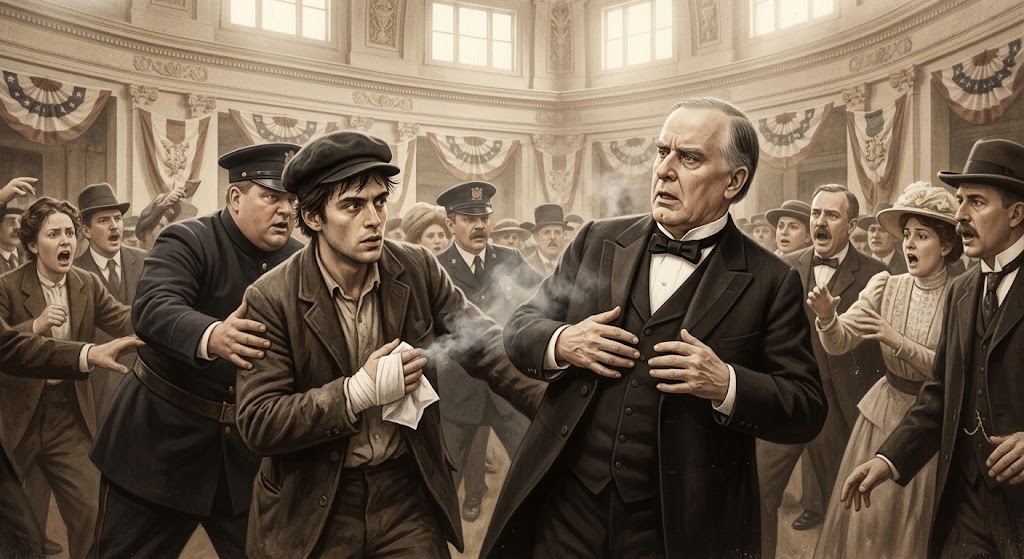
Historical depiction of Leon Czolgosz shooting President McKinley at the Temple of Music in Buffalo, NY (September 6, 1901).
The Great Pan-American Exposition
The centerpiece of America’s celebratory mood was the Pan-American Exposition—a lavish, 350-acre world’s fair designed to showcase Western Hemisphere innovation. Its crown jewel was the Temple of Music, an auditorium illuminated by thousands of newly invented electric lightbulbs powered by Niagara Falls.
McKinley arrived in Buffalo in early September to deliver a major address on international trade. The crowds were ecstatic. On September 6th, after touring Niagara Falls, McKinley scheduled a public reception inside the Temple of Music to greet ordinary citizens. His personal secretary, George Cortelyou, was plagued by bad premonitions and had canceled the event twice. Each time, McKinley reinstated it, asking warmly, “Why should I not meet them? They are my friends.”The Assassination of William McKinleyPage 1
The Assassin in the Line
While thousands waited under the sweltering autumn sun to shake the President’s hand, one man in line was not there to celebrate. His name was Leon Czolgosz, a 28-year-old former steelworker from Michigan who had drifted into radical political circles. Brooding, unemployed, and deeply alienated by the harsh labor exploitation of the Gilded Age, Czolgosz had become obsessed with anarchism—specifically the idea of “propaganda of the deed,” which held that assassinating powerful leaders was the fastest way to overthrow oppressive systems.
Just a year earlier, an Italian anarchist had assassinated King Umberto I of Italy. Czolgosz was mesmerized by the news, clipping the article and keeping it in his pocket like a blueprint. When he read that President McKinley was visiting Buffalo, Czolgosz bought a .32-caliber Iver Johnson revolver for $4.50, wrapped his right hand in a white handkerchief to fake an injury, and walked into the Temple of Music.
“I killed President McKinley because I done my duty. I didn’t believe one man should have so much service and another man should have none.” — Leon Czolgosz
Two Shots in the Temple of Music
At 4:07 PM, the doors opened and the crowd surged forward. Organist William J. Gomph was playing Bach’s Sonata in F. McKinley stood at the front of the receiving line, smiling and shaking hands at a rate of fifty people per minute. Secret Service agents stood nearby, but their attention was focused on men with hands in their pockets or suspicious coats.
The interior of the Temple of Music at the Pan-American Exposition. An ‘X’ marks the spot where McKinley stood.
As Czolgosz approached, his right hand was completely encased in the bulky white bandage. McKinley assumed the young man had suffered a burn or work injury and reached out with his left hand instead. Czolgosz didn’t hesitate. He thrust his bandaged hand forward and pulled the trigger twice through the cloth.
The first bullet grazed McKinley’s chest, deflecting off a coat button without causing serious harm. But the second bullet pierced his abdomen, ripping through his stomach, pancreas, and kidney before embedding itself deep within his back muscles. The sound of the shots rang out like firecrackers against the pipe organ music.The Assassination of William McKinleyPage 2
Chaos, Pandemonium, and Medical Blunders
Before Czolgosz could fire a third time, he was tackled by James “Big Jim” Parker, a 6-foot-6 African American waiter from Georgia who happened to be next in line. Parker slammed the assassin to the floor while guards and Secret Service agents swarmed, beating Czolgosz into unconsciousness.
McKinley, clutching his bleeding stomach, managed to maintain his characteristic composure. As he collapsed into a chair, his first thought was of his delicate, chronically ill wife, Ida. He whispered to his secretary, “My wife—be careful, Cortelyou, how you tell her—oh, be careful.” Seeing the crowd beating his attacker, McKinley added faintly, “Don’t let them hurt him.”
What followed was a tragic series of medical errors that ultimately cost the President his life. McKinley was rushed to the exposition’s emergency hospital, but the fair’s medical facility was ill-equipped for major surgery. The head surgeon was out of town, leaving Dr. Matthew Mann, a gynecologist with limited experience in abdominal trauma, to perform emergency surgery under poor lighting.
The Cruel Irony of Modern Technology
The Pan-American Exposition was designed to showcase the pinnacle of American technological progress, yet two glaring ironies sealed McKinley’s fate:
- The X-Ray Machine: A newly invented X-ray machine was on display nearby, but doctors were terrified to use it on the President, fearing unknown radiation risks. Finding the bullet visually proved impossible.
- Electric Lighting: Though the exterior of the fair was lit by millions of electric bulbs, the emergency operating room had no interior electric lights. Doctors held up pans to reflect sunlight into McKinley’s open abdomen.
A False Sense of Hope
Dr. Mann closed the wound without probing deeply for the bullet or placing surgical drains—a critical oversight in an era before antibiotics. Surprisingly, over the next five days, McKinley appeared to make a miraculous recovery. His fever dropped, his mind cleared, and he began eating solid foods.
Nationwide panic gave way to relief. Vice President Theodore Roosevelt, reassured by doctors that McKinley was out of danger, left Buffalo to join his family on a hiking trip in the remote Adirondack Mountains. Newspapers printed celebratory headlines declaring the President saved.
However, beneath the sutured skin, a silent catastrophe was unfolding. The unextracted bullet had caused gangrene to spread throughout the lining of McKinley’s stomach and surrounding organs.The Assassination of William McKinleyPage 3
The Fall and the Rise of Teddy Roosevelt
On September 12th, McKinley’s condition collapsed suddenly. Toxins from gangrenous tissue entered his bloodstream. By September 13th, doctors realized the end was near. McKinley slipped in and out of consciousness, softly humming his favorite hymn, “Nearer, My God, to Thee,” before passing away early in the morning on September 14, 1901.
Meanwhile, Theodore Roosevelt was miles away atop Mount Marcy when a park messenger sprinted up the trail with an urgent telegram: The President is dying. Roosevelt’s wild midnight carriage ride down the treacherous mountain roads became legendary. By the time he reached Buffalo, McKinley was dead. At age 42, Roosevelt was sworn in as the 26th President—the youngest in U.S. history.
Justice (and Electric Revenge)
If McKinley’s medical care was agonizingly slow, the justice system was terrifyingly fast. Leon Czolgosz was put on trial nine days after McKinley’s death. His defense attorneys offered no witnesses and made almost no argument, as Czolgosz refused to cooperate or express remorse.
The jury took just 30 minutes to find him guilty of murder. On October 29, 1901—just 53 days after the shooting—Czolgosz was executed in the electric chair at Auburn State Prison. To ensure he became no martyr, authorities poured sulfuric acid into his coffin to completely dissolve his remains before burial.
Why This Still Matters Today
The assassination of William McKinley was far more than a tragic historical footnote; it reshaped modern governance and security in three permanent ways:1. Birth of the Modern Secret Service: Prior to 1901, the Secret Service was primarily tasked with stopping counterfeiters. McKinley’s death forced Congress to officially mandate full-time presidential protection, creating the modern security apparatus we know today.
2. The Birth of Modern Progressive Politics: McKinley was a conservative champion of big business. Roosevelt’s ascension ignited the Progressive Era, leading to trust-busting, environmental conservation, and consumer protection laws.
3. Anti-Extremism Laws: The tragedy triggered the Immigration Act of 1903 (the “Anarchist Exclusion Act”), marking the first time the U.S. barred entry to immigrants based on political ideology.
Historical Sources & References
• Leech, Margaret. In the Days of McKinley. Harper & Brothers, 1959.
• Miller, Scott. The President and the Assassin: McKinley, Terror, and Empire at the Dawn of the American Century. Random House, 2011.
• Rauchway, Eric. Murdering McKinley: The Making of Theodore Roosevelt’s America. Hill and Wang, 2003.




Leave a Reply