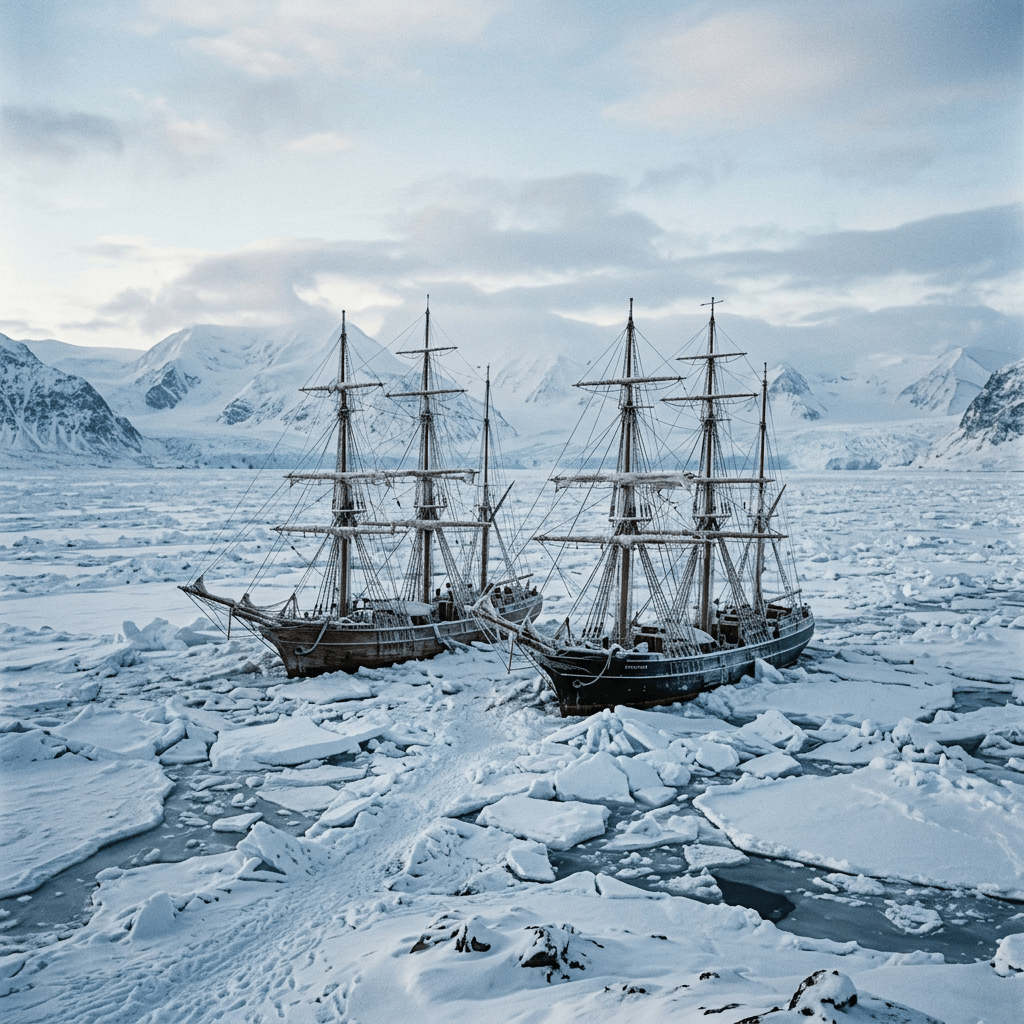
How does an elite naval crew consisting of 129 men, equipped with state-of-the-art steam engines, thousands of books, and three years’ worth of gourmet canned food, completely vanish off the face of the Earth?
To understand the sheer magnitude of the catastrophe, we have to rewind to April 25, 1848, on the frozen waste of King William Island. Captain Francis Crozier and Commander James Fitzjames have just scribbled a desperate, chilling message on a scrap of paper and buried it inside a stone cairn. The message records that Commander Sir John Franklin died ten months earlier, 24 men are already dead, and the remaining crew has just abandoned their two ships—trapped fast in thick sea ice for nearly two years—to attempt an agonizing 800-mile march across frozen tundra toward the nearest fur-trading post. None of them would survive.
Setting Sail: High Hopes and High Tech
In May 1845, the British Royal Navy launched what it believed to be an invincible voyage. The mission was straightforward: map the final unknown section of the Northwest Passage, a shortcut above North America that would connect the Atlantic to the Pacific and cement Britain’s global naval dominance.
Commanding the expedition was Sir John Franklin, a famous 59-year-old Arctic explorer. The Navy spared no expense. They outfitted two heavily reinforced bomb vessels—HMS Erebus and HMS Terror—with brand-new 20-horsepower steam engines modified from railway locomotives to propel them through ice. They packed library shelves with over 1,000 books, installed hot-water heating systems inside the living quarters, and stored 8,000 tins of preserved meat, soups, and vegetables.
When the two ships were spotted by whalers in Baffin Bay in July 1845, spirits were soaring. It was the last time any European would see Franklin’s crew alive.
Trapped in the Great White Trap
The winter of 1845–1846 went smoothly enough at Beechey Island, though three sailors died of natural illnesses and were buried in the permafrost. But in late summer 1846, as Franklin navigated south toward King William Island, disaster struck. The pack ice seized both ships in Victoria Strait.
Unlike typical seasonal ice that thaws in summer, the pack ice in Victoria Strait was thick, multi-year ice pushed down from the Arctic Basin. Summer 1847 arrived, but the ice refused to melt. The ships remained firmly locked in place. Sir John Franklin died in June 1847 under unknown circumstances.
As another brutal winter settled in, supplies began running low, scurvy set in, and morale collapsed. By the spring of 1848, the survivors made the fateful decision to march on foot. Dragging heavy wooden lifeboats loaded with silver cutlery, books, and winter gear across the rough ice, men collapsed and died one by one in what local Inuit later described as a trail of dead bodies.
What Poisoned the Crew?
For more than a century, historians argued over what caused the expedition’s absolute collapse. While cold, starvation, and scurvy were certainly the ultimate killers, modern science revealed secondary factors that may have driven the men to madness:
- Lead Poisoning: In the 1980s, autopsies on the preserved mummies of the three sailors buried at Beechey Island revealed extraordinarily high levels of lead. Scholars initially blamed the hastily soldered tin cans containing their food provisions, though modern research suggests lead may also have come from the ships’ complex internal lead-pipe desalination systems.
- Tuberculosis and Pneumonia: Extreme cold weakened immune systems, leaving officers and sailors vulnerable to respiratory infections.
- Cannibalism: Cut marks on recovered human bones found on King William Island during late 19th-century search missions—and confirmed by modern forensic anthropologists—showed clear evidence of defleshing and marrow extraction. In their final days, starving survivors turned to cannibalism to stay alive.
Rediscovering the Lost Ships
While searchers spent decades fruitlessly sweeping the Arctic, local Inuit oral histories had pointed to the location of the wrecks all along. For over 150 years, western explorers largely ignored these stories.
Finally, in 2014, Parks Canada underwater archaeologists, working in close partnership with Inuit historians, located the wreck of HMS Erebus sitting in shallow waters off King William Island. Just two years later, in 2016, HMS Terror was discovered in remarkable preservation in Terror Bay.
Artifacts recovered during 19th-century search operations for the lost expedition.
Why This Still Matters
The Franklin Expedition is far more than a haunting Victorian ghost story; it holds profound relevance for the modern world:
- The Power of Indigenous Knowledge: The discovery of the wrecks highlighted the historical validity of Inuit oral history. For over a century, European search teams overlooked accurate accounts of where the ships sank and where the survivors walked. Today, Arctic research increasingly relies on combining western science with Indigenous Knowledge Systems.
- Climate Change and Navigation: As global climate change thaws Arctic ice pack, the Northwest Passage—once an impenetrable frozen trap that destroyed Franklin—is becoming commercially navigable. The story serves as a reminder of the historical cost of navigating these waters and underpins ongoing geopolitical discussions about Arctic sovereignty between Canada, international powers, and Indigenous nations.
- Caution Against Technological Overconfidence: Franklin’s crew possessed the absolute cutting edge of Industrial Revolution technology, yet nature proved overwhelmingly superior. It stands as a timeless lesson in humility against technological hubris.
Sources & SEO
Sources
- Parks Canada: Wrecks of HMS Erebus and HMS Terror National Historic Site (Archaeological Findings & Dive Surveys).
- Royal Museums Greenwich: The Franklin Expedition & The Search for the Northwest Passage.
- Beattie, Owen & Geiger, John: Frozen in Time: The Fate of the Franklin Expedition (1987).
- Encyclopaedia Britannica: Franklin Expedition Overview.



Leave a Reply