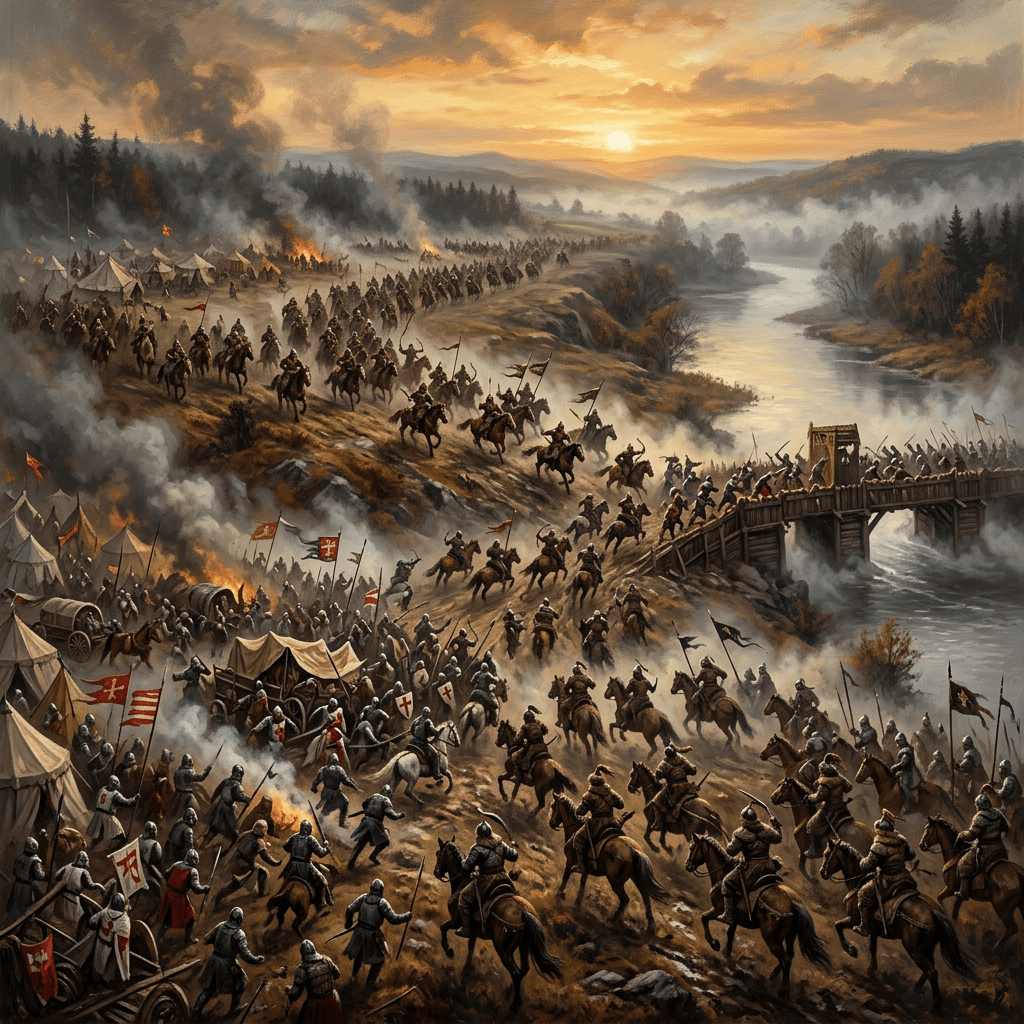
What if the total destruction of Western Europe was avoided not by a heroic knightly charge or a miraculous tactical triumph, but because a man thousands of miles away drank himself to death?
In December 1241, the elite armies of Christendom lay shattered, their noble knights slaughtered, and their grandest kingdoms reduced to smoldering ruins. The Mongol Empire stood on the doorstep of Vienna, poised to sweep across the remainder of the continent with absolute, terrifying efficiency. And then, at the absolute peak of their conquest, the deadliest military force on Earth turned around and walked away.
To understand how Europe found itself staring into the abyss—and how it narrowly escaped—we have to rewind two decades, back to the grand vision of Genghis Khan and the military genius he unleashed upon the world.
The Mongol advance across Europe (1236–1242). Source: Wikipedia
The Mastermind Behind the Horde: Genghis Khan and Subutai
While popular history credits Genghis Khan with leading the assault on Europe, the Great Khan had actually passed away in 1227. However, the invasion was entirely the fulfillment of his grand design. Genghis Khan had built an empire from the steppes of Mongolia to the borders of Persia, establishing a military machine powered by meritocracy, strict discipline, and unmatched mobility.
Before his death, Genghis designated his son, Ögedei Khan, as his successor, and appointed his primary general, Subutai, to secure the western frontier.
Subutai was arguably the greatest military strategist in human history. A blacksmith’s son who rose purely on talent, Subutai directed operations across thousands of miles. He had already scouted the Russian steppes during a legendary reconnaissance expedition in the 1220s. By 1236, Ögedei officially authorized the grand Western Campaign, placing Genghis’s grandson Batu Khan as the nominal leader, while Subutai held true operational control.
Subutai: The mastermind of Mongol strategy. Source: Wikipedia
The Mongol army was not an unorganized horde of barbarian wildmen. It was a precise, highly disciplined force structured around the decimal system (units of 10, 100, 1,000, and 10,000 called tumens). Every warrior was a skilled horseman equipped with a composite recurve bow capable of piercing armor at long range, backup melee weapons, and multiple horses to maintain continuous speed. Combined with an unparalleled intelligence network of spies and scouts, Subutai knew the political fractures, terrain, and weather of Europe long before his main cavalry forces set foot on the continent.
The Fall of the Rus: Winter Warfare and Total Destruction
European leaders had heard vague, apocalyptic rumors of strange horsemen conquering lands in the East, but they paid little attention. They assumed the dense forests and freezing winters of Eastern Europe would protect them. They were disastrously wrong.
The Mongols specifically chose winter to launch their assault on the principalities of Kievan Rus starting in 1237. Frozen rivers became natural high-speed highways for horse archers. City after city fell in rapid succession. Ryazan, Vladimir, and Suzdal were besieged using advanced siege techniques adapted from Chinese engineers, including catapults, mangonels, and gunpowder-based incendiaries.
Mongol horse archers executing dynamic tactical maneuvers. Source: TheCollector
In December 1240, the historic city of Kiev was surrounded. After a brutal siege, the city was razed so thoroughly that visiting envoys years later reported finding only human skulls and bones scattered across the plains. With the Rus principalities subjugated, Subutai looked west toward the heart of feudal Europe: Poland and Hungary.
A Masterclass in Blitzkrieg: The Dual Strike on Poland and Hungary
In early 1241, Western Europe’s monarchs received an awakening. Subutai devised a multi-pronged strategy that modern military historians compare to the modern Blitzkrieg. Recognizing that King Béla IV of Hungary was his primary target, Subutai knew he had to prevent the northern European powers—the Poles, Czechs, and Teutonic Knights—from marching south to assist Hungary.
Subutai split his forces. A secondary strike force of around 10,000 to 20,000 men under Kadan and Baidar swept northwest into Poland as a distraction, while Subutai and Batu led the main strike force of roughly 30,000 to 50,000 directly toward Hungary through the Carpathian Mountains.
The distraction campaign in Poland worked flawlessly:
- The Sacking of Kraków: Mongol forces burned Kraków, driving panicked refugees westward.
- The Battle of Legnica (April 9, 1241): Duke Duke Henry II the Pious of Silesia gathered a joint army of Polish knights, Bavarian miners, and elite crusading orders like the Templars and Teutonic Knights. At Legnica, the Mongols feigned retreat—a classic tactic that lured the heavily armored European cavalry away from their infantry support. Once separated, the horse archers encircled the knights, rained down arrows, used smokescreens to cause chaos, and cut down the Allied force. Duke Henry was beheaded, and his head was paraded on a spear before the walls of Legnica.
Having paralyzed Northern Europe in a matter of weeks, the northern detachment turned south to join Subutai in Hungary for the final blow.
The Massacre at the Sajo River: The Battle of Mohi
Two days after the victory at Legnica, the main European theater came to a head in Hungary. King Béla IV had assembled a massive army of knightly heavy cavalry, feudal levies, and Templar volunteers—nearly 60,000 strong. Béla established a fortified camp on the plain of Mohi, near the Sajó River, using heavy wagons chained together in a wagon-fort formation (tabor).
To European military minds, a chained wagon camp was an impenetrable fortress. To Subutai, it was a trap of the enemy’s own making.
Tactical layout of the Battle of Mohi. Source: Medievalists.net
On the night of April 10–11, 1241, the Battle of Mohi unfolded:
- The Bridge Attack: Batu Khan launched a direct assault on the bridge over the Sajó River, drawing the Hungarian defenders into a intense, localized clash. The Mongols deployed siege engines directly on the riverbanks, bombarding the Hungarian bridge guards with heavy stones and fiery naphtha containers—marking one of the earliest uses of artillery bombardment on European soil.
- The Flanking Movement: While Batu held the Hungarian army’s focus at the bridge, Subutai secretly led a force downriver under the cover of night, constructing a temporary wooden bridge to cross the freezing waters unnoticed.
- The Trap Closes: By dawn, Subutai’s force had maneuvered around the Hungarian flank, completely surrounding the chained wagon camp.
- The “Golden Cage” Feint: Instead of making a desperate assault against the fortified camp, the Mongols bombarded it with catapults and fire arrows. Panicked, the Hungarian troops packed tightly together. Sensing their desperation, the Mongols deliberately left a visible gap in their surrounding lines to the west.
Thinking they had found an escape route, the Hungarian soldiers broke formation and fled down the open corridor. It was a calculated trick. As the fleeing army strung out along the road, exhausted and dropping their armor, Mongol horsemen rode alongside them for miles, systematically hunting them down.
Nearly the entire Hungarian army was destroyed in a single afternoon. King Béla IV barely escaped into the mountains, fleeing toward the Adriatic coast. Hungary was systematically laid waste, losing an estimated 15 to 25 percent of its population over the following months.
The Miraculous Retreat: A Twist of Fate
By late 1241, the path to Western Europe stood completely open. The Holy Roman Empire was divided by internal strife between the Pope and Emperor Frederick II. France and England were locked in territorial disputes. None of them possessed an army capable of matching Subutai’s speed, intelligence networks, or combined-arms tactics. Advanced Mongol scouting parties pushed into Austria, reaching the suburbs of Vienna.
Europe seemed destined to become the westernmost province of the Mongol Empire.
Then, in December 1241, an event occurred thousands of miles away in Karakorum, the Mongol capital: Ögedei Khan, the Great Khan, died after a heavy drinking session following a hunting trip.
Under Mongol law and custom, when a Great Khan died, all royal princes (Borjigin) were required to return to the homeland for the Kurultai—the traditional council convened to elect the next ruler. Batu Khan was a key contender for power, and Subutai’s loyalties lay with the royal line.
In early 1242, to the absolute bewilderment of the surviving European rulers, the Mongol tumens began packing up their encampments. They withdrew eastward through the Balkans, laying waste to parts of Bulgaria on their return path, and settled in the southern Russian steppes. Batu Khan established the capital of the Golden Horde along the Volga River, never resuming the push into Western Europe.
Why This Still Matters
The Mongol invasion of Europe was not merely an obscure medieval war; it was a pivot point that fundamentally altered world history.
- The Survival of Western Europe: Had Ögedei Khan lived a few years longer, the destruction brought upon Rus and Hungary likely would have extended to Germany, France, and Italy. The cultural, scientific, and economic developments of the late Middle Ages and the Renaissance could have been delayed or erased entirely.
- The Rise of Moscow: The destruction of Kievan Rus rearranged the geopolitics of Eastern Europe. The Grand Duchy of Moscow gradually emerged as the primary tax collector and intermediary for the Mongol Golden Horde, laying the structural groundwork for the modern Russian state.
- Global Connectivity (The Pax Mongolica): The unification of Eurasia under Mongol control created trade and diplomatic networks spanning from Eastern Europe to the Pacific. This era facilitated unprecedented exchanges of technology—including gunpowder, paper, the compass, and printing techniques—between East and West, while also inadvertently facilitating the spread of the Black Death a century later.
- Military Innovation: The sheer shock of Mongol tactics forced European warfare to evolve, accelerating developments in fortification design, light cavalry integration, and tactical intelligence.
Historical Sources
- Allsen, Thomas T. Culture and Conquest in Mongol Eurasia. Cambridge University Press, 2001.
- Jackson, Peter. The Mongols and the West: 1221–1410. Routledge, 2005.
- May, Timothy. The Mongol Art of War: Chinggis Khan and the Mongol Military System. Westholme Publishing, 2007.
- Morgan, David. The Mongols. Wiley-Blackwell, 2nd Edition, 2007.
- Weatherford, Jack. Genghis Khan and the Making of the Modern World. Crown, 2004.


Leave a Reply