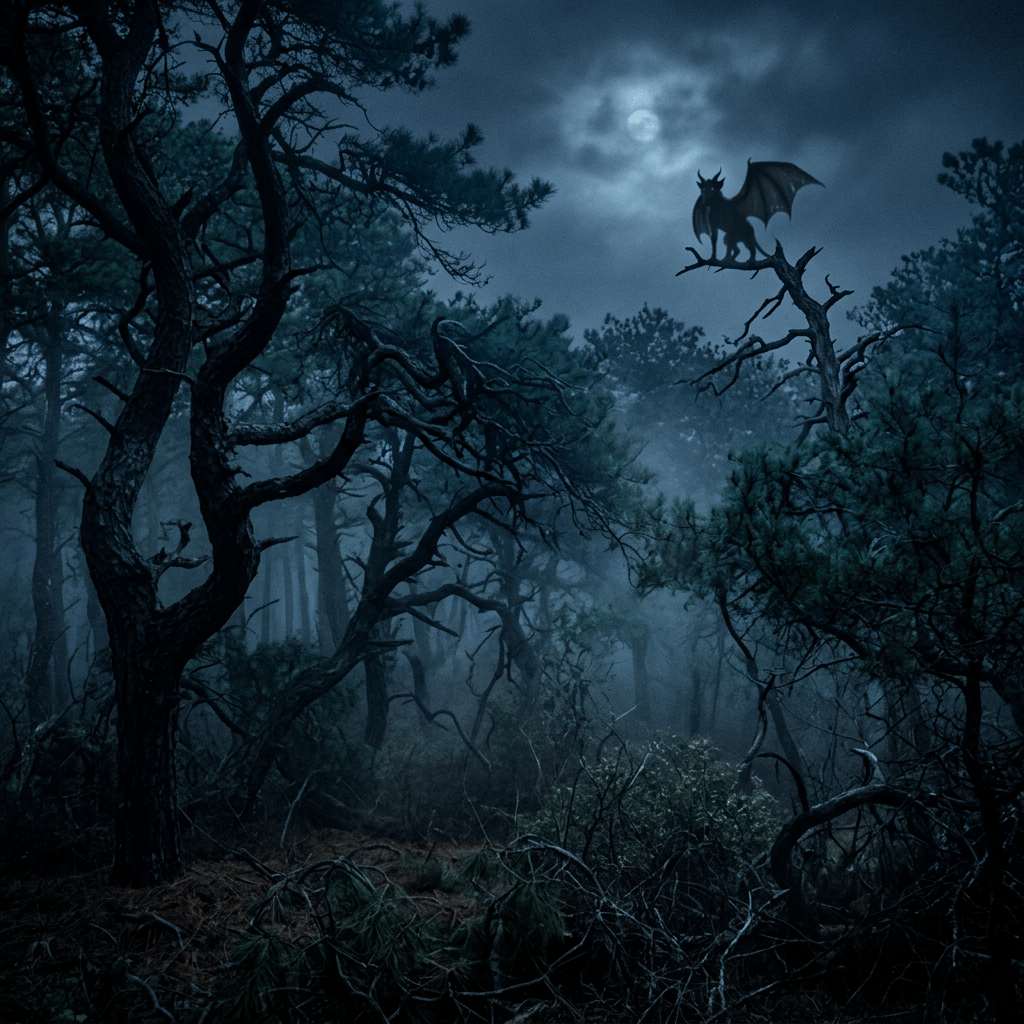
What if the most infamous monster in American folklore wasn’t born in a cursed swamp, but in a pettifogging printer’s feud between Benjamin Franklin and a rival almanac publisher?
Before it became a hockey team, a campfire scare, or a creature featured on late-night paranormal television, the Jersey Devil was a blood-curdling beast said to possess the head of a horse, the wings of a bat, cloven hooves, and a tail that whipped through the gloom of the Pine Barrens. But to understand how a mythical demon came to terrorize the mid-Atlantic for three centuries, we have to rewind to the 1730s—long before rumors of leather-winged beasts took flight—and look at the very human rivalries of early colonial America.
The Birth of the Legend: Mother Leeds’ Thirteenth Child
According to South Jersey folklore, the story begins on a stormy night in 1735 in Estellville, New Jersey. Deborah Leeds—known locally as “Mother Leeds”—was lying in bed, in labor with her thirteenth child. Exhausted, impoverished, and overwhelmed by the strain of raising a dozen children in the dense, isolated wilderness of the Pine Barrens, she reportedly threw her hands in the air and cried: “Let it be the devil!”
As the tale goes, the child was born normal at first, but within moments transformed into a terrifying horror. It sprouted horns, hooves, bat-like wings, and a long, raspy tail. The creature screeched, attacked the midwife, flew up the chimney, and vanished into the dark, cedar-lined swamps of the Pine Barrens, where it has hunted ever since.
While it makes for a classic ghost story around a campfire, historical records tell a very different, far more grounded tale. Deborah Leeds was a real person, married to Japheth Leeds, and they lived in what is now Atlantic County, New Jersey. She did indeed have twelve children, and in her husband’s 1748 will, a thirteenth child was listed. But the “monster” that grew out of the Leeds household was not supernatural—it was political, religious, and commercial.
Almanacs, Astrology, and Benjamin Franklin’s Prank
To find the true origins of the Jersey Devil, one must trace the family tree of Daniel Leeds, who arrived in New Jersey in the 1670s. Leeds was an astronomer and published popular almanacs containing astrological forecasts, crop information, and tide tables.
However, Leeds’ fellow Quakers in West Jersey took issue with his work. They accused his astrological predictions of being pagan, occult, and sacrilegious. The local Quaker meeting censured Leeds, seized his almanacs, and forced him to destroy them. Furious at what he viewed as religious censorship, Daniel Leeds broke away from the Quakers and spent the rest of his career launching aggressive printed counter-attacks against the Quaker establishment.
By the 1720s and 1730s, Daniel’s son, Titan Leeds, had taken over the family almanac business. Titan continued the family tradition of publishing astrological charts and picked up his father’s old rivalries. Enter a young, ambitious printer in Philadelphia named Benjamin Franklin.
In 1732, Franklin published the first edition of Poor Richard’s Almanack under the pseudonym Richard Saunders. To drum up publicity and outsell his main rival—Titan Leeds—Franklin resorted to a famous satirical hoax. Using mock astrology, Franklin “predicted” that Titan Leeds would die on October 17, 1733, at 3:29 PM.
When October 17 passed and Titan Leeds remained very much alive, Leeds publicly called Franklin a liar and a fool in his next almanac. Franklin doubled down on the joke, claiming in his subsequent edition that Titan Leeds had indeed died, but that an imposter had taken over his name to keep printing almanacs. Franklin mockingly referred to Leeds as a “ghost” and a “demonic” presence writing from beyond the grave.
Because of the Leeds family’s Quaker feuds, their association with astrology, their political ties to royal governors, and Franklin’s relentless public mockery, the family was branded as heretics, outcasts, and “devils” in local pop culture.
The Dark Wilderness of the Pine Barrens
If the human ingredients for the myth were forged in Philadelphia print shops, the physical backdrop was provided by the Pine Barrens itself. Covering over a million acres of southern New Jersey, the Pine Barrens is a vast expanse of dense pitch pine, acidic rivers, tea-colored cedar swamps, and deep sand.
In the 18th and 19th centuries, the interior of the Pine Barrens was largely isolated from urban centers. It was inhabited by woodchoppers, charcoal burners, smugglers, and dissidents—collectively known by outsiders as “Pineys.” The region’s thick forests and eerie nocturnal sounds, from the shrieks of screech owls to the uncanny calls of sandhill cranes, created an ideal environment for ghost stories and regional folklore to thrive.
Over decades, the political slur “Leeds Devil” shifted from a jab at a controversial political family into a literal creature residing in the dense woods.
Mass Hysteria: The Great Sightings of 1909
For over a century, sightings of the beast remained sporadic—a hunter spotting strange tracks in the mud or a farmer hearing screams in the night. That all changed in January 1909, when South Jersey and the surrounding region experienced one of the largest mass hysteria events in American history.
Between January 16 and January 23, 1909, thousands of people across New Jersey, Eastern Pennsylvania, and Delaware reported encounters with the creature:
- Unexplained Tracks: Hoofprints were found stamped in deep snow across rooftops, over high fences, and through narrow gaps in Burlington, Camden, and Haddonfield.
- Eyewitness Reports: Police officers, streetcar drivers, and city officials claimed to see a flying monster with glowing eyes, horse-like features, and leathery wings soaring through town streets.
- Public Panic: Schools were closed across South Jersey, mill workers stayed home, and armed vigilante squads patrolled the woods. The Philadelphia Zoo offered a $10,000 reward for the creature’s capture, dead or alive.
Eventually, the madness subsided. Investigations revealed that many of the infamous “tracks” were created by natural animals like sandhill cranes, dogs, or deliberate hoaxes using carved wooden stamps. A Philadelphia museum curator even displayed a kangaroo with artificial wings glued to its back to profit from the craze.
In 1938, New Jersey officially renamed the monster the “Jersey Devil,” solidifying its transition from regional bogeyman to state icon.
Why This Still Matters
The history of the Jersey Devil is more than a colorful ghost story—it reveals how media, politics, and fear interact to create modern mythology.
- Media Manipulation: Long before social media “fake news,” 18th-century print media showed how rumors, satire, and political smear campaigns can take on a life of their own. Benjamin Franklin’s joke helped turn a real family’s name into a monster.
- Fear of the Unknown: The legend demonstrates how human psychology fills dark, unmapped places—like the dense Pine Barrens—with monsters to explain unsettling sounds, isolation, and social outsiders.
- Cultural Identity: Today, the Jersey Devil is a point of pride for New Jersey, lending its name to the state’s NHL team and serving as a symbol of regional folklore that preserves early American history.
Sources
- Regenschneider, Brian. The Jersey Devil: Historical Roots of a Legend. New Jersey Historical Society, 2011.
- Sceurman, Mark, and Mark Moran. Weird N.J.: Your Travel Guide to New Jersey’s Local Legends and Best Kept Secrets. Sterling Publishing, 2003.
- McPhee, John. The Pine Barrens. Farrar, Straus and Giroux, 1968.
- Franklin, Benjamin. The Papers of Benjamin Franklin, Vol. 1: 1706 through 1734. Yale University Press.



Leave a Reply