The Day Rome Built a Wall Inside Out
Would you order your men to build a massive, fifteen-mile wooden fortress around an enemy army, only to turn around and build an even larger, twenty-one-mile fortress directly behind your own backs to protect yourselves from being swallowed alive? Julius Caesar did exactly that, trapped in a nightmarish military donut of his own design.
But before we watch eighty thousand starving Gauls look down from their hill at a wall of Roman spikes, we have to rewind to a moment where Julius Caesar—the man who would conquer the known world—was running for his absolute life through the dense woods of Gaul, his armor dented, his legions scattered, and his legendary luck completely drained. For five long years, Caesar had treated the Celtic tribes of modern-day France like stepping stones for his personal political ambitions. He had marched, bribed, and slaughtered his way across the territory, writing home to Rome boastful dispatches that made him look like an invincible god.
Then came the year 52 BC, and with it, a man who refused to follow the Roman script.
The Long-Haired Menace and the Rogue Aristocrat
Until this point, the Roman Republic viewed the Gauls less as a unified nation and more as a chaotic collection of volatile, gold-obsessed tribes who spent more time chopping off each other’s heads than forming a cohesive state. They were physically imposing, fiercely brave, and completely disorganized. Caesar played them like a fiddle, backing one tribe against another in a masterful game of divide-and-conquer.
Enter Vercingetorix. His name literally translates to “Great King of Warriors,” and he lived up to every syllable. A young, fiercely charismatic nobleman of the Arverni tribe, Vercingetorix possessed something no Gaulish leader before him had: a mind for grand strategy and a terrifying degree of discipline. He didn’t just want to fight the Romans; he wanted to systematically starve them.
Recognizing that the Roman legions were an unstoppable, industrial-grade meat grinder in open combat, Vercingetorix enacted a brutal scorched-earth policy. “Burn the towns!” he ordered his countrymen. “Torch the fields! Let the Roman beast find nothing but ash and hunger wherever it marches.” Thousands of Gaulish villages went up in smoke. It was a heartbreaking strategy for his own people, but it worked beautifully. Caesar’s supply lines stretched to the breaking point. The legions grew lean, cranky, and desperate.
After giving Caesar a bloody nose at the Battle of Gergovia—a rare, humiliating defeat that sent the Roman general retreating with his tail between his legs—Vercingetorix made a critical, fateful pivot. Believing his momentum was absolute, he gathered a massive force of roughly eighty thousand warriors and withdrew into the heavily fortified hilltop town of Alesia. It was an ancient fortress surrounded by steep valleys and rivers, seemingly impregnable. Vercingetorix figured he could rest his men, await massive reinforcements from across Gaul, and let the starving Romans break themselves against the rocks.
He vastly underestimated the obsessive-compulsive engineering fury of Julius Caesar.
The Engineering Nightmare of the Circumvallation
When Caesar arrived at the base of Alesia, he didn’t look up at the mountain with despair; he looked at it as a blueprint. Assaulting the hill directly would be suicidal. Leaving would destroy his prestige and forfeit Gaul forever. So, Caesar chose option C: he decided to turn the entire mountain into a massive prison.
“We aren’t going up,” Caesar told his exhausted, hungry legionaries. “We’re locking them in.”
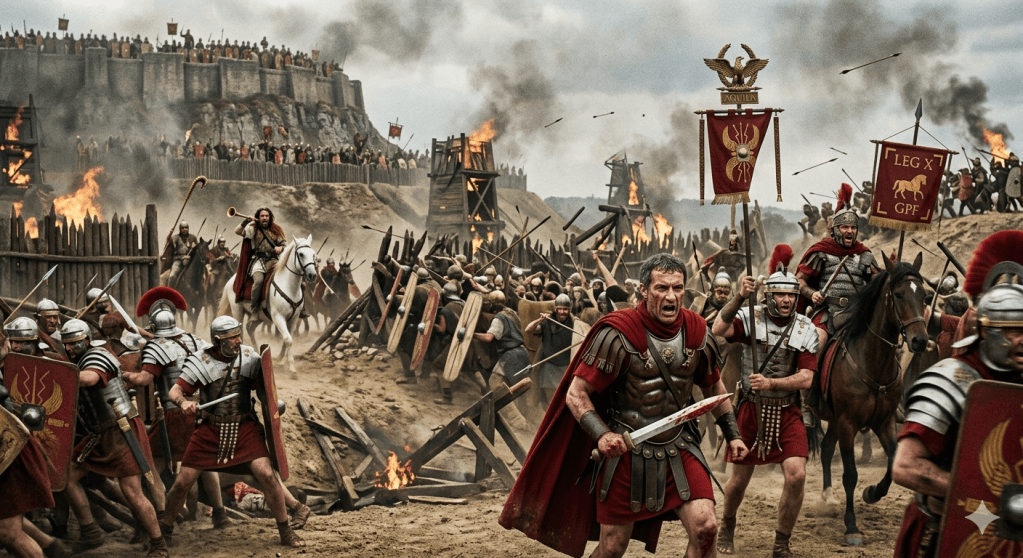
Caesar ordered his men to construct a line of circumvallation—a fancy military term for a jaw-droppingly complex, eleven-mile-long ring of fortifications entirely surrounding the hill of Alesia. For weeks, the Roman legionary ceased to be a traditional soldier and became a highly efficient, heavily armed construction worker. They felled entire forests, dug massive trenches, and erected twelve-foot-high wooden walls bristling with defensive towers every eighty feet.
But Caesar didn’t stop there. He knew that simple walls could be breached by an army desperate enough. He engineered a multi-layered gauntlet of absolute horror in front of the walls to ensure no Gaul could ever get close enough to touch the timber. The defensive array consisted of terrifying, trap-like components:
- The Double Trenches: Two parallel ditches, fifteen feet wide and fifteen feet deep. Caesar diverted local rivers to fill the inner trench completely with water, creating a deep, muddy moat.
- The “Cippi”: Five continuous rows of sharpened tree branches, woven tightly together and anchored deep into the earth. Anyone trying to clear them would be impaled before they even reached the water.
- The “Lilies” (Lilia): Rows of hidden pits shaped like wine cups, containing sharpened stakes hardened by fire, completely covered over with brushwood to disguise them. Step into one, and your leg was instantly impaled.
- The “Spurs” (Stimuli): Iron-barbed hooks fixed into small wooden stakes hidden just beneath the soil, designed to tear the soles of charging feet to ribbons.
“The Roman soldier fights as effectively with a shovel as he does with a gladius. Against an enemy trapped by pride, a spade can be deadlier than a spear.” — Modern Military Commentary on Caesar’s Tactics
Vercingetorix watched from his hilltop high above as this intricate web of death slowly materialized around his army. Realizing he was being choked out without a single major infantry engagement, the Gaulish chieftain launched vicious cavalry sorties to disrupt the construction. The Romans beat them back, but a small contingent of Gaulish horsemen managed to slip through the unfinished lines under the cover of night. Their mission? Ride to the far corners of Gaul and summon the ultimate relief army to smash Caesar from the outside.
The Donut of Death: Enter the Contravallation
Caesar’s scouts soon captured Gaulish deserters who spilled the terrifying truth: an enormous pan-Gaulish relief force was answering Vercingetorix’s call. Modern estimates put this incoming army at well over one hundred thousand warriors; Caesar’s own accounts boasted a terrifying quarter of a million.
Suddenly, the hunters were about to become the hunted. Caesar was staring down the barrel of total annihilation. If he stayed put, he would be crushed between eighty thousand Gauls attacking from the hilltop behind him and hundreds of thousands of frenzied Gauls charging into his rear. If he retreated, his army would be picked apart across the open plains.
Most generals would have abandoned the siege. Caesar, possessing an ego that could warp gravitational fields, simply ordered his men to turn around and start digging again.
He constructed a second, even larger ring of fortifications facing outward: the line of contravallation. This outer wall stretched for fourteen miles around the inner ring. The Roman army was now packed inside a narrow tactical donut. They were besieging a city while simultaneously being besieged by a massive global force. It was madness, it was brilliant, and it meant that if either wall broke, the Romans would be wiped from the pages of history.
As the massive Gaulish relief army arrived on the surrounding hills, lighting thousands of watchfires that painted the night sky blood-red, the stage was set for one of the most complex, multi-directional meat grinders ever recorded in human conflict.
The Climax: A Three-Way Dance of Blood and Iron
Inside Alesia, conditions had degenerated into pure horror. Vercingetorix, running critically low on grain, made the agonizing decision to cast out all the women, children, and elderly from the town to save food for his fighters. These civilian refugees stumbled down into the no-man’s-land between the Gaulish town and the Roman lines, weeping and begging the Romans for mercy or enslavement—anything for a crust of bread.
Caesar coldly refused. He ordered his men to keep their weapons leveled and turn them back. Starving, weak, and terrified, the innocent civilians were left to slowly die of exposure in full view of both armies, a psychological weapon that tore at the hearts of the Gaulish defenders but left Caesar completely unmoved.
The waiting ended with a deafening roar. The Gaulish relief army launched a massive, coordinated assault on the outer Roman walls, while Vercingetorix led his eighty thousand men down from the hill to strike the inner lines simultaneously. The Roman legions were stretched incredibly thin. Soldiers stood back-to-back, one line thrusting spears outward into the chest of the relief army, the other thrusting inward at Vercingetorix’s desperate forces.
“The Romans were gripped by an intense terror… for they saw that their own safety depended entirely on the bravery of others, and that the fight was happening behind their backs.”
— Julius Caesar, Commentarii de Bello Gallico
The battle raged across multiple fronts for days. The Gauls utilized their massive numbers, attempting to fill the deadly Roman trenches with bundles of sticks and earth, throwing themselves recklessly against the spikes. The Roman lines began to crack under the sheer weight of flesh and muscle.
The absolute breaking point came on the third day. Gaulish scouts identified a weak spot in the Roman outer wall—a steep hill where the terrain had prevented the Romans from constructing a completely continuous fortification. An elite force of sixty thousand fierce Gaulish warriors, led by Vercingetorix’s cousin, launched a ferocious assault on this vulnerable sector. At the exact same moment, Vercingetorix poured out of Alesia to attack the corresponding inner line.
The Roman trenches were overwhelmed. The outer walls began to splinter. Towers were set ablaze. Caesar’s top general, Labienus, was sent to hold the breach with thirty-nine cohorts, but he was rapidly being encircled. He sent a desperate message to Caesar: We cannot hold much longer.
This was the moment that defined Western history. Caesar realized that if he stayed in his command bunker, he was dead. He threw on his famous bright scarlet paludamentum—his general’s cloak—so every single soldier on the battlefield could see him. He gathered his remaining cavalry reserves and marched straight into the bleeding heart of the breach.
The sight of their commander, cloaked in brilliant crimson, fighting on foot alongside them, ignited a mad, fanatical frenzy in the exhausted Roman legionaries. “The onset of our men being discovered by the color of Caesar’s robe,” Caesar wrote later with characteristic modesty, “the enemy joined battle.”
While his infantry held the line with renewed vigor, Caesar’s cavalry reserves quietly slipped out of an unbroken section of the outer wall, swept around the hills, and slammed directly into the rear of the sixty thousand Gauls attacking the breach. Caught completely by surprise, the Gaulish lines disintegrated into mass panic. The retreat turned into an absolute slaughter. The relief army broke and scattered into the winds. The battle was over.
The Surrender and the Aftermath
The next day, realizing that all hope had evaporated and his people were starving to death, Vercingetorix dressed in his finest ceremonial armor. He mounted his warhorse, rode down from the gates of Alesia, and approached the tribunal where Julius Caesar sat among his victorious standards.
Without saying a word, the proud Gaulish chieftain dismounted, stripped off his armor piece by piece, threw his sword, spear, and helmet at Caesar’s feet, and sat down silently on the ground. He had played a high-stakes chess match against a monster, and he had lost.
Caesar did not offer a chivalrous hand to his brilliant opponent. Vercingetorix was thrown into a dark, subterranean Roman dungeon, where he languished in squalor for six long years. He was finally dragged out in 46 BC to be paraded through the crowded streets of Rome as the crowning trophy of Caesar’s Gallic Triumph, before being ceremonially strangled to death for the entertainment of the Roman public.
Why This Still Matters
The Siege of Alesia was not just another dusty battle in the ancient world; it was a profound civilizational pivot point that fundamentally re-mapped the globe. Had Vercingetorix’s relief army broken through Caesar’s walls, Julius Caesar would have been killed or captured, his political career snuffed out, and the concept of the Roman Empire as we know it would have died in its infancy.
Instead, Caesar’s total victory secured the Roman conquest of Gaul, adding a massive territory that encompasses modern-day France, Belgium, and parts of Germany to the Roman sphere. This conquest injected unprecedented wealth, slaves, and land into Rome, giving Caesar the absolute loyalty of veteran legions that he would use just two years later to cross the Rubicon, spark a civil war, overthrow the Republic, and pave the way for the rise of the Roman Empire.
Furthermore, the Romanization of Gaul permanently altered European culture. It laid the foundation for the development of the French language (a Romance language directly descended from Latin), introduced Roman law, engineering, and architecture across Western Europe, and created the strategic geopolitical framework that would dictate European history for the next two millennia.
Selected Historical Sources
- Julius Caesar: Commentarii de Bello Gallico (Book VII) – Caesar’s firsthand, highly calculated personal field reports on the Gallic Wars.
- Plutarch: Life of Caesar – For detailed insights into Caesar’s personality, the dramatic surrender of Vercingetorix, and the political atmosphere in Rome.
- Cassius Dio: Roman History (Book XL) – Providing critical external historical context on the tactical movements during the siege.

 History in 5 Minutes or less
Leave a comment