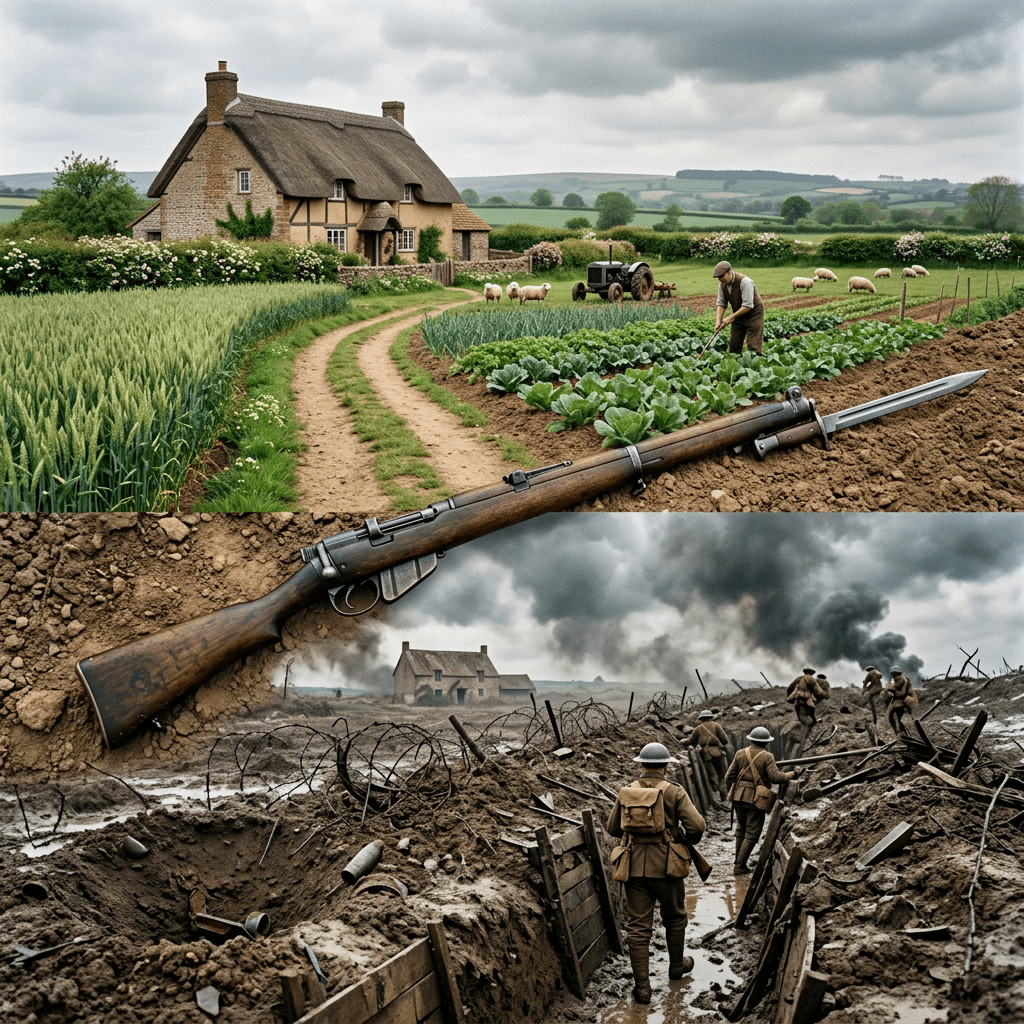
Would you believe that America’s greatest World War I hero was a man who tried everything in his power to avoid going to war in the first place? In fact, when his draft notice arrived in 1917, he explicitly wrote on it: “I don’t want to fight.” Rewind just a few years earlier, and you would find Alvin Cullum York not as a disciplined soldier, but as a hard-drinking, bar-brawling backwoodsman who could shoot the eye out of a turkey at a hundred yards but couldn’t keep his life on the rails. Yet, on October 8, 1918, in the mud and blood of the Meuse-Argonne offensive in France, this deeply religious conscientious objector single-handedly broke the back of a German machine-gun battalion. Armed with just a rifle and a pistol, he killed over 20 enemy soldiers and captured 132 prisoners.
This is the improbable, rollicking, and entirely true story of how a peaceful mountain man became an international legend.
The Wild Boy of the Valley
Alvin York was born in 1887 in a one-room log cabin in Pall Mall, Tennessee, a remote pocket of the Cumberland Plateau. He was the third of eleven children. Life in the valley was tough, defined by subsistence farming, logging, and blacksmithing. Schooling was a luxury Alvin barely tasted—he only managed about nine months of formal education before his labor was required to keep the family fed.
When his father died in 1911, the crushing weight of supporting his mother and siblings fell squarely on Alvin’s broad shoulders. To cope with the stress, he went wild. Alvin became a regular at the local blind tigers (illegal saloons across the Kentucky border), earning a reputation as a fierce gambler, a heavy drinker, and a man whose fists were as dangerous as his temper.
But Alvin had a saving grace: he was a savant with a muzzle-loading rifle. In the mountains, hunting wasn’t a hobby; it was dinner. If you missed a shot, your family went hungry. Alvin learned to read the wind, soothe his breathing, and hit moving targets with terrifying precision.
His life took a dramatic turn in 1915 after a close friend was killed in a violent bar fight. Shaken to his core, and urged on by his devout mother, Mary, Alvin attended a revival meeting run by the Church of Christ in Christian Union. He experienced a profound conversion. He quit drinking, gave up gambling, and embraced a strict pacifist doctrine that forbade the taking of human life under any circumstance. Alvin York had found peace.
Then, the world caught fire.
Conscience vs. Country
In April 1917, the United States entered World War I. Suddenly, Uncle Sam needed millions of young, strong men to throw into the meat grinder of the Western Front. When the draft registration opened, Alvin filled out his card, but his new faith screamed at him that killing was a sin. He applied for status as a conscientious objector.
Unfortunately for Alvin, his church was a small, localized sect that the U.S. government didn’t officially recognize as an established pacifist denomination (unlike the Quakers or Mennonites). His appeals were denied three separate times. In November 1917, the peaceful blacksmith was packed off to Camp Gordon in Georgia to join Company G of the 328th Infantry Regiment, 82nd Division.
At camp, Alvin was a paradox. On the shooting range, he astonished his instructors by hitting bullseyes with casual ease. Yet, in barracks discussions, he wept over the thought of having to point a rifle at another human being.
Recognizing his deep sincerity and immense talent, his commanding officer, Captain Edward Danforth, and his battalion commander, Major G. Edward Buxton, spent hours debating the Bible with him. Buxton, a deeply religious man himself, pointed out scriptures regarding just wars and defending the helpless. He told York, “If a man can protect his country and his women and children by fighting, it is his duty to do so.”
Buxton gave York a ten-day furlough to go back to the Tennessee mountains, pray, and make his final decision. Alvin spent days walking the hills, searching his soul. Finally, he returned to camp with his answer. He believed God had given him a sign: he would fight, and he trusted God to bring him home alive.
The Valley of Death
By the autumn of 1918, York was in France. The Allies were launching the Meuse-Argonne Offensive, the largest and bloodiest operation in American military history, aimed at breaking the German lines and ending the war.
On the morning of October 8, York’s unit was ordered to seize the Decauville Railroad near the village of Châtel-Chéhéry. It was a miserable, foggy morning. The terrain was a nightmare of steep, wooded hills and deep ravines, completely dominated by German machine-gun nests hidden on the ridges above.
As the Americans advanced into the valley, the fog lifted, and the German machine guns opened up. The crossfire was devastating. The air turned into a wall of flying lead, instantly cutting down dozens of Americans. York’s platoon was pinned down in the mud, unable to move forward or backward.
In a desperate bid to knock out the guns, a 17-man detachment—including Corporal Alvin York—was ordered to slip around the left flank through the dense brush to catch the Germans from behind.
At first, the gamble worked. The detachment snuck through the woods and stumbled upon a large German headquarters unit. The Germans, caught completely by surprise while eating breakfast, surrendered. But the victory was short-lived. Just up the slope, German machine gunners spotted the Americans. They spun their heavy Maxim guns around and unleashed a ferocious volley down into the hollow.
In seconds, six Americans were killed and three were wounded. Among the dead was York’s best friend, Corporal Savage. The remaining Americans dove for cover behind the captured prisoners.
Because the other squad leaders were dead or incapacitated, command fell upon the broad shoulders of Corporal Alvin York. He was trapped in the open, just 30 yards from the chattering muzzles of the German guns.
“Touch Them Off”
York realized he had no time to dive into the brush or hide behind a tree. If he did, his men and the prisoners would be shredded. So, he did the only thing a Tennessee backwoodsman knew how to do under fire: he began sharpshooting.
Every time a German gunner raised his head above the trench to aim, York shot him. In his diary, York later recounted:
“Those machine guns were spitting fire and cutting down the undergrowth all around me something awful… I didn’t have time to dodge behind a tree or dive into the brush… As soon as the machine guns opened fire on me, I began to exchange shots with them. In order to sight me or to swing their machine guns on me, the Germans had to show their heads above the trench, and every time I saw a head I just touched it off.”
To York, the Germans were just like the clay targets or wild turkeys back in Pall Mall. Every shot was deliberate. Between shots, he actually yelled at the Germans, shouting, “Come on down out of there! I don’t want to kill any more of you than I have to!”
Seeing their gunners methodically picked off by a lone rifleman, a German officer ordered a squad of six soldiers to fix bayonets and charge York from the brush. They were only twenty yards away.
York was using an M1917 Enfield rifle, which held five rounds. Instead of panicking, he dropped his rifle and pulled out his Colt .45 automatic pistol. He knew that if he shot the leading man first, the others would drop to the ground and open fire. So, York used a trick he learned while hunting wild turkeys back home: he shot the last man in the line first.
As the men in the back dropped, the front runners kept charging, completely unaware their backup was disappearing. York methodically shot all six attackers from the back to the front. Not a single one reached him.
The Surrender
With his bayonet charge wiped out and his machine gunners terrified to look over the parapet, the German commander on the ridge, Lieutenant Paul Vollmer, decided he had had enough. He had assumed he was fighting an entire American brigade.
Vollmer crawled down from his position, approached York, and asked in English, “English?”
“No,” York replied. “American.”
“Good Lord,” Vollmer said, looking at the carnage. “If you won’t shoot any more, I will make them surrender.”
Vollmer blew his whistle, and dozens of German soldiers threw down their weapons and climbed out of their trenches. York gathered his remaining seven functional soldiers. He placed himself at the front of the column, put Lieutenant Vollmer directly ahead of him with a pistol to his back, and lined up the prisoners in columns of fours.
As they marched back toward American lines, they ran into more German positions. York simply had Vollmer order them to surrender too. By the time the ragtag group walked back into the American camp, York’s small squad was escorting a staggering 132 German prisoners, including four officers. They had also neutralized an estimated 35 machine guns.
When York reported to his brigade commander, General Julian Lindsay, the general looked at the massive sea of prisoners and remarked, “Well, York, I hear you captured the whole damned German army.”
York simply saluted and replied, “No, sir. I only got 132 of ’em.”
The Reluctant Celebrity
Alvin York was immediately promoted to Sergeant. When the war ended a month later, journalist George Patullo discovered the story and wrote a massive feature for The Saturday Evening Post in April 1919. Overnight, York became a global phenomenon.
He was awarded the Congressional Medal of Honor, the French Croix de Guerre, and the Italian Croce di Guerra, among dozens of other decorations. When he arrived in New York City, he was showered with a massive ticker-tape parade.
Hollywood executives and big-business tycoons swarmed him, offering hundreds of thousands of dollars for product endorsements, stage appearances, and movie rights. York turned them all down. He was disgusted by the idea of capitalizing on the deaths of other men.
“This uniform is not for sale,” York declared.
Instead, he went straight back to Pall Mall, married his sweetheart, Gracie Williams, and bought a farm. However, York didn’t just disappear into the mountains. He realized his fame gave him leverage, and he decided to use it for the one thing his childhood lacked: education. He spent the next two decades traveling the country, raising money to build schools, high schools, and trade institutes for the impoverished children of rural Tennessee.
In 1941, with World War II looming, York finally relented and allowed Hollywood to make a movie about his life, starring Gary Cooper. Sergeant York became the highest-grossing film of the year, and Cooper won an Academy Award. True to form, York donated his share of the movie royalties to fund an agricultural school.
Alvin York passed away in 1964 at the age of 76, buried in the simple mountain soil he loved so dearly.
Why This Still Matters
The story of Alvin York isn’t just an entertaining piece of battlefield trivia; it resonates deeply even today for several profound reasons:
- The Complexity of Conscience: York reminds us that bravery isn’t the absence of doubt or the love of violence. His struggle highlights the enduring human challenge of balancing deep personal, religious, or moral beliefs with civic duty and the protection of others.
- The Power of the Underdog: In an era dominated by industrialized warfare, massive artillery, and impersonal machinery, York’s actions proved that individual skill, cool-headedness, and sheer willpower could still alter the course of history.
- Legacy Beyond the Battlefield: Most war heroes are remembered strictly for what they did with a weapon. York’s true legacy was what he did after he laid his weapon down. By leveraging his fame to fight rural poverty and illiteracy, he showed that true patriotism extends far beyond military victory.
Sources
- The National Museum of the United States Army: Biographical Record of Sergeant Alvin C. York. 2. The Congressional Medal of Honor Society: Official Citation for Alvin C. York, October 1918.
- The Saturday Evening Post: The Second Elder Gives Battle by George Patullo (April 26, 1919).
- York, Alvin C.: Sgt. York: His Own Life Story and War Diary (1928).
- The Doughboy Foundation: Historical Analysis of the Meuse-Argonne Offensive and Unit Records of the 82nd Division.



 History in 5 Minutes or less
Leave a comment