
What if the most famous queen of ancient Egypt wasn’t actually Egyptian at all, but a Macedonian Greek whose family gained power by executing history’s most audacious corpse heist?
To understand how a family of European generals ended up wearing the double crown of the Pharaohs for nearly three centuries, we have to rewind to the summer of 323 BCE, into a sweat-soaked palace room in Babylon where a 32-year-old king lay dying without a will.
The Chaos of a Vacant Empire
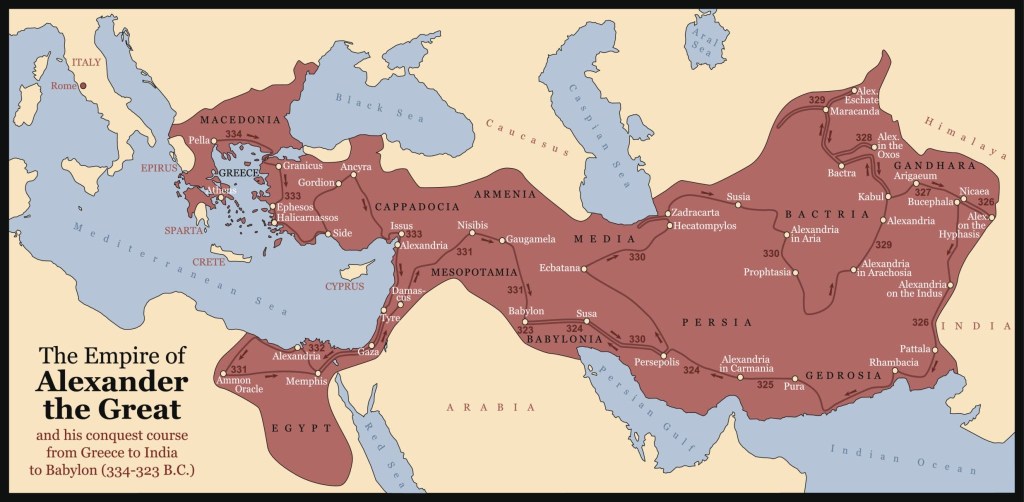
When Alexander the Great drew his last breath, he left behind an empire that stretched from Greece to India, but he left no clear heir. Legend says that when asked on his deathbed who should inherit his massive realm, Alexander croaked out a final, terrifying phrase: “To the strongest.”
Whether he actually said it or his generals just fancied an excuse for a massive free-for-all, the result was the same. Alexander’s top commanders—a hardened, ruthless group known as the Diadochi (the Successors)—immediately began eyeing each other like wolves over a fresh kill.
Most of these generals wanted to control the whole empire. They wanted Babylon, Persia, and the grand capital. But one man, a shrewd and pragmatic general named Ptolemy, son of Lagus, looked at the map and realized something his peers missed: trying to hold the whole world is a great way to get stabbed in the back. Instead, he wanted one specific, incredibly wealthy, easily defensible piece of the pie. He wanted Egypt.
The Ultimate Corpse Heist
During the initial carve-up of the empire, Ptolemy successfully maneuvered to be named the satrap (governor) of Egypt. But a governor is not a king, and Ptolemy knew his rivals would eventually come for him. He needed something to legitimize his rule, something that carried absolute, divine authority.
He needed Alexander’s body.
In the ancient world, burying the dead king was the ultimate symbol of royal legitimacy. The man who laid Alexander to rest would practically be viewed as his rightful successor. Perdiccas, the regent of the empire, had ordered Alexander’s embalmed body to be sent in a spectacular, gold-encrusted funeral carriage back to Macedonia.
Ptolemy saw his window. In 321 BCE, as the grand funeral cortege wound its way through Syria, Ptolemy launched a military ambush. He didn’t steal gold or land; he hijacked the royal hearse. He intercepted the caravan, seized the golden sarcophagus containing Alexander’s mummified remains, and hurried it away south to Egypt—first to Memphis, and later to his new capital, Alexandria.
Perdiccas was furious. He immediately marched a massive army toward Egypt to crush Ptolemy and retrieve the stolen conqueror. But Ptolemy had spent his time reinforcing the Nile’s natural defenses. When Perdiccas tried to force his army across the roaring river, the Nile crocodiles had a feast. Over two thousand of Perdiccas’s soldiers drowned or were eaten. Mutinous and humiliated, Perdiccas’s own officers walked into his tent and murdered him. Ptolemy had won the first round without even having to fight the main army himself.
Becoming the Pharaoh
By 305 BCE, the fiction of a unified empire was completely dead. The remaining generals all began declaring themselves kings of their respective regions. Ptolemy officially dropped the title of “Governor” and declared himself King Ptolemy I, later earning the title Soter (Savior) after helping defend the island of Rhodes.
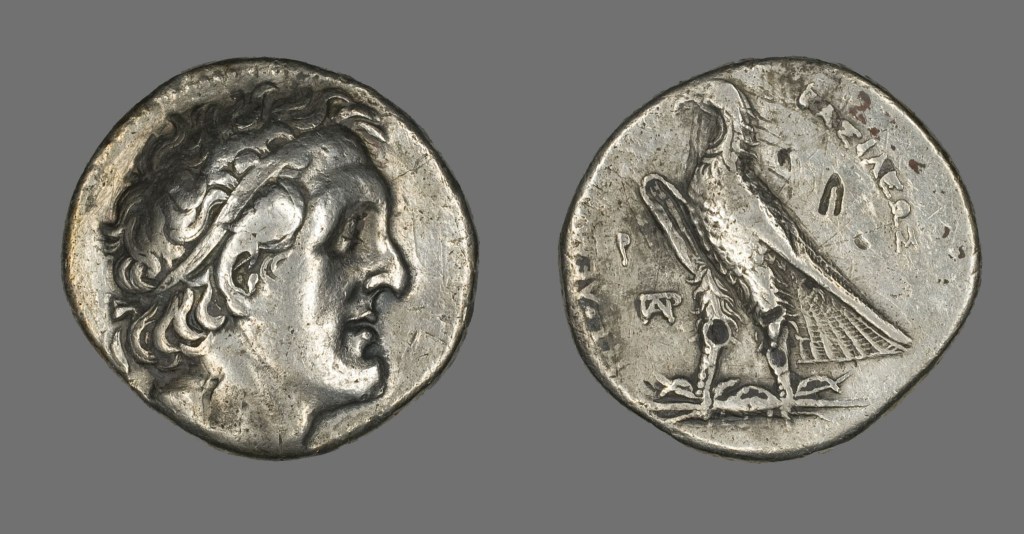
However, Ptolemy faced a massive cultural hurdle. He and his court were completely Greek. They spoke Greek, wore Greek clothes, worshipped Greek gods, and lived in Alexandria—a city that was essentially a shiny Greek polis grafted onto the edge of the Mediterranean. But the millions of people living along the Nile were fiercely traditional Egyptians who had spent thousands of years being ruled by living gods. They weren’t going to take orders from a foreign military occupier for long.
Ptolemy’s solution was a masterclass in political rebranding. Rather than forcing the Egyptians to become Greek, the Ptolemies chose to visually become Egyptian.
Ptolemy I and his descendants started portraying themselves on temples as traditional Pharaohs, complete with the royal kilts, false beards, and traditional crowns. They bankrolled the construction of massive Egyptian temples, like the ones at Edfu and Philae. They even adopted the bizarre and intense royal tradition of brother-sister marriage to keep the bloodline pure and mimic the divine relationships of Egyptian gods like Osiris and Isis.
To bridge the religious gap, Ptolemy promoted a brand-new composite god named Serapis. Serapis combined aspects of the Greek gods Zeus and Hades with the traditional Egyptian gods Osiris and Apis. It was a perfectly calculated, state-sponsored deity designed to give both Greeks and Egyptians something to worship together.
The Golden Age of Alexandria
Under Ptolemy I and his equally ambitious son, Ptolemy II Philadelphus, Egypt entered an era of unparalleled wealth and intellectual dominance. They transformed Alexandria into the undisputed cultural capital of the Mediterranean world.
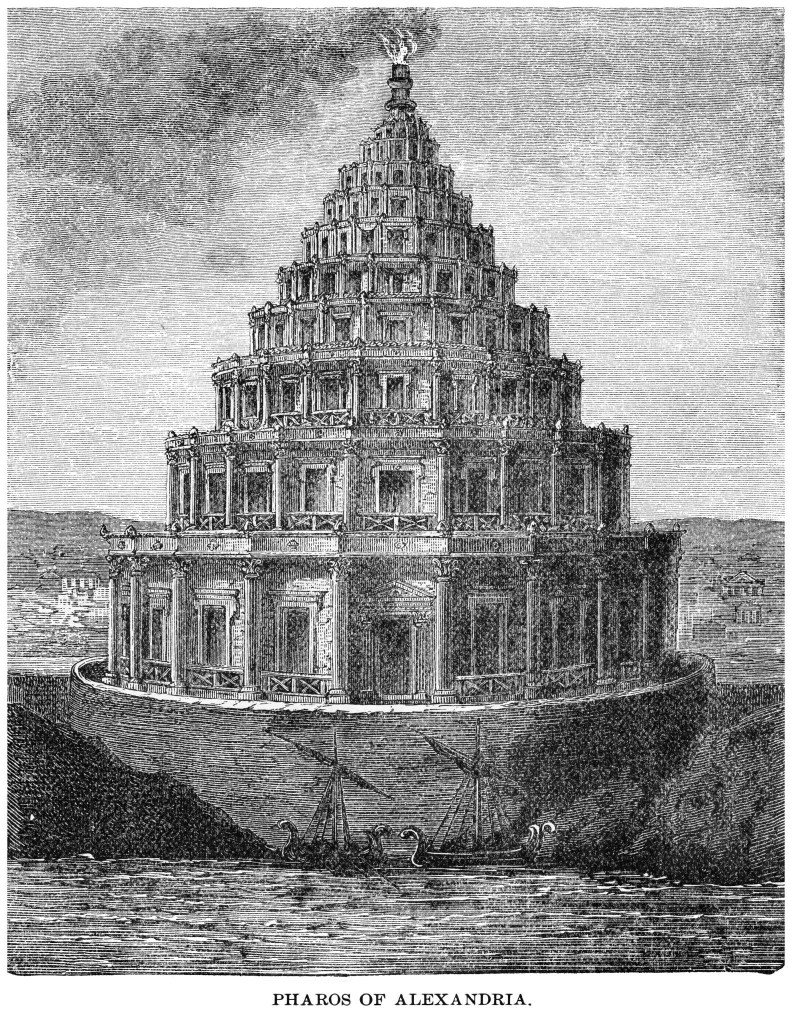
They constructed two wonders of the ancient world:
- The Pharos of Alexandria: A towering lighthouse over 300 feet tall, utilizing massive mirrors to project light miles out into the sea, guiding global trade directly into their harbor.
- The Great Library of Alexandria: A massive research institution with the aggressive mandate to acquire a copy of every single book in the known world. Ptolemaic soldiers notoriously searched every docking ship; if they found a scroll, they seized it, copied it, gave the copy back to the owner, and kept the original for the library.
For over a century, the Ptolemaic dynasty was the richest and most powerful of all the Hellenistic kingdoms. They controlled the eastern Mediterranean trade, possessed a dominant navy, and sat on an absolute monopoly of the world’s grain supply thanks to the hyper-fertile Nile delta.
Incest, Incompetence, and the Long Decay
While the first three Ptolemies were brilliant administrators and generals, dynasties have a habit of decaying from the inside out—especially when your family tree looks less like a branching oak and more like a telephone pole.
The rampant sibling marriage meant that successive generations grew increasingly unstable, paranoid, and physically unhealthy. By the time we reach the mid-second century BCE, the palace at Alexandria was a hornet’s nest of assassinations, civil wars, and bizarre family soap operas.
- Ptolemy IV was deeply indifferent to ruling, preferring to spend his time building a massive, useless pleasure boat that required 4,000 rowers.
- Ptolemy VIII was so profoundly overweight and cruel that his subjects nicknamed him Physcon (Potbelly). He systematically murdered his own family members and expelled the city’s leading intellectuals in a fit of rage.
As the Ptolemies wasted their immense wealth fighting bloody internal civil wars for the throne, a new powerhouse was rising in the west: Rome. Realizing they could no longer protect themselves by military might alone, later Ptolemaic kings resorted to massive bribes, turning Egypt into a de facto client state of the Roman Republic just to keep their crowns.
The Final Act: Cleopatra VII
The story of the Ptolemaic lineage ends exactly how it began: with high-stakes political gambling, incredible theater, and a fierce refusal to go down quietly. Enter the most famous Ptolemy of them all: Cleopatra VII.
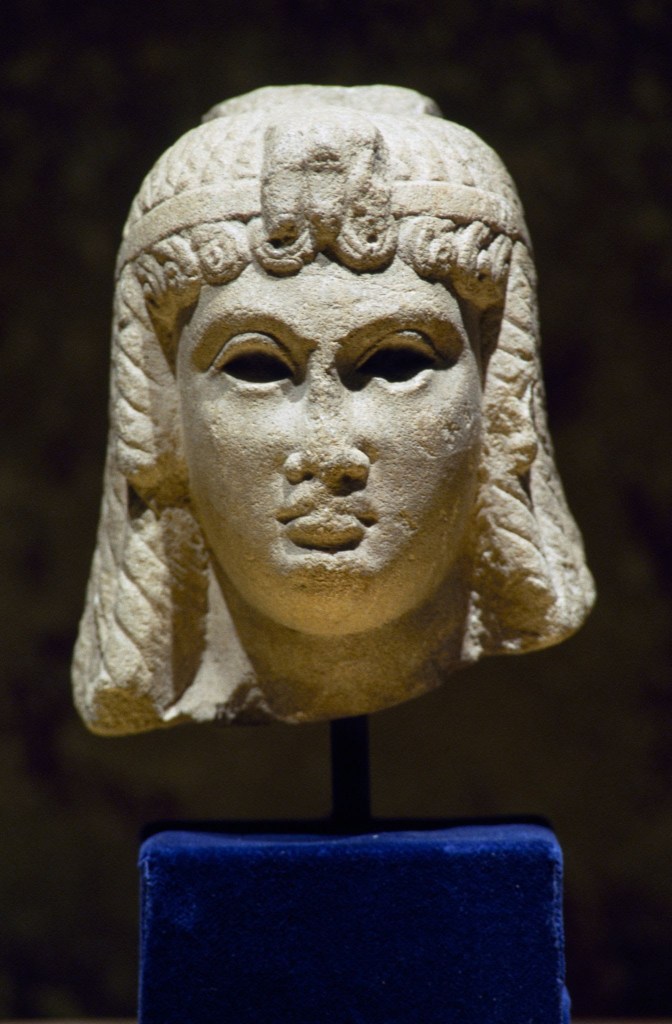
Cleopatra was a brilliant politician, a master strategist, and famously, the only member of her entire 300-year dynasty who actually bothered to learn how to speak the native Egyptian language. Finding herself locked in a civil war against her younger brother (and husband) Ptolemy XIII, she recognized that her only path to survival lay in capturing the support of Rome’s greatest generals.
In a move that beautifully mirrored her ancestor Ptolemy I’s corpse heist, Cleopatra had herself smuggled past enemy lines into Julius Caesar’s private chambers—legend says rolled up inside a hemp bed-sack or luxury rug. Caesar was captivated by her audacity and intelligence. With Roman legions at her back, Cleopatra secured the throne, eliminating her brother-husband.
When Caesar was assassinated, she adapted, forming a passionate romantic and political alliance with Mark Antony. Together, they dreamed of building an eastern empire that would rival Rome itself. But history ran out of patience for the Ptolemies. In 31 BCE, Octavian (the future Emperor Augustus) crushed Antony and Cleopatra’s combined forces at the naval Battle of Actium.
In 30 BCE, rather than being paraded through the streets of Rome in golden chains as a captive, Cleopatra took her own life. With her died the Ptolemaic dynasty, and with it, the very last independent gasp of ancient Egyptian history.
Why This Still Matters
The rise and fall of the Ptolemies isn’t just a collection of wild anecdotes about stolen bodies, massive lighthouses, and royal drama. It fundamentally altered the trajectory of global history in ways we still feel today.
- The Blueprint for Cultural Fusion: The Ptolemies proved that an occupying power could maintain control not just through raw military force, but through cultural synthesis. By blending Greek and Egyptian religious, artistic, and political styles, they created a unique, enduring hybrid culture that shaped the Mediterranean for centuries.
- The Preservation of Human Knowledge: Without the Ptolemaic obsession with building and funding the Library of Alexandria, massive chunks of ancient Greek, Babylonian, and Egyptian science, mathematics, and literature would have been lost to time forever. They institutionalized the idea of state-funded scientific research.
- The Birth of the Roman Empire: It was the unimaginable wealth of Ptolemaic Egypt that funded Octavian’s transformation of Rome from a chaotic, collapsing Republic into the stable, sprawling Roman Empire. The fall of the Ptolemies is the exact pivot point upon which western antiquity swings into the imperial age.
Sources and SEO
Historical References
- Arrian, Anabasis of Alexander & Events After Alexander (Critical source for the death of Alexander and the early Diadochi wars).
- Plutarch, Life of Antony & Life of Caesar (Primary source for the reign and final days of Cleopatra VII).
- Polybius, The Histories (Details the political decline and Roman intervention in Ptolemaic Egypt).
- Beverly Bowen Moers, Alexandria: Dual Identity and Magic (Modern analysis of the cultural blending under Ptolemy I).
SEO Metadata
- Target Keywords: Ptolemaic dynasty, Ptolemy I Soter, Alexander the Great funeral heist, History of Ptolemaic Egypt, Cleopatra VII lineage, Diadochi wars, Library of Alexandria history.
- Meta Description: Discover the wild history of how Ptolemy I stole Alexander the Great’s body, crowned himself Pharaoh, and launched the 300-year Ptolemaic dynasty that ended with Cleopatra.








Leave a Reply