The Fatal Feast of Twelfth Night
In the dead of winter, January 7, 878, the Kingdom of Wessex died over dessert. King Alfred and his court were sleeping off their post-Christmas food comas at the royal estate of Chippenham, completely oblivious to the fact that hundreds of heavily armed, silent Vikings were slipping through the freezing darkness outside. Within minutes, the doors flew open, axes carved through the royal guard, and the last surviving Anglo-Saxon kingdom collapsed like a house of cards. Alfred, the Lord of the West Saxons, was forced to flee into the biting night wind with nothing but his boots, his sword, and the absolute certainty that he was utterly, irrevocably screwed.
But wait let’s pull the emergency brake on this historical train wreck and rewind a bit. How did the ruler of England’s most powerful kingdom end up playing hide and seek for his life in a freezing ditch? To understand why the entire future of the English-speaking world was currently running through a swamp with chattering teeth, we have to look at the terrifying force that brought him there: the Great Heathen Army.
When the Skies Rained Axes
For decades, the Vikings had played a predictable, if bloody, game. They would sail across the North Sea in their terrifyingly efficient longships, jump out onto an unsuspecting beach, butcher a monastery full of unarmed monks, steal anything that sparkled, and hop back on their boats before anyone could organize a defense. It was a smash and grab economy. But in 865, the Vikings changed their business model from “rob and run” to “conquer and stay.”
They arrived in a massive coalition known to history as the Great Heathen Army, led by the legendary and terrifying sons of Ragnar Lothbrok men like Ivar the Boneless, Halfdan, and Ubba. These guys weren’t just raiders; they were conquerors. One by one, the divided Anglo-Saxon kingdoms fell. Northumbria was shattered, its kings brutally executed. East Anglia was crushed, its pious King Edmund turned into a human pincushion for refusing to renounce Christ. Mercia was hollowed out and turned into a puppet state. By 871, only one obstacle stood between the Vikings and total dominion over the island: Wessex.
And who was the grand defender of Wessex? Not a towering barbarian slayer, but a frail, hyper religious twenty two year old named Alfred. Alfred was the youngest of five brothers, meaning he was never supposed to be king. He spent his youth reading poetry, praying, and suffering from a mysterious, chronic stomach ailment (likely Crohn’s disease) that caused him agonizing pain throughout his entire life. Yet, as the Viking meat-grinder chewed through his older brothers one by one, the crown was eventually placed on the head of the guy who would much rather have been compiling a library.
The Art of Buying Time
Alfred’s reign started with an immediate series of military disasters. The Vikings, led by a brilliant and cunning new chieftain named Guthrum, were relentless. Recognizing that his exhausted army was on the verge of total annihilation, Alfred resorted to a controversial, pragmatic tactic: he paid them to go away.
This protection money, later known as Danegeld, was seen by many as a cowardly move, but Alfred knew exactly what he was doing. He wasn’t paying for peace; he was buying time. While Guthrum’s Vikings spent the money and preoccupied themselves with subjugating neighboring Mercia, Alfred worked tirelessly behind the scenes. He drilled his men, strengthened his positions, and prepared for the inevitable.
Yet, no amount of preparation could protect him from Guthrum’s ultimate stroke of tactical genius: the winter blitzkrieg at Chippenham. Vikings traditionally did not campaign during winter; it was considered too hazardous. By breaking this unwritten rule, Guthrum took Alfred completely by surprise, scattering the Wessex army and forcing the King into an ignominious, desperate exile.
The Royal Pastry Disaster and the Somerset Bog
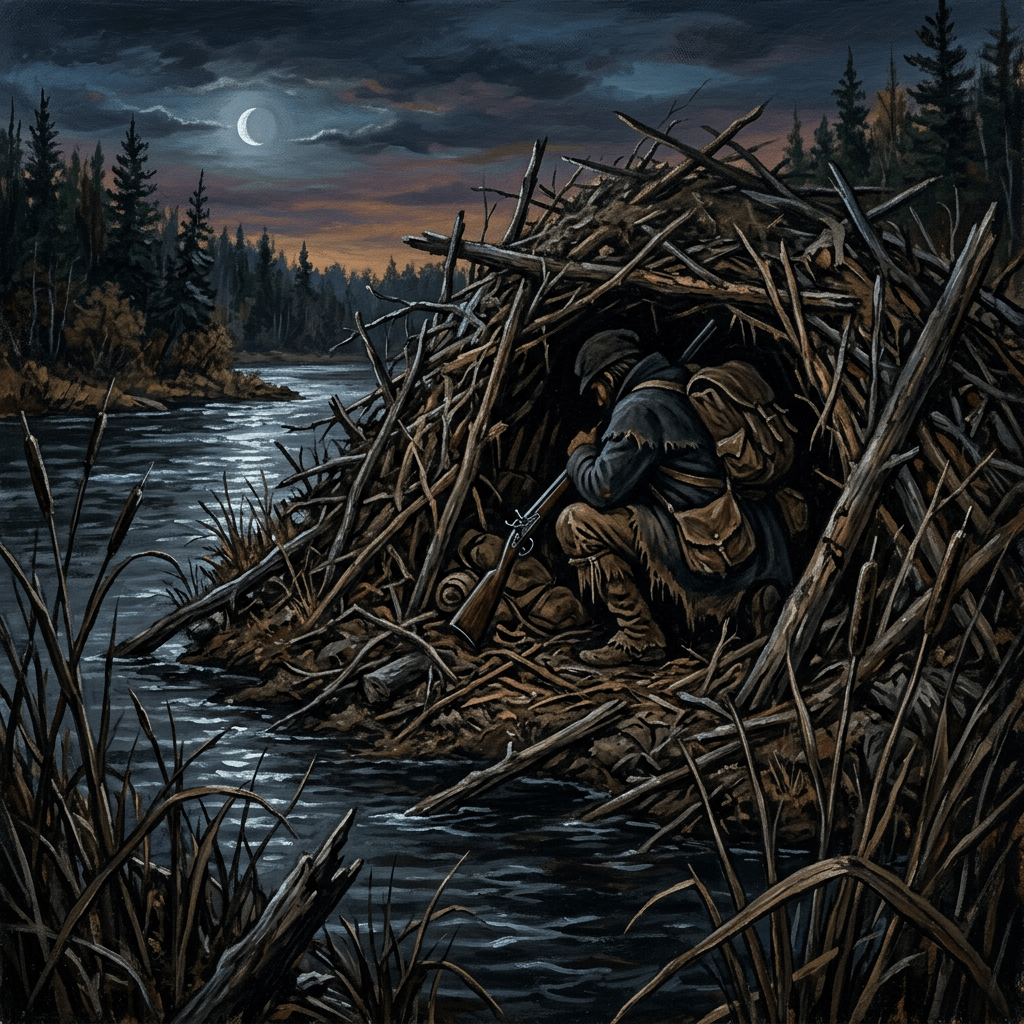
With Wessex fully occupied by the Vikings, Alfred fled to the Somerset Levels—a vast, treacherous expanse of flooded bogs, dense reed beds, and malaria ridden swamps. It was an environment that would kill an unguided traveler in hours. But for a desperate king, it was the perfect fortress. On a small island of dry land called Athelney, Alfred established a guerrilla base camp. He was reduced from a grand monarch to the leader of a band of swamp dwelling partisans, launching hit-and-run raids on Viking supply lines.
It is from this bleak period that England’s most famous folk legend is born: the Story of the Burnt Cakes. As the tale goes, an incognito Alfred took shelter in the hut of a local swineherd. The swineherd’s wife, completely unaware that this ragged, muddy traveler was her king, asked him to watch some wheat cakes baking on her hearth while she went out to tend the animals. Alfred, weighed down by the crushing psychological trauma of losing his kingdom and fearing for the erasure of Christian civilization, stared blankly into the fire and let the cakes burn to a crisp.
When the housewife returned, she smelled the smoke and flew into a rage, scolding the king of England for being too lazy to flip the bread, snapping that he was happy enough to eat them when they were hot. Instead of executing her for treason, Alfred humbly took the scolding, apologized, and ate the charred remains. True or not, the story captured the essence of Alfred’s transformation at Athelney: he was stripped of all royal pretense, humbled by the earth, and forged into something far tougher than a hereditary monarch.
“He led a restless life in great affliction and hardship… For he had nothing to live on except what he could take by frequent raids, either openly or by stealth, from the pagans.” — Bishop Asser, Life of King Alfred
The Gathering of the Fyrd
By the spring of 878, Alfred’s underground resistance network had done its job. Rumors spread through the occupied villages: The King still lives. From his swampy hideout, Alfred sent out secret messengers across the shires of Wiltshire, Somerset, and Hampshire, calling for all able-bodied men to assemble at a mysterious, pre-arranged landmark known as Egbert’s Stone.
In early May, Alfred rode out of the swamps to the meeting place. When he arrived, he didn’t find a broken, defeated people. Instead, the Anglo-Saxon chronicles record that the men of Wessex received him as if he had risen from the dead. Thousands of farmers, local noblemen, and survivors—known collectively as the fyrd—clashed their shields, cheered his name, and prepared for a final, apocalyptic showdown.
Guthrum, hearing word of this miraculous resurrection, gathered his entire host and marched out from Chippenham to meet him. The two armies converged near the modern village of Edington (then called Ethandun). There would be no more payments, no more retreats, and no more hiding in the mud. The future of England was to be decided by cold steel.
The Battle of Edington: A Wall of Shields
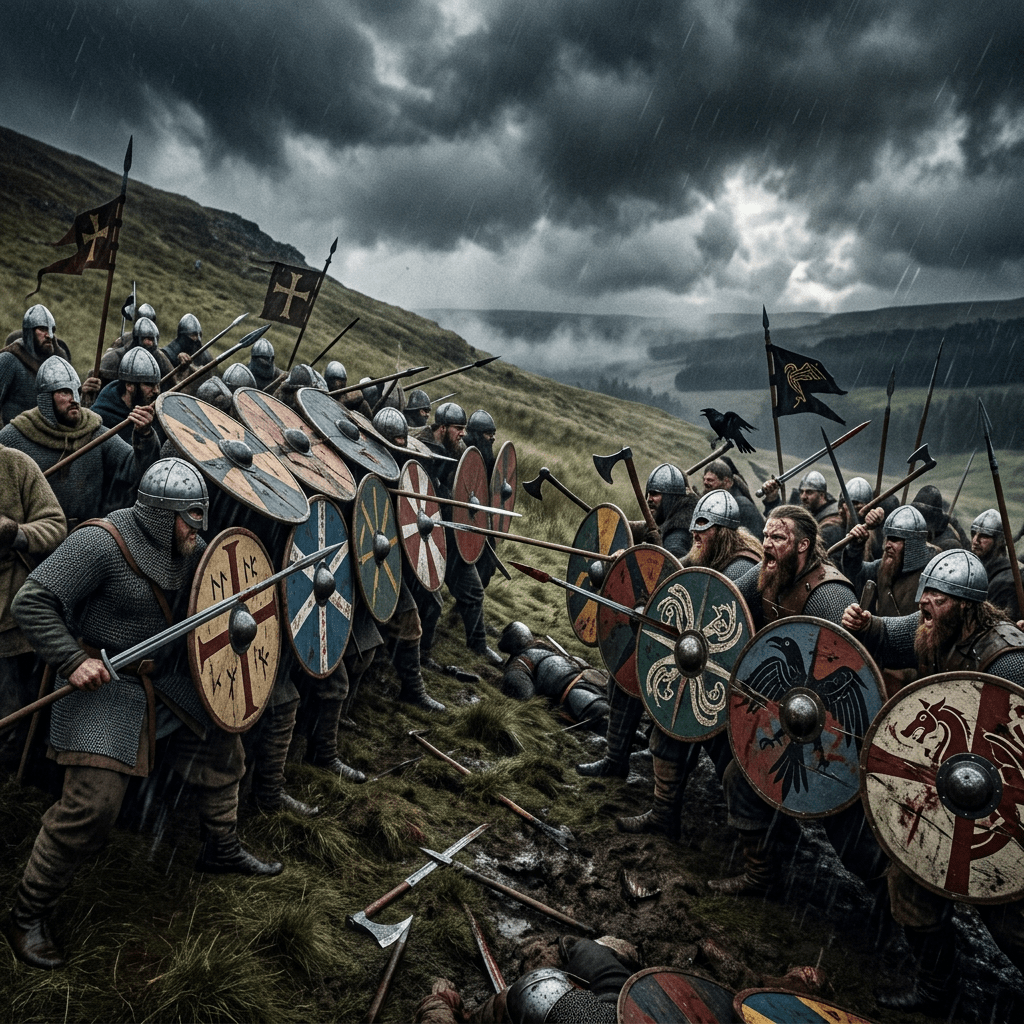
On that fateful May morning, Alfred deployed his men along the high ground of Salisbury Plain. The tactical playbook of ninth-century warfare was brutal, intimate, and simple: the shield wall. This wasn’t a movie where soldiers broke off into individual, cinematic martial arts duels. This was a human rugby scrum with axes and spears.
Alfred locked his men together, shield overlapping shield, creating a wooden, leather-faced wall that stretched across the ridge. The Vikings formed their own wall opposite them. Then, with a deafening roar of war cries and insults, the two massive formations slammed into each other.
The fighting was barbaric and exhausting. For hours, men shoved against each other, stabbing through tiny gaps in the shields, the ground turning into a slick mire of mud and blood. Guthrum’s veterans threw themselves at the Saxon line with frantic ferocity, but Alfred’s men held firm. They were fighting for their homes, their families, and their faith.
Sensing the critical moment of physical and mental exhaustion in the Viking ranks, Alfred did what all great commanders do: he put himself at the absolute tip of the spear. Leading a furious, desperate counter-shove, Alfred and his personal guard punched a hole right through the center of the Viking line. The Viking wall buckled, cracked, and finally shattered. The terrifying raiders who had pulverized every kingdom in Britain suddenly turned and ran for their lives, with Alfred’s victorious Saxons hacking at their heels all the way back to their fortress at Chippenham.
The Miracle of Wedmore
Instead of launching a suicidal assault on the stout walls of Chippenham, Alfred surrounded the fortress and starved the Vikings out. For fourteen agonizing days, Guthrum’s men endured hunger, cold, and the terrifying realization that no help was coming. Finally, a broken Guthrum walked out of the gates and threw himself at Alfred’s mercy.
If Alfred had behaved like a typical medieval ruler, he would have chopped off Guthrum’s head, stuck it on a pike, and slaughtered every Norseman in sight. But Alfred wasn’t a standard warlord; he was a statesman. He recognized that he could never completely eradicate the Vikings from Britain. Therefore, he needed a political solution that would convert them into peaceful neighbors.
Under the Treaty of Wedmore, Alfred offered Guthrum incredibly generous terms, packed with a massive catch. The Vikings had to abandon Wessex and move to the east of England (an area that became known as the Danelaw). In return, Guthrum had to accept the ultimate spiritual submission: he had to convert to Christianity.
In an extraordinary ceremony, Guthrum was baptized, with Alfred himself acting as his godfather. The fierce Viking king was washed in holy water, dressed in white robes, and spent twelve days feasting as Alfred’s honored guest. It was a masterstroke of psychological warfare. By converting Guthrum, Alfred brought him into the European family of Christian monarchs, binding him by sacred oaths that the Norseman actually respected. The war was over; Wessex had survived.
Rebuilding a Ruined Realm
Defeating Guthrum at Edington won Alfred the war, but it didn’t win the peace. Alfred knew the Vikings would eventually return. He spent the remainder of his reign totally reinventing the structural DNA of his kingdom so that it would never fall to a surprise attack again.
- The Burghal System: He mapped out Wessex and built a network of thirty-three fortified towns, called burgs (from which we get the word “borough”), spaced exactly nineteen miles apart. This meant that no matter where a Viking raider landed in Wessex, they were less than a day’s march away from a fortified garrison.
- The Standing Navy: He created England’s first standing navy, designing long, fast warships that could intercept Viking raiders before they ever touched English soil.
- Cultural Renaissance: Alfred believed that the Viking invasions were a punishment from God because his people had neglected learning and literacy. He personally translated Latin texts into Old English, established schools, and decreed that all freeborn young men must learn to read. He didn’t just save his people’s bodies; he rescued their minds.
Why This Still Matters Today
It is easy to look at Alfred the Great as a dusty figure from a forgotten millennium, but the reality is that the modern world would look entirely different without his swampy stand at Athelney. Alfred is the only English monarch in history to be awarded the title “The Great,” and he earned every syllable of it.
Had Alfred failed at the Battle of Edington, the Anglo-Saxon culture, law, and language would have been systematically extinguished. The island would have become a fractured Norse colony. The English language as we know it today—a rich tapestry that evolved from Old English—would never have developed; you might very well be reading this article in a variant of Old Norse.
Furthermore, Alfred’s vision of a unified, Christian, and literate island laid the direct political and cultural foundations for his grandson, Athelstan, to formally create the unified Kingdom of England in 927. When you look at the map of modern Europe, the legal structures of the West, or the global dominance of the English language, you are looking directly at the legacy of a sick prince who refused to give up in a Somerset bog.
Historical Sources & References
- Asser, Bishop of Sherborne. Life of King Alfred (c. 893).
- The Anglo-Saxon Chronicle (Manuscript A, compiled during Alfred’s reign).
- Abels, Richard. Alfred the Great: War, Kingship and Culture in Anglo-Saxon England (Routledge, 1998).
- Sturdy, David. Alfred the Great (Constable, 1995).


 History in 5 Minutes or less
Leave a comment