The King Who Wore Nothing But Gold
Sir Walter Raleigh stared at the executioner’s axe, realizing that a fictional city made of solid gold had just cost him his head.
But wait—let’s rewind. Before the English courtier found himself kneeling on a scaffold in London, and long before thousands of Spanish conquistadors starved to death in the dense, mosquito-ridden swamps of the Amazon, El Dorado wasn’t a city at all. It was a human being.
Our story truly begins high in the Andes mountains of modern-day Colombia, around the year 1400. The Muisca civilization lived in relative isolation on a fertile plateau. They didn’t value gold for its monetary worth—they didn’t have currency—but rather for its spiritual power. To them, the glittering metal was a physical manifestation of the sun’s energy.
Whenever a new chieftain, or zipa, came to power, he had to perform a sacred ritual to appease the goddess of Lake Guatavita. The incoming ruler would strip naked, slather his entire body in sticky plant sap, and roll around in a fine powder of pure gold dust until he shone like a living statue. He was El Hombre Dorado—The Gilded Man.
Accompanied by high priests, the golden king would float out to the center of the perfectly round volcanic lake on a balsa raft. As thousands of subjects cheered from the shores, chanting and playing pipes, the king would dive into the emerald waters, washing away the gold dust as an offering to the gods. Meanwhile, his people threw emeralds, golden trinkets, and intricate ornaments into the lake, letting them sink into the deep mud below.
It was a beautiful, deeply religious ceremony. But to the European explorers who arrived on the shores of South America a century later, it sounded like a blank check.
The Rumor That Conquered a Continent
By the 1530s, the Spanish empire had already systematically dismantled the two greatest superpowers of the Americas. Hernán Cortés had looted the Aztecs in Mexico; Francisco Pizarro had ransacked the Incas in Peru. The sheer volume of silver and gold shipped back to Seville fundamentally disrupted the global economy.
European adventurers became convinced that a third, even wealthier empire must be hiding somewhere in the vast, unexplored interior of the continent.
When Spanish soldiers first heard whispers of a “gilded man” from local Indigenous captives, the story suffered from a massive case of historical telephone. The ritual at Lake Guatavita had actually ceased decades earlier after the Muisca were conquered by a rival tribe, but the rumor grew legs.
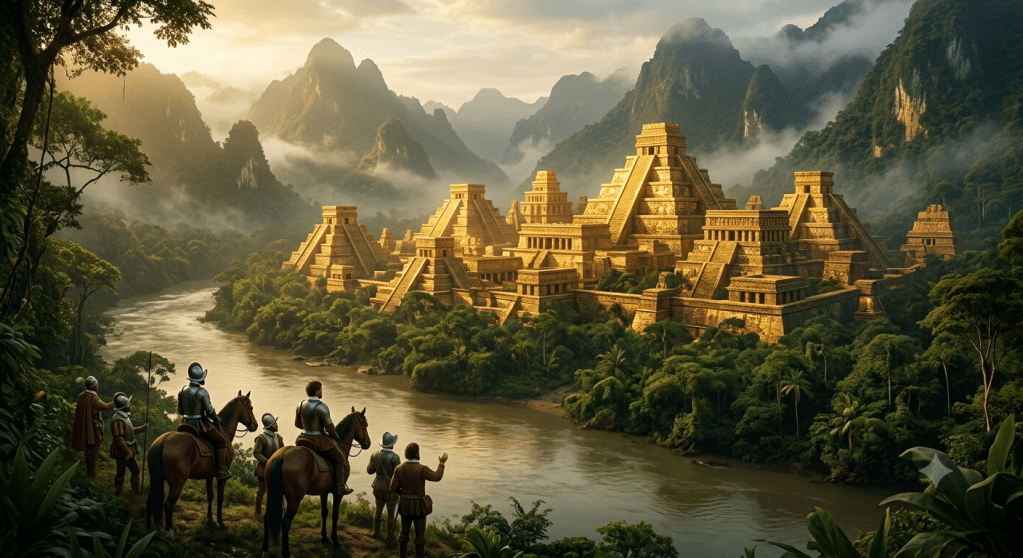
In the minds of the gold-mad conquistadors, the Gilded Man quickly transformed into a Gilded City, which then mutated into an entire Gilded Empire called El Dorado. European mapmakers, who hated leaving empty spaces on their charts, began casually sketching a massive, shimmering metropolis named Manoa right in the middle of uncharted territories, usually on the banks of a mythical body of water called Lake Parime.
The hunt was on, and it would quickly become one of the most lethal wild goose chases in human history.
The Cannibalism and Cinnamon Expedition
In 1541, Gonzalo Pizarro—the younger, equally ruthless brother of Francisco Pizarro—assembled a massive army in Quito, Ecuador. He wasn’t just looking for El Dorado; he was also seeking the fabled “Land of Cinnamon,” a spice that fetched exorbitant prices back in Europe.
Pizarro spared no expense. He marched out of the mountains with 340 heavily armed Spanish soldiers, 4,000 enslaved Indigenous laborers, 150 horses, a massive herd of llamas, and 2,000 hunting dogs trained for war.
The expedition was a catastrophe from week one. As they descended the eastern slopes of the Andes, the crisp mountain air gave way to suffocating heat and torrential downpours that rotted their boots and rusted their armor. The dense jungle brush was so thick they had to hack through it foot by foot with machetes.
Worse still, the local tribes they encountered had no idea what Pizarro was talking about. Frustrated and paranoid, Pizarro tortured Indigenous village elders, burning them alive or throwing them to his war dogs when they failed to provide directions to the golden city. To save their own lives, many captives simply pointed further into the horizon, whispering exactly what the Spaniard wanted to hear: “Yes, yes, just a few weeks more in that direction. A city of pure gold.”
Months dragged on. The food ran out. The Spaniards were forced to eat their llamas, then their war dogs, and eventually, the leather from their own saddles and stirrups. Diseases like malaria and yellow fever decimated the ranks.
By the time they hit the Coca River, Pizarro realized his men were too weak to march. He ordered his second-in-command, Francisco de Orellana, to take 50 men and a hastily constructed brigantine boat downriver to forage for food and return.
Orellana left—and never came back. The river current was too strong to row upstream against, so Orellana simply kept going. He accidentally floated down the entire length of the largest river system on earth, naming it the Amazon River after his expedition fought off a fierce tribe of female warriors.
Back upriver, a bitter Pizarro waited for weeks. Realizing he had been abandoned, he turned his surviving skeletal crew around and dragged them back up the Andes. When he finally stumbled back into Quito in 1542, only 80 of his original 340 Spaniards were alive. Virtually all 4,000 Indigenous laborers had perished.
The English Courtier’s Fatal Delusion
You might think a disaster of that scale would cure Europe of its golden fever. Instead, it only heightened the mystique. If El Dorado was that difficult to find, it must be because it was incredibly well hidden!
Over the next fifty years, dozens of expeditions swept across Venezuela, Colombia, and Brazil. Blood, disease, and madness followed each one. Yet, the location of the mythical city kept shifting. Every time an explorer thoroughly mapped a region and found nothing but trees and mud, mapmakers simply pushed El Dorado further east into the unexplored highlands of Guyana.
This brings us back to Sir Walter Raleigh. By 1595, Raleigh was a man desperate to regain the favor of Queen Elizabeth I. He had secretly married one of her maids of honor without royal permission, earning himself a temporary stay in the Tower of London and an eviction from the royal court.
To win back his power, Raleigh decided he needed an exploit so magnificent it could not be ignored: he would claim El Dorado for the English Crown.
Raleigh sailed to modern-day Venezuela and navigated his ships up the Orinoco River. He charmed local tribal chiefs, promising them that the English Queen would liberate them from Spanish cruelty. He collected samples of shiny rocks—which he erroneously believed contained gold ore—and listened intently to stories of a golden empire located past the mountains.
When he returned to England empty-handed but enthusiastic, he published a sensationalized book titled The Discovery of the Large, Rich, and Beautiful Empire of Guiana. It was an instant bestseller filled with vivid descriptions of Amazonian landscapes, headless men with eyes in their shoulders, and, of course, a dazzling city of gold.
Raleigh truly believed his own hype. Twenty-two years later, in 1617, a aging and sickly Raleigh convinced King James I to let him launch a second expedition. James agreed, but on one strict condition: Raleigh must not engage in any military conflict with the Spanish, who now claimed the region, or it would mean war between England and Spain.
The expedition was an unmitigated disaster. Raleigh grew too sick with fever to leave his ship. His men, led by his son Watt Raleigh, ignored the King’s orders and attacked a Spanish outpost along the Orinoco River. During the chaotic battle, young Watt was shot through the heart and killed.
Heartbroken, broken in health, and entirely devoid of gold, Raleigh returned to England. King James, furious over the diplomatic crisis with Spain, enforced his original ultimatum. On October 29, 1618, Raleigh was led to the scaffold. Before the blade fell, he touched the edge of the axe and famously muttered: “This is a sharp Medicine, but it is a Physician for all diseases.”
Why This Still Matters
The tragicomic saga of El Dorado might sound like an ancient, bizarre case of mass hysteria, but its ripples are still actively shaping our modern world.
First, the myth functioned as the direct engine for the geographic exploration of South America. If Spanish and English explorers hadn’t been driven by a pathological obsession with gold, the mapping of the Amazon basin, the Andes, and the massive river systems of the Orinoco would have taken centuries longer. The literal map of our world was drawn by people chasing a phantom.
Second, it serves as a stark historical critique of short-sighted greed. The nations that chased El Dorado focused entirely on the extraction of immediate wealth rather than building sustainable, equitable systems. Spain poured its stolen gold and silver into endless European wars, triggering a devastating cycle of hyperinflation that ultimately caused the empire’s economic decline.
Finally, the real tragedy of El Dorado is ecological and cultural. The obsession with gold obliterated Indigenous civilizations, replacing complex cultures with slave-labor networks. Today, that same extractive mentality persists in the Amazon. Illegal gold mining relies on clearing thousands of acres of pristine rainforest and using toxic mercury to separate gold from sediment, poisoning the very rivers that Francisco de Orellana accidentally mapped five centuries ago.
El Dorado was never a place on a map; it was a mirror reflecting humanity’s endless capacity for self-delusion. The golden city didn’t exist, but the destructive desire to find it certainly did.
Sources
- Hemming, John. The Search for El Dorado. Phoenix, 2001. (The definitive historical text covering the individual Spanish and British expeditions).
- Raleigh, Walter. The Discovery of Guiana. 1596. (Primary source detailing Raleigh’s firsthand accounts and mythologizing of the region).
- Silverberg, Robert. The Golden Dream: Seekers of El Dorado. Ohio University Press, 1996. (An engaging look into the psychological drivers of the conquistadors).
- Nicholl, Charles. The Creature in the Map: Sir Walter Raleigh’s Quest for El Dorado. William Morrow & Co, 1995.


Leave a Reply