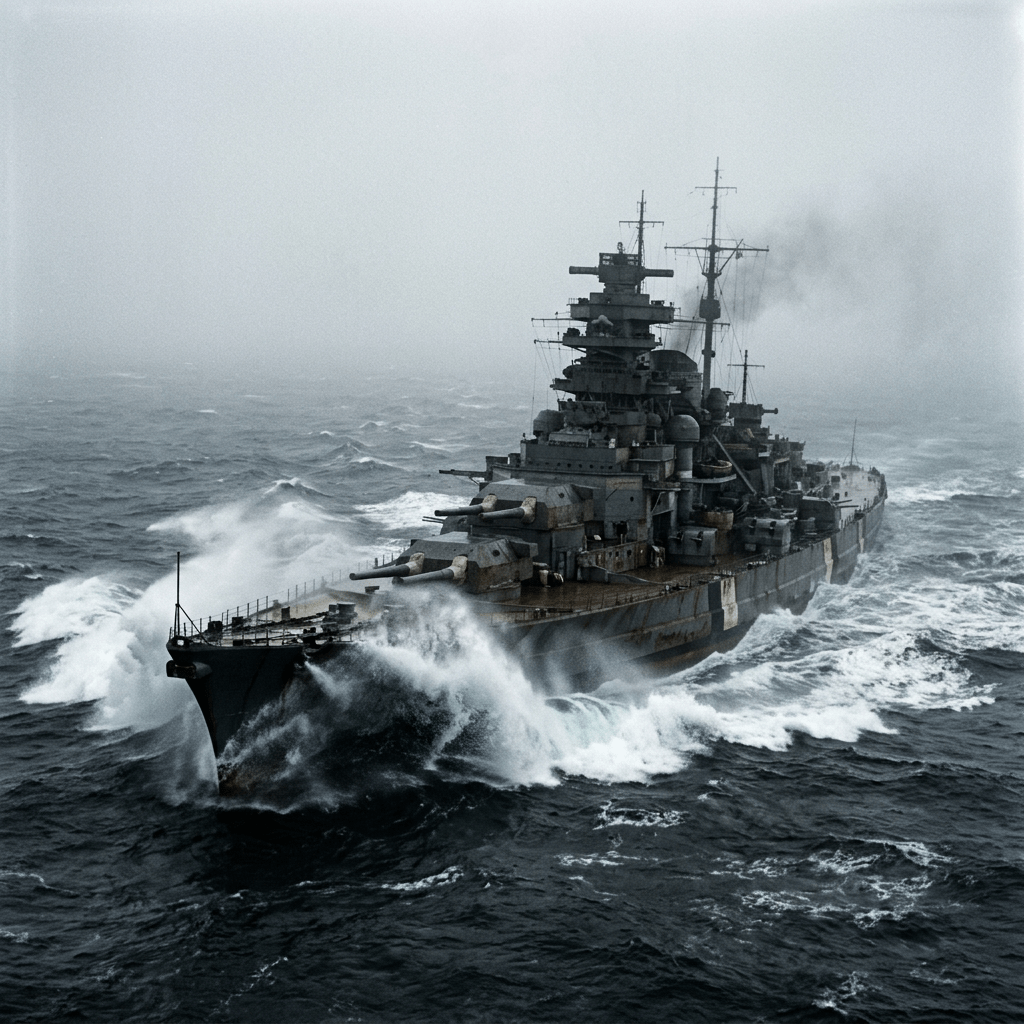
Did you know that the pride of the British Empire—a massive 42,000-ton battlecruiser that had dominated the seas for two decades—was vaporized in less than eight minutes by a single, terrifyingly precise shell?
To understand how a solitary German leviathan managed to shock the world, break the heart of Great Britain, and ignite the most relentless naval manhunt in human history, we have to rewind to May 1941, when the German battleship Bismarck slipped out of port with one goal: starve Britain into total surrender.
The Beast Awakens: Operation Rheinübung
By early 1941, Nazi Germany had crushed continental Europe. Britain stood alone, a stubborn island nation kept alive solely by a vital lifeline of merchant shipping crossing the icy, U-boat-infested Atlantic Ocean.
Enter the Bismarck.
Commissioned in August 1940, Bismarck was an engineering marvel—and a floating nightmare for Allied strategists. Displacing over 50,000 tons fully loaded, armored in impenetrable Krupp steel, and packing eight 15-inch main guns that could throw 1,800-pound armor-piercing shells over 20 miles, she was the largest and most dangerous warship ever built by Germany.
Under the command of Admiral Günther Lütjens, Bismarck set sail alongside the heavy cruiser Prinz Eugen under the secret code name Operation Rheinübung (Rhein Exercise). The mission wasn’t to fight the British fleet head-on; it was to break out into the open Atlantic and annihilate Allied supply convoys.
However, secrecy in WWII was a fleeting luxury. Swedish naval patrols spotted the two warships slipping through the Kattegat Strait. Within hours, the intelligence reached London. Prime Minister Winston Churchill’s instruction was simple, brutal, and immediate: “Sink the Bismarck.”
The Battle of the Denmark Strait: Horror in Eight Minutes
On the fog-choked morning of May 24, 1941, two Royal Navy titans intercepted Bismarck and Prinz Eugen in the narrow ocean corridor between Greenland and Iceland—the Denmark Strait.
Leading the British squadron was HMS Hood, the beloved flagship known universally as “The Mighty Hood,” accompanied by Britain’s newest battleship, HMS Prince of Wales. Hood was a symbol of British global dominance, but she had a hidden, fatal flaw: her deck armor was thin, a relic of World War I design principles that prioritized speed and firepower over horizontal protection.
At 05:52, the heavy guns roared. The freezing Atlantic air shook with the force of exploding cordite.
At first, British gunners misidentified the German ships, targeting Prinz Eugen by mistake. Bismarck, meanwhile, locked onto Hood with terrifying, clockwork mathematical precision.
At 06:00, Bismarck fired her fifth salvo. A single 15-inch shell plunged through Hood’s thin upper deck, penetrating deep into her aft ammunition magazines.
The result was cataclysmic. A pillar of orange flame shot hundreds of feet into the sky, followed by a roar that shook the hulls of nearby ships. HMS Hood broke in two and vanished beneath the waves in under three minutes. Out of her 1,418 officers and crew, only three men survived.
Shaken and damaged, HMS Prince of Wales was forced to retreat under a smoke screen. In less than ten minutes, Nazi Germany had dealt the British Royal Navy its most devastating psychological blow of the war.
The Vanishing Act in the North Atlantic
While the German officers celebrated, Admiral Lütjens knew he had a problem. During the skirmish, Prince of Wales had landed three hits on Bismarck. One shell pierced her bow fuel tanks, causing a steady leak of vital fuel oil and contaminating several bunker tanks with saltwater.
With her top speed reduced and a distinct trail of oil trailing behind her, Bismarck could no longer execute her commerce-raiding mission. Lütjens made a controversial call: split from Prinz Eugen and head south toward the port of Saint-Nazaire in occupied France for repairs.
What followed was a high-seas game of blind hide-and-seek across hundreds of thousands of square miles of stormy ocean.
The British Admirality threw every available asset into the search—battleships, battlecruisers, aircraft carriers, cruisers, destroyers, and submarines. Yet on May 25, through a combination of heavy fog, stormy weather, and tactical maneuvering, Bismarck managed to slip past her pursuers. She had gone ghost.
For nearly 30 agonizing hours, the Royal Navy hunted blindly. If Bismarck made it under the protective umbrella of the Luftwaffe’s air cover off the French coast, she would live to fight another day.
Then, Lütjens made a fatal error.
Believing the British were still tracking him via radar, he transmitted a series of long, detailed radio messages back to Berlin. British radio direction-finding stations intercepted the signals. While an initial plotting error by the British Admiral John Tovey sent ships racing in the wrong direction, a RAF Catalina flying boat piloted by American officer Leonard B. Smith spotted the telltale oil slick and shadowed hull on the morning of May 26.
Bismarck was only 690 nautical miles from France. Time was running out.
Stringbags to the Rescue: The Unlikely Canvas Biplanes
The main British battle fleet was too far behind to catch Bismarck before she reached the safety of French waters. The Admiralty had only one card left to play: Force H, floating up from Gibraltar, led by the aircraft carrier HMS Ark Royal.
It fell upon one of the most absurd-looking aircraft in modern military history to save the day: the Fairey Swordfish.
Nicknamed the “Stringbag” because it seemed held together by canvas, wood, and piano wire, the Swordfish was an obsolete, open-cockpit biplane that looked like a leftover relic from 1918. It had a top speed of barely 140 mph.
Yet, in one of history’s great ironies, its obsolescence was its greatest strength.
On the evening of May 26, fifteen Swordfish launched from the pitching deck of HMS Ark Royal into a howling gale with zero visibility. They flew low over the waves, braving a wall of anti-aircraft fire from Bismarck.
Bismarck’s state-of-the-art fire-control computers were designed to track fast, modern monoplanes; they literally could not calculate a firing solution for biplanes crawling through the air at 90 knots. Furthermore, the 20mm AA shells punched clean through the Swordfish’s fabric wings without detonating.
Most torpedoes splashed harmlessly into the water or bounced off the ship’s heavy armored belt. But one torpedo landed a miracle strike near the stern.
It struck Bismarck’s port quarter, jamming her dual rudders at a 12-degree port turn.
The mighty leviathan was suddenly trapped in a nightmare. Unable to steer straight, Bismarck could only circle helplessly in the stormy Atlantic, turning directly back into the path of the approaching British fleet.
The Final Execution
As dawn broke on May 27, 1941, the grey Atlantic sky matched the grim atmosphere aboard the doomed German battleship. Lütjens knew there was no escape.
At 08:47, the British battleships HMS King George V and HMS Rodney, flanked by heavy cruisers, closed in for the kill.
What followed was not a battle, but a relentless, point-blank pounding. HMS Rodney closed to within three miles—unheard-of range for modern capital ships—firing massive 16-inch shells directly into Bismarck’s superstructure.
Within an hour, Bismarck’s main guns were silenced, her bridge destroyed, and her decks turned into a burning inferno. Yet her heavy belt armor held. Refusing to let the battered ship float as a monument, her crew opened the scuttling valves while British cruiser HMS Dorsetshire slammed three torpedoes into her side.
At 10:39 AM on May 27, 1941, Bismarck rolled over and sank into the dark waters of the North Atlantic, taking over 2,000 of her 2,200 crew members with her.
Why This Still Matters
The hunt for the Bismarck was more than just a dramatic sea chase; it marked a pivotal structural turning point in military history.
- The End of the Battleship Era: For centuries, heavy-gunned line-of-battle ships ruled the seas. Bismarck‘s destruction by obsolete biplane torpedo bombers proved that naval aviation—not massive armor and big guns—would define the future of naval warfare. The aircraft carrier had officially inherited the crown.
- The Power of Allied Intelligence: The battle demonstrated the critical role of signals intelligence (SIGINT), air reconnaissance, and radar integration. The era of pure seamanship was replaced by technological integration.
- The Lifeline of Freedom: Had Bismarck reached the Atlantic convoy lanes, she could have crippled British supply lines, potentially delaying or preventing the Allied liberation of Europe. Her destruction ensured that the Atlantic remained an Allied highway.
Sources & Historical References
- Kennedy, Ludovic. Pursuit: The Chase and Sinking of the Bismarck. William Collins, 1974.
- Müllenheim-Rechberg, Burkard von. Battleship Bismarck: A Survivor’s Story. Naval Institute Press, 1990.
- Ballantyne, Iain. Killing the Bismarck: Destroying the Pride of Hitler’s Fleet. Pen & Sword Maritime, 2010.
- Imperial War Museums (IWM): The Hunt for the Bismarck Archives & Photographic Collections.






Leave a comment