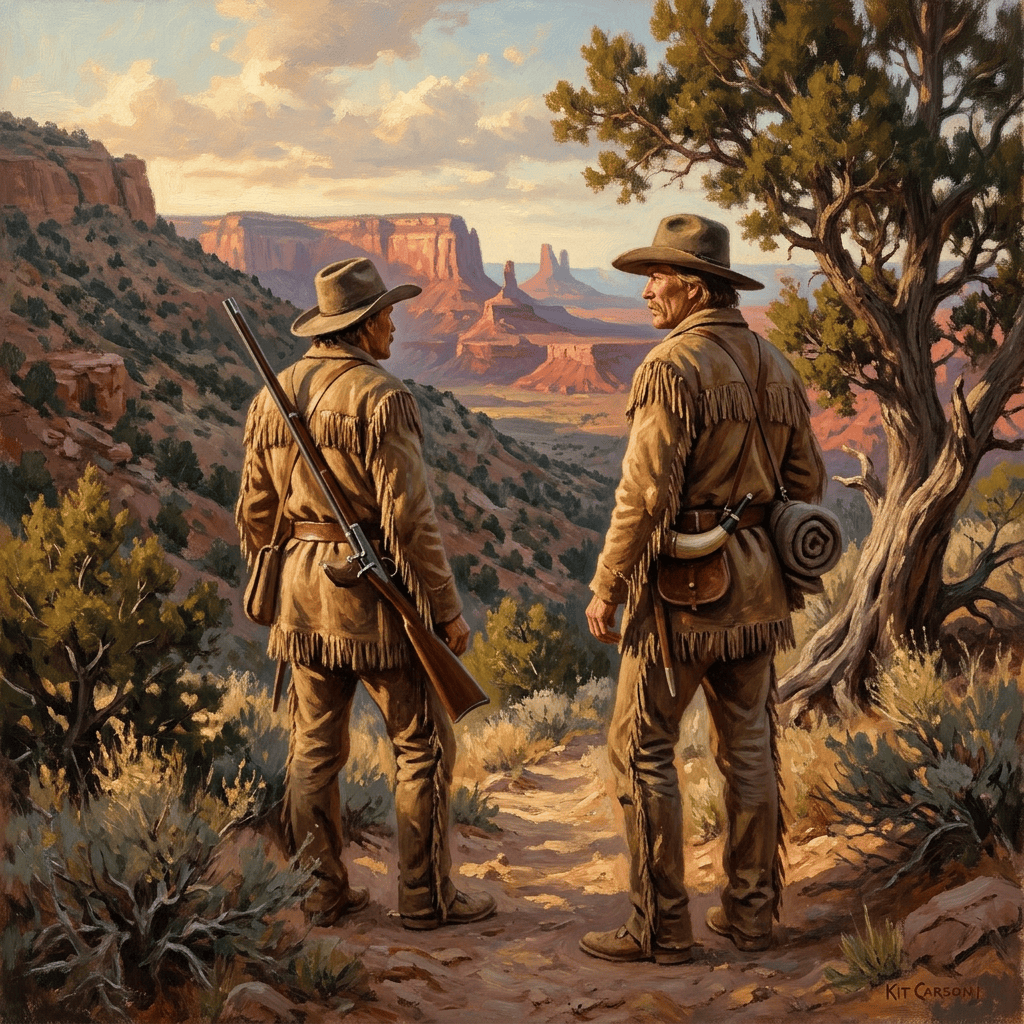
Did you know that Christopher “Kit” Carson—the legendary American frontiersman whose name was stamped on dime novels and state capitals—was completely illiterate for nearly his entire life? While millions of Americans were breathlessly reading fictionalized stories of his daring exploits, Carson himself couldn’t read a single word of his own fame.
Wait—let’s rewind. Before Carson was a folklore superhero, and long before he led one of the most tragic military campaigns in Native American history, he was just a runaway teenager hiding in the back of a westward wagon.
The One-Cent Runaway
Born in Kentucky in 1809 and raised in Missouri, Kit Carson left school at age nine when his father died. By 15, he was apprenticed to a saddlemaker. Despising the indoor work and craving the wild frontier, 16-year-old Kit ran away in 1826 to join a Santa Fe-bound caravan. His master placed a 1-cent reward notice in the local newspaper—Carson was deemed barely worth the paper the ad was printed on. Yet, that runaway was about to walk into the pages of history.
Mountain Man and Western Scout
Carson adapted quickly to the Southwest, learning Spanish, Native sign languages, and wilderness survival. Despite standing just 5-foot-4, he gained a reputation for stoic toughness and dead-eye marksmanship.
In 1842, a chance riverboat encounter linked Carson with John C. Frémont, an officer mapping the Oregon Trail. Carson guided Frémont across three massive expeditions spanning the Rockies and California. When Frémont’s bestselling government reports praised his guide’s unmatched tracking skills, Carson became an overnight national hero.
Fact vs. Dime-Novel Fiction
In the 1850s, pulp “dime novels” exaggerated Carson into a giant, pistol-toting superhero fighting off hordes of enemies. Carson was baffled by his fictitious fame. Upon seeing a sensationalized book cover featuring himself, he dryly noted, “I never killed no one that looked like that, and I sure never wore a hat like that.”
In reality, Carson’s personal life was deeply intertwined with Indigenous cultures. He married an Arapaho woman named Waanibe (Singing Grass), whom he loved deeply, and later married a Cheyenne woman named Making-Out-Road. After converting to Catholicism, he settled in New Mexico with his third wife, Josefa Jaramillo.
The Mexican-American War & Military Service
During the Mexican-American War (1846–1848), Carson served as a scout. At the Battle of San Pasqual, surrounded U.S. forces faced defeat. Carson and two companions slipped past enemy lines at night, removing their shoes to stay silent. After losing their boots in the dark, they crawled barefoot through 30 miles of cactus-filled terrain to secure reinforcements in San Diego, saving the command.
The Navajo Campaign and the Long Walk
During the Civil War, Carson became a Colonel in the Union Army. In 1863, General James Henry Carleton ordered him to force the Navajo (Diné) onto a desolate reservation at Bosque Redondo.
When the Navajo refused to leave their ancestral lands, Carson executed a ruthless scorched-earth campaign—destroying crops, slaughtering livestock, and burning orchards. Starved out, over 8,000 Navajo were forced onto the Long Walk: a brutal 300-mile march to eastern New Mexico. Hundreds died from starvation, disease, and exposure during the march and subsequent imprisonment.
The Final Sunset
Carson spent his remaining years as an Indian Agent, often advocating for fair government treatment for tribes. Weakened by an aortic aneurysm, he was heartbroken when his wife Josefa died following childbirth in April 1868. Kit Carson died just one month later on May 23, 1868, at age 58. His final words were simple: “Adios, compadre.”
Why This Still Matters
Kit Carson’s life embodies the messy, complex reality of American westward expansion. He was a man of remarkable courage and adaptability who built genuine ties with Native communities, yet he also carried out devastating military orders that shattered Indigenous lives. Examining his legacy forces us to look past simple folk mythologies and confront the tragic collisions that built the modern American West.
Sources
- Sides, Hampton. Blood and Thunder: The Epic Story of Kit Carson and the Conquest of the American West. Doubleday, 2006.
- Guild, Thelma S., and Harvey L. Carter. Kit Carson: A Pattern for Heroes. University of Nebraska Press, 1984.
- Dunlay, Tom. Kit Carson and the Indians. University of Nebraska Press, 2000.
 History in 5 Minutes or less
Leave a comment