Hubris, 20 Million Tons of Water, and the Cataclysmic Johnstown Flood of 1889
Imagine standing on your front porch on a rainy Friday afternoon, sipping coffee, when you suddenly hear a sound like continuous, thunderous cannon fire echoing from the mountains. Seconds later, a 40-foot-tall wall of liquid death, bristling with pulverized houses, locomotives, telegraph poles, and barbed wire, tearing down the valley at forty miles per hour, swallows your entire neighborhood whole.
That was not a nightmare scenario conjured by a Hollywood director; it was the terrifying reality for the citizens of Johnstown, Pennsylvania, on May 31, 1889. In less than an hour, a bustling industrial hub of 30,000 people was flattened, resulting in 2,209 deaths and leaving an indelible stain on American history. But to truly understand how a thriving steel town was erased from the map, we have to rewind the clock—past the torrential rains, past the frantic telegraph warnings that went ignored, and right into the exclusive drawing rooms of Pittsburgh’s most infamous Gilded Age millionaires.
The Millionaires’ Playground on the Hill
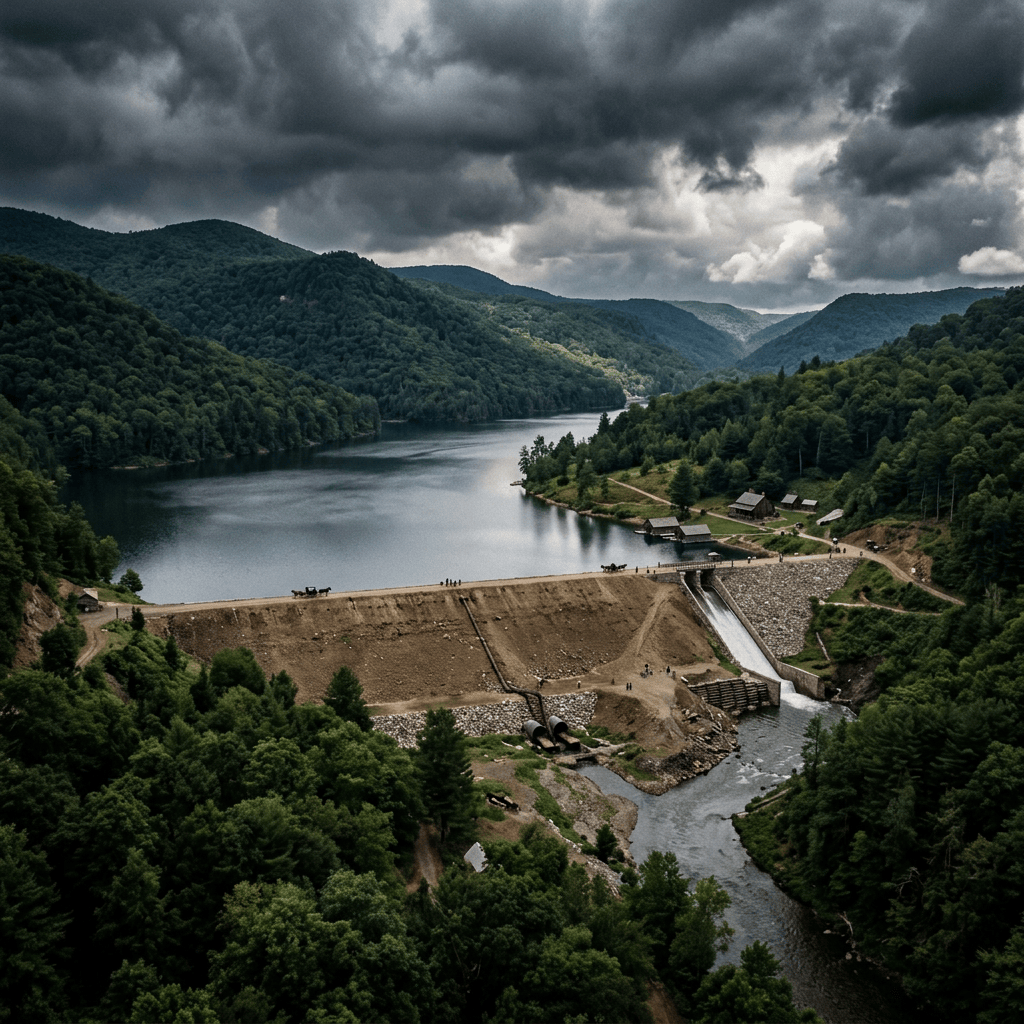
Fourteen miles upstream and 450 feet above Johnstown sat Lake Conemaugh, a man-made reservoir held back by the massive earthen South Fork Dam. Originally built by the state of Pennsylvania in the mid-19th century as part of the public canal system, the dam became obsolete with the rise of the steam locomotive. Abandoned and neglected, the structure sat like a sleeping giant until 1879, when a group of elite Pittsburgh industrial titans saw an opportunity for a private summer retreat.
Led by railroad tycoon Benjamin Ruff and backed by legendary corporate barons like Andrew Carnegie, Henry Clay Frick, Andrew Mellon, and Philander Knox, the group purchased the abandoned reservoir and formed the South Fork Fishing and Hunting Club. It was designed to be an ultra-exclusive playground where Gilded Age royalty could escape the soot, grime, and labor unrest of Pittsburgh to hunt deer, sail fancy yachts, and sip champagne in a luxurious clubhouse.
The Price of Luxury: “To make the lake wide enough for pleasure boats, the club lowered the dam crest to allow carriages to drive across it, lowered the spillway, and installed iron fish screens that trapped leaves and debris, effectively choking the dam’s only emergency relief valve.”
To make their mountain paradise suitable for elite leisure, however, the club made a series of catastrophic engineering modifications. They lowered the top of the dam by several feet so that four carriages could drive side-by-side across the crest. To stock the lake with prize black bass, they installed heavy iron mesh screens across the spillway—ensuring no fish escaped, but guaranteeing that fallen branches and river debris would clog the outlet. Crucially, they had previously removed and sold the large cast-iron discharge pipes at the base of the dam, leaving the structure with no mechanism to lower the water level during heavy storms.
Engineers from the nearby Cambria Iron Works warned the club repeatedly that the modified earthen dam was structurally unsound and posed a fatal threat to the thousands living in the valley below. The club’s management shrugged off the warnings. After all, what could possibly go wrong at a gentlemen’s sanctuary?
The Perfect Storm: May 30–31, 1889
Nature hit the Conemaugh Valley with unprecedented fury in late May 1889. An extraordinary dark atmospheric mass, shifting east from the Midwest, collided with cold air over the Allegheny Mountains. It unleashed the heaviest rainfall ever recorded in the region—an estimated 7 to 10 inches falling in a single 24-hour period.
By the morning of Friday, May 31, Lake Conemaugh was rising at the terrifying rate of several inches an hour. Streams were roaring into the reservoir, dumping thousands of gallons of runoff per second into a lake that already held over 20 million tons (5.2 billion gallons) of water.
At the dam, 34-year-old resident engineer Elias Unger woke up to find the water nearly cresting the top of the earthen embankment. Desperate to prevent disaster, Unger assembled a crew of laborers to dig a new spillway ditch around the end of the dam. But the rocky ground proved nearly impossible to penetrate with hand shovels. Next, they tried to clear the iron fish screens, but the mass of clogged tree trunks and mud was immovable.
By 11:30 AM, water began topping the center of the earthen dam. Because the dam was built of clay and gravel rather than solid masonry, overflow meant swift, structural death. The water began washing away the outer face of the wall. Unger sent a young man riding horseback to the nearby town of South Fork to send a telegraph warning down the valley to Johnstown: “South Fork Dam is in bad shape—may go at any time.”
Key Statistics of the Disaster
- Total Water Released: 20 Million Tons (5.2 billion gallons / 19 million m³)
- Peak Height of Water Wave: 36 to 40 feet (over 11 meters)
- Speed of Liquid Wall: 40 miles per hour (64 km/h)
- Total Fatalities: 2,209 people (including 99 entire families)
- Financial Damage: $17 Million in 1889 dollars (over $500 Million today)
- Debris Field at Stone Bridge: Covered 30 to 45 acres, burned for 3 continuous days
Tragically, Johnstown had experienced minor spring flooding for decades due to its position at the confluence of the Stonycreek and Little Conemaugh rivers. The telegraph operators in town received the warnings, but citizens had heard false alarms before. Many assumed it meant a routine few feet of water in the streets, not a biblical deluge. They moved furniture to the second floor and waited, oblivious to the mountain collapsing above them.
The Breach and the Wall of Death
At precisely 3:10 PM on May 31, 1889, the center of the South Fork Dam gave way with a deafening roar. A breach 300 feet wide opened instantly. In less than 45 minutes, the entire 20-million-ton Lake Conemaugh emptied itself into the narrow valley.
What rushed down the valley was not merely water. As the torrent slammed through the mountain gorge, it acted as a giant scraper, scouring the earth to bedrock. It swallowed forests, boulder fields, small villages, sawmills, and coal mines. By the time the surge reached Mineral Point, four miles downstream, it was no longer a river—it was a churning, grinding mountain of liquid battering ram, carrying entire houses, hundreds of miles of telegraph wire, miles of iron train tracks, and thousands of uprooted trees.
At East Conemaugh, the wave encountered the Pennsylvania Railroad yards. It picked up 30-ton steam locomotives as if they were bath toys, tossing them hundreds of yards. It swept through the town of Cambria City and hit the massive Cambria Iron Works, snapping steel girders like toothpicks and adding tons of heavy manufacturing machinery, hot iron boilers, and rolls of barbed wire to the churn.
By 4:07 PM, the wave slammed into Johnstown proper. Witnesses described the sight as a dark, towering cloud of black mist and splintered timber preceded by a wind so violent it blew roofs off buildings before the water even touched them. Moving at 40 miles per hour, the 40-foot wall swallowed the city in minutes. Houses were lifted intact off their foundations, crushed together like accordions, or smashed into matchsticks against neighboring buildings.
The Inferno at the Stone Bridge
For many victims, the water was only the first nightmare. Just below Johnstown, where the Little Conemaugh and Stonycreek rivers meet, stood the massive stone arch bridge built by the Pennsylvania Railroad. Built with heavy masonry, the bridge stood firm against the staggering force of the flood.
However, this structural integrity proved fatal. The arches of the bridge acted as a giant sieve, catching millions of tons of debris—splintered wooden homes, uprooted trees, kerosene tanks, rail cars, and thousands of terrified, screaming survivors trapped inside or clinging to the wreckage. A massive debris jam accumulated behind the bridge, covering an area of over 30 acres and stacking up to 40 feet high.
Then came the ultimate horror. At around 6:00 PM, an overturned stove inside one of the crushed wooden houses ignited spilled oil from a derailed tank car. The 30-acre mass of debris caught fire. What followed was a hellish inferno that raged through the night and burned for three days. Hundreds of people who had survived the wave, pinned alive beneath heavy timbers, were burned to death in full view of rescuers who were helpless to reach them across the roaring, turbulent water.
Aftermath: A Nation Shocked, A Red Cross Transformed
When the sun rose on June 1, 1889, Johnstown was unrecognizable. Where a vibrant industrial city had stood 24 hours prior, there was only a vast plain of yellow mud, tangled steel, and smoking ruins. Out of a population of 30,000, 2,209 people were dead, including 396 children. Ninety-nine entire families were wiped out. Over 700 unidentifiable bodies were buried in a mass grave at Grandview Cemetery, marked only by stark white marble headstones reading “Unknown.”
The disaster galvanized the entire nation. It became one of the first major news events covered by international telegraph and modern photojournalism. Donations poured in from around the world—from England, France, Russia, and Australia.
It was also the first major disaster relief effort led by Clara Barton and the newly formed American Red Cross. Arriving in Johnstown on June 5 with a small team, the 67-year-old Barton stayed on the ground for five months. She organized emergency shelters, constructed temporary hotel-style barracks, distributed food and clothing, and established medical clinics. Her triumph in Johnstown cemented the American Red Cross as an essential institution in American disaster response.
The Legal Farce: Wealth Without Responsibility
While relief workers dug bodies out of the mud, public outrage turned toward the mountain top. The survivors of Johnstown knew exactly who was responsible: the wealthy elites of the South Fork Fishing and Hunting Club.
Newspapers across the country lambasted Andrew Carnegie, Henry Clay Frick, and their fellow club members as negligent aristocrats whose vanity project murdered thousands of working-class families. A grand jury indicted the club for manslaughter, and survivors filed dozens of lawsuits seeking millions in damages.
The Legal Shield: “The courts ruled the flood an ‘Act of God’—a natural disaster caused by unprecedented rain—exempting the wealthy club members from paying a single penny in civil damages.”
Yet, not a single member of the South Fork Fishing and Hunting Club was ever held legally or financially liable. Represented by top-tier legal minds—including club member Philander Knox, who later became U.S. Attorney General—the defense argued that the collapse was caused by an unprecedented “Act of God” (the extreme rainfall) rather than structural negligence. Furthermore, the club had been incorporated as a limited liability entity, protecting the personal fortunes of Carnegie, Frick, and Mellon.
Though legally cleared, several members felt the sting of public condemnation. Carnegie personally donated money to build a new library for Johnstown, and club members raised funds for relief, but no admission of fault was ever uttered.
Why This Still Matters Today
The Johnstown Flood was not just a tragic historical anomaly; it was a watershed moment that reshaped American society, infrastructure engineering, and tort law. Here is why the story continues to resonate in the modern era:
- The Evolution of Legal Liability and Tort Law: In the late 19th century, American law heavily favored corporate development and wealthy landowners over public safety. The sheer injustice of the Johnstown legal outcomes outraged the public and legal scholars alike. Over the following decades, courts shifted away from strict fault-based liability toward the concept of strict liability for inherently dangerous activities and property modifications. Today, if a private entity modifies land in a way that endangers a downstream community, they can no longer simply hide behind “Act of God” defenses or corporate veils.
- Aging Infrastructure and Dam Safety: The collapse of the earthen South Fork Dam served as the catalyst for modern dam safety regulations and civil engineering standards. Today, thousands of earthen dams across North America and the globe are aging, many receiving low safety ratings from civil engineering bodies. The lesson of Johnstown—that deferred maintenance, improper modifications, and ignoring warning signs lead to catastrophic failure—remains an urgent warning for modern infrastructure management.
- Climate Extremes and Disaster Preparedness: As severe weather events and extreme precipitation become more frequent worldwide, the vulnerability of communities situated downstream or in low-lying valleys is higher than ever. Johnstown proved that emergency communications must be clear, actionable, and taken seriously—a challenge emergency managers face today during flash floods, hurricanes, and wildfires.
- Corporate Accountability vs. Wealth Disparity: The dynamic of ultra-wealthy elites insulating themselves from the consequences of actions that impact vulnerable working-class populations remains a central theme in modern socio-economic debates. The disaster stands as a timeless cautionary tale regarding wealth, influence, and civic responsibility.
Primary Sources & References
- McCullough, David. The Johnstown Flood. Simon & Schuster, 1968. (The definitive historical narrative of the disaster).
- National Park Service. Johnstown Flood National Memorial: History & Culture. U.S. Department of the Interior.
- Frank, Richard. The Disaster of 1889: Gilded Age Legal Reform and Corporate Liability. Pennsylvania History Journal, 1988.
- American Red Cross Historical Archives. Clara Barton and the Johnstown Relief Effort of 1889.



Leave a Reply